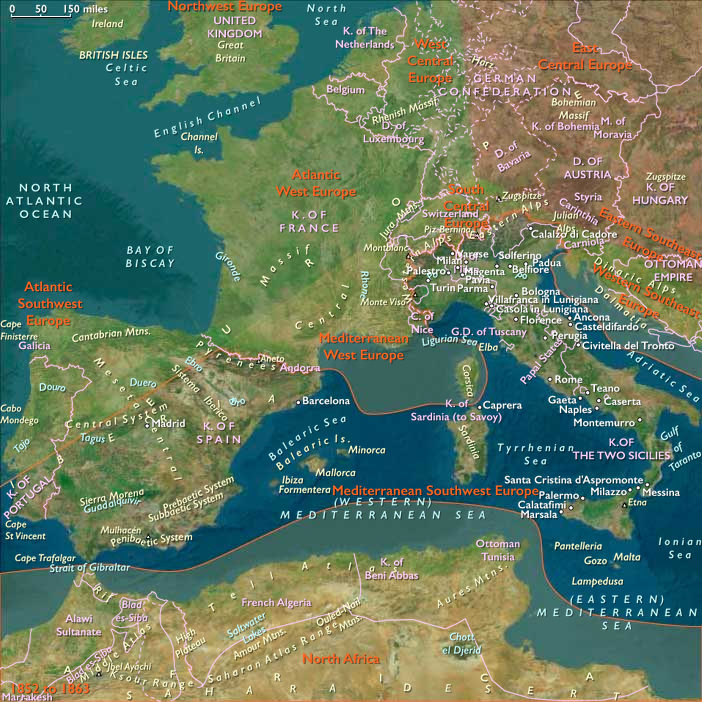
Mediterranean Southwest Europe (1852–1863 CE): Nationalism, Unification,…
1852 CE to 1863 CE
Mediterranean Southwest Europe (1852–1863 CE): Nationalism, Unification, and Cultural Renewal
The era from 1852 to 1863 CE is marked by transformative political and cultural shifts across Mediterranean Southwest Europe, encompassing the Italian Peninsula, southern and eastern Spain, southern Portugal, Andorra, the Balearic Islands, Sicily, Sardinia, and Malta. Dominated by Italy’s struggle for unification, this period also witnesses significant developments in regional nationalism, liberal reforms, and cultural flourishing.
Italian Unification: Second War of Independence and Garibaldi's Campaign
In 1859, the Kingdom of Sardinia, guided by the diplomatic and political acumen of Camillo Benso, Count of Cavour, launches the Second Italian War of Independence against Austrian dominance. With decisive French military support, the campaign results in the crucial liberation of Lombardy, energizing nationalist movements across the peninsula.
In the south, revolutionary leader Giuseppe Garibaldi embarks on his legendary Expedition of the Thousand (1860–1861), successfully overthrowing Bourbon rule in Naples and Sicily. A defining moment occurs on October 26, 1860, at Teano, where Garibaldi meets Victor Emmanuel II, King of Sardinia. Prioritizing national unity, Garibaldi relinquishes republican ideals to support a united constitutional monarchy, hailing Victor Emmanuel as King of Italy.
On March 17, 1861, the Kingdom of Italy is officially proclaimed, uniting northern, central, and southern regions under the House of Savoy. Soon thereafter, the capital moves from Turin to Florence, signifying Italy’s evolving political identity.
Liberalism and Regionalism in Spain and Portugal
During this period, liberalism continues to reshape Spain, although internal divisions persist between Moderate and Progressive factions. The reign of Queen Isabella II is characterized by political instability, frequent government turnovers, and deepening societal divides. In southern and eastern Spain, regionalist sentiments endure, notably in Catalonia and Valencia, setting the stage for future political dynamics.
In Portugal, liberal reforms stabilize following the tumultuous Civil War earlier in the century, but economic challenges and regional disparities, especially in southern provinces like Algarve, remain prominent concerns, fueling ongoing demands for economic modernization and administrative reform.
Cultural Renaissance and Romanticism
Culturally, this era represents a peak of Romantic artistic expression, with Giuseppe Verdi’s operatic masterpieces serving as powerful reflections of Italian nationalism and cultural identity. Works such as Rigoletto (1851), Il Trovatore(1853), and La Traviata (1853) resonate widely, symbolizing the emotional depth and patriotic fervor associated with the Risorgimento.
Simultaneously, Romanticism profoundly influences artistic and literary expression in Spain, Portugal, and the wider Mediterranean region, capturing the spirit of national pride, historical reflection, and cultural renewal.
Andorra and Malta: Stability Amidst Change
Andorra maintains its unique political status as a co-principality, experiencing relative stability amidst surrounding transformations. Its economy benefits modestly from improved relations with neighboring Spain and France. In Malta, a British colony since 1814, strategic naval importance grows, fostering economic stability and infrastructure development despite ongoing colonial tensions.
Conclusion: An Era of Transformation
Between 1852 and 1863 CE, Mediterranean Southwest Europe undergoes dramatic transformations driven by nationalism, liberalism, and cultural revival. The unification of Italy emerges as the era’s defining event, reshaping regional dynamics, while Spain, Portugal, Andorra, and Malta each navigate their unique paths through political reform, cultural expression, and evolving national identities.
People
Groups
Subjects
Regions
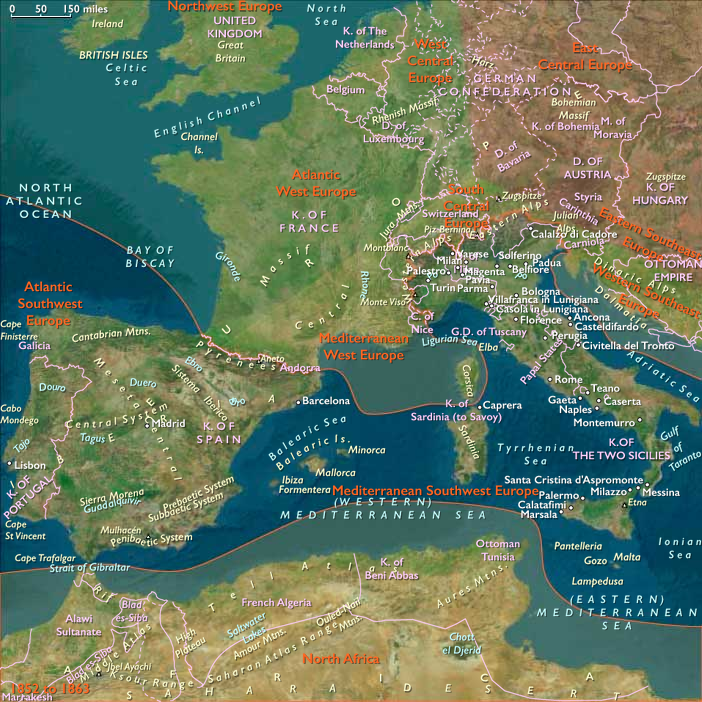
Southwest Europe
View →Subregions