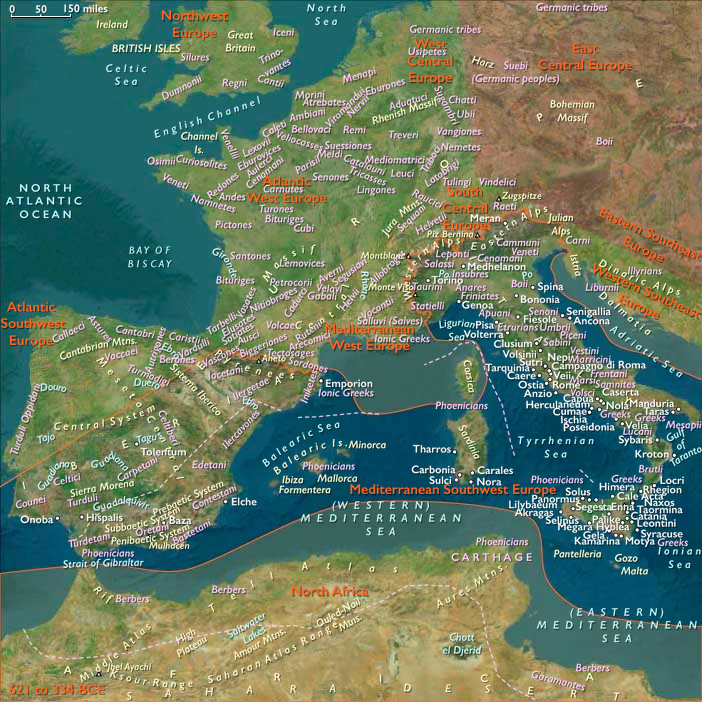
Mediterranean Southwest Europe (561–550 BCE): Tyranny, Cultural…
561 BCE to 550 BCE
Mediterranean Southwest Europe (561–550 BCE):
Tyranny, Cultural Flourishing, and Etruscan Artistry
The period 561–550 BCE in Mediterranean Southwest Europe is marked by the height of Akragas under the infamous tyrant Phalaris, significant cultural contributions from Greek poet Stesichorus, and notable advances in Etruscan artistry.
Akragas and the Tyranny of Phalaris
In Sicily, Phalaris, the tyrant of Akragas (Agrigentum), reaches the zenith of his rule, characterized by ambitious urban development and significant infrastructural enhancements, including improved water supplies, fortified city walls, and magnificent civic buildings. Despite these accomplishments, Phalaris becomes notorious for his cruelty, particularly through legends of the brazen bull, an infamous device of torture attributed to him, although historical accounts remain mixed. His reign eventually provokes widespread rebellion, leading to his violent overthrow.
Cultural Impact of Stesichorus
During this era, the celebrated lyric poet Stesichorus resides in Himera, in northern Sicily. Renowned for his innovative contributions to lyric poetry and his epic-inspired narratives, Stesichorus significantly influences the development of Greek literary tradition. Despite his opposition, the citizens of Himera appoint Phalaris as their military general, reflecting complex political dynamics in Greek Sicily. Stesichorus's works, largely lost but influential, remain foundational to the Greek poetic tradition.
Etruscan Artistic Flourishing
In Etruria, potters in cities like Orvieto and Chiusi produce exceptional fine red-figure ware, marking significant advancements in pottery techniques and artistic expression. These exquisite ceramics highlight the high level of craftsmanship and artistic innovation within the Etruscan civilization, reinforcing its cultural and commercial significance in the broader Mediterranean.
Carthaginian Cultural Realignment
Building upon earlier insights, Carthage during this period continues to reflect its Greek-aligned cultural and strategic orientation. Rather than functioning as an isolated Phoenician outpost, Carthage maintains close cooperative relationships with major Greek cities, especially Syracuse and other Corinthian colonies. This cooperation significantly shapes Carthaginian interactions throughout the western Mediterranean, including its political strategies and economic policies.
Legacy of the Era
The era 561–550 BCE solidifies Sicily as a dynamic cultural and political hub, driven by the complex legacy of Phalaris’s tyranny, the literary contributions of Stesichorus, and the artistic sophistication of the Etruscans. Concurrently, the continued evolution of Carthage’s Greek-oriented identity reshapes regional interactions and alliances, influencing future geopolitical and cultural developments across Mediterranean Southwest Europe.
Groups
Commodities
Regions
Southwest Europe
View →Subregions