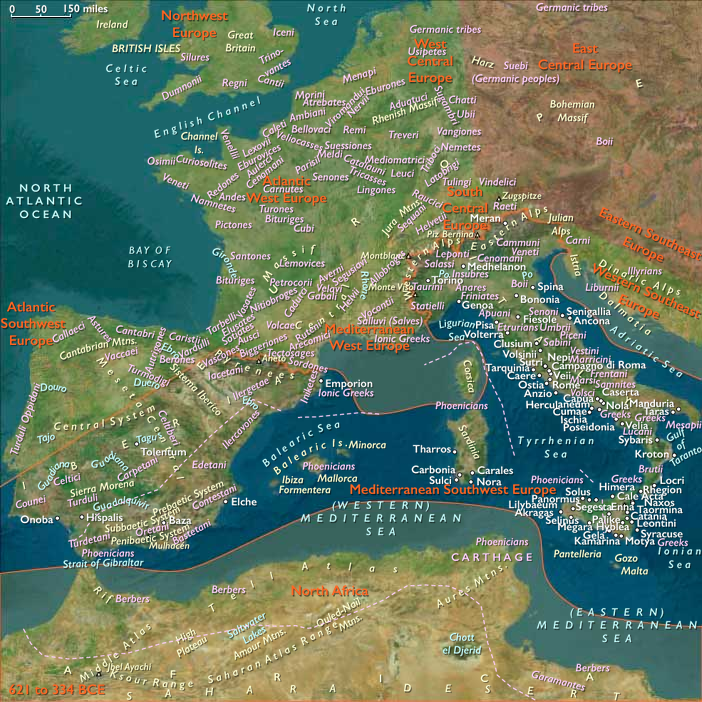
Mediterranean Southwest Europe (597–586 BCE): Expansion of…
597 BCE to 586 BCE
Mediterranean Southwest Europe (597–586 BCE):
Expansion of Etruscan Influence and Roman Urban Development
Between 597 and 586 BCE, Mediterranean Southwest Europe experiences further Etruscan territorial expansion, continued Roman urban and cultural development, and an intensification of Etruscan influence across central Italy. This era marks significant progress in urbanization, infrastructure, and regional power dynamics.
Roman Developments under Tarquinius Priscus
According to tradition, Rome’s Etruscan King, Tarquinius Priscus, significantly shapes Rome’s urban landscape and cultural institutions during this period. Credited with subduing the Sabines and Latins, Tarquinius initiates major civic improvements, notably draining marshes, and constructing vital public landmarks, including the Circus Maximus, the Roman Forum, and the Capitoline temple. He also integrates substantial elements of Etruscan culture into Roman religion, governance, and social organization, laying enduring foundations for Rome’s later development.
Etruscan Territorial Expansion and Urban Peak
By the beginning of the sixth century BCE, the Etruscans have consolidated their control over significant portions of northern Italy, extending their influence to cities such as Fiesole (ancient Faesulae) and Volterra (ancient Volaterrae). At the same time, their territorial ambitions drive expansion southward into Campania, with Capua emerging as their principal foundation, alongside Nola. This southward push underscores Etruscan strategic objectives, challenging Greek dominance along Italy’s southern coast.
Etruscan urban civilization achieves its zenith during this era, distinguished by sophisticated cities, flourishing trade networks, and significant artistic achievements, notably evident in painted tombs and decorated ceramics.
Cultural and Economic Dynamics
Although the Etruscans dominate much of the Italian mainland, coastal regions remain largely under Greek influence, maintaining active trade and cultural interactions with Greek colonies. This coexistence creates a vibrant economic and cultural mosaic, characterized by competition and cooperation, facilitating broader Mediterranean exchanges.
Legacy of the Era
The years from 597 to 586 BCE represent a transformative period for Mediterranean Southwest Europe, characterized by Etruscan territorial consolidation, Roman urban advancements, and dynamic cultural exchanges between Etruscan and Greek populations. These developments establish enduring cultural, political, and economic frameworks that will shape the region for centuries to come.
Groups
Regions
Southwest Europe
View →Subregions