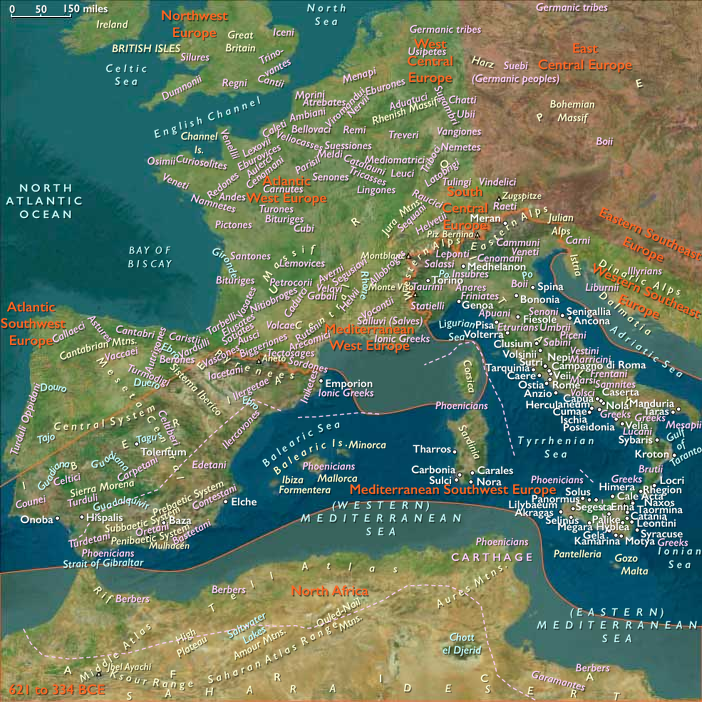
Mediterranean Southwest Europe (621–487 BCE): Rome's Foundation,…
621 BCE to 478 BCE
Mediterranean Southwest Europe (621–487 BCE):
Rome's Foundation, Etruscan Conflicts, and Greek Cultural Flourishing
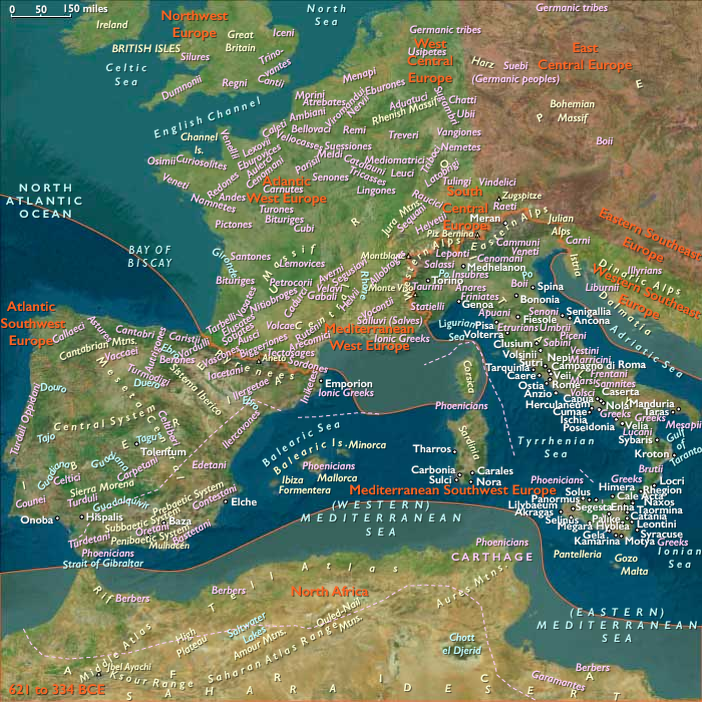
Between 621 and 487 BCE, Mediterranean Southwest Europe—covering Italy, southwestern Spain, Andorra, and the Western Mediterranean Islands (excluding Corsica)—undergoes significant political and cultural developments, including Rome's early foundation and shift from monarchy to republic, intensified interactions between Greek, Phoenician, and indigenous peoples, and the emergence of pivotal intellectual movements in southern Italy.
Rome: From Kingdom to Republic
The settlement of Rome, traditionally founded in 753 BCE, evolves significantly during this era. Initially governed by a monarchy composed of Latin, Sabine, and eventually Etruscan kings, Rome transitions in 509 BCE into an oligarchic republic after expelling its last king, Tarquinius Superbus. This political shift marks a crucial turning point, setting the foundations for Rome's future expansion and republican governance.
Greek Colonies and the Rise of Intellectualism
Greek cities in southern Italy, particularly Sybaris, reach their cultural and economic apex. Sybaris becomes renowned for its wealth and innovation, minting its own coinage and pioneering advancements such as one of the world's earliest street-lighting systems and concepts of intellectual property. This cultural milieu provides fertile ground for intellectual developments, notably in the city of Croton, where philosopher and mathematician Pythagoras establishes his influential philosophical and religious school. Pythagoreans explore mathematics, astronomy, and medicine, profoundly influencing subsequent Greek and Mediterranean thought.
Phoenician Settlements and Carthaginian Influence
Carthage, historically considered a Phoenician colony in North Africa, is now understood by recent research to have significant Greek cultural and possibly ethnic ties during this period. This nuanced identity places Carthage firmly within the broader sphere of Magna Graecia, integrating it culturally and economically into Greek-dominated networks across southern Italy, Sicily, and the wider Mediterranean.
Celtic Presence in Northern Italy
The era also sees the continued migration and settlement of Celtic peoples into northern Italy. According to classical sources like Livy, Gauls under leader Bellovesus cross the Alps around 600 BCE, occupying territories between modern Milan and Cremona, areas already inhabited by the Celtic Insubres. Archaeological and literary evidence supports the establishment of Celtic communities, marking significant cultural transformations and interactions with indigenous Italian peoples.
Artistic and Technological Achievements of the Etruscans
The Etruscans, continuing their influence from previous centuries, maintain significant political and cultural dominance in central and northern Italy. Their artisans produce sophisticated pottery, notably the black "bucchero" ware and elaborately decorated ceramics, many reflecting Greek stylistic influences. Etruscan cities engage in sustained conflicts with the emerging Roman Republic, shaping the geopolitical landscape of central Italy.
Legacy of the Age
The period from 621 to 487 BCE is transformative for Mediterranean Southwest Europe, defined by Rome's foundational shift to republican governance, Greek intellectual and cultural flourishing, significant Phoenician (and increasingly Hellenized Carthaginian) influence, and the ongoing integration of Celtic peoples in the north. These complex interactions lay the groundwork for subsequent historical developments, setting the stage for Rome's rise and broader Mediterranean integration.
Groups
Topics
Commodities
Regions
Southwest Europe
View →Subregions