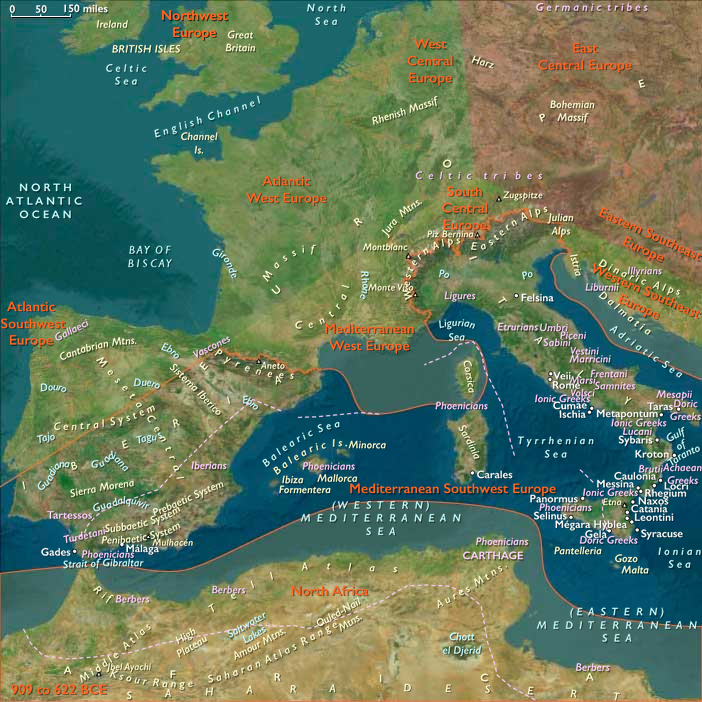
Mediterranean Southwest Europe (741–730 BCE): Greek Colonization…
741 BCE to 730 BCE
Mediterranean Southwest Europe (741–730 BCE):
Greek Colonization in Southern Italy and Sicily
Between 741 and 730 BCE, Mediterranean Southwest Europe experiences intensive Greek colonization, establishing permanent settlements in southern Italy and Sicily. These colonies, primarily driven by trade, significantly shape the region culturally, economically, and politically, laying foundations for the area later known as Magna Graecia.
Foundation of Syracuse and Naxos
In 734 BCE, Corinthian settlers led by the aristocrat Archias establish Syracuse on the east coast of Sicily. The settlers form an elite class (gamoroi), dominating the indigenous Sicel populations, who are forced into agricultural labor. Simultaneously, Chalcidian settlers under Theocles (Thucles) establish Naxos around 734 BCE near modern Taormina, marking Sicily's earliest known Greek colony.
Establishment of Zankle (Messina)
The Chalcidians from Euboea found Zankle (modern Messina) around 730 BCE at a strategic location on the Strait of Messina, opposite Reggio di Calabria. Named for its sickle-shaped harbor, Zankle becomes a vital maritime and commercial center, connecting Sicily to mainland Italy and the wider Greek world.
Commercial Expansion via Ischia and Pithecusae
Around 730 BCE, permanent Greek colonies based on metals trade thrive at Ischia and Pithecusae, islands off the western coast of southern Italy. These trade-driven settlements facilitate robust economic exchanges, serving as critical nodes connecting Greek, Etruscan, and Phoenician merchants, thereby fostering an extensive cultural and economic network in the region.
Legacy of the Era
This dynamic colonization profoundly impacts Mediterranean Southwest Europe, spreading Hellenic culture, introducing sophisticated urban planning, and setting patterns for sustained Greek influence in Italy and Sicily. These early settlements are foundational to the later prominence of Magna Graecia, significantly shaping the cultural heritage and historical trajectory of the entire western Mediterranean.
Groups
Commodities
Subjects
Regions
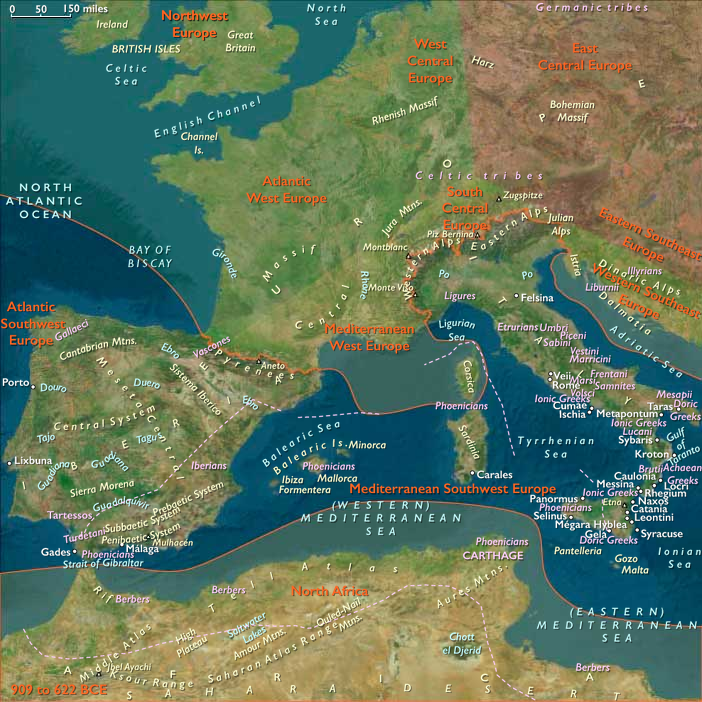
Southwest Europe
View →Subregions