
Mediterranean Southwest Europe (820–831 CE): Frankish Stability,…
820 CE to 831 CE
Mediterranean Southwest Europe (820–831 CE): Frankish Stability, Umayyad Cultural Revival, and Mozarab Influence
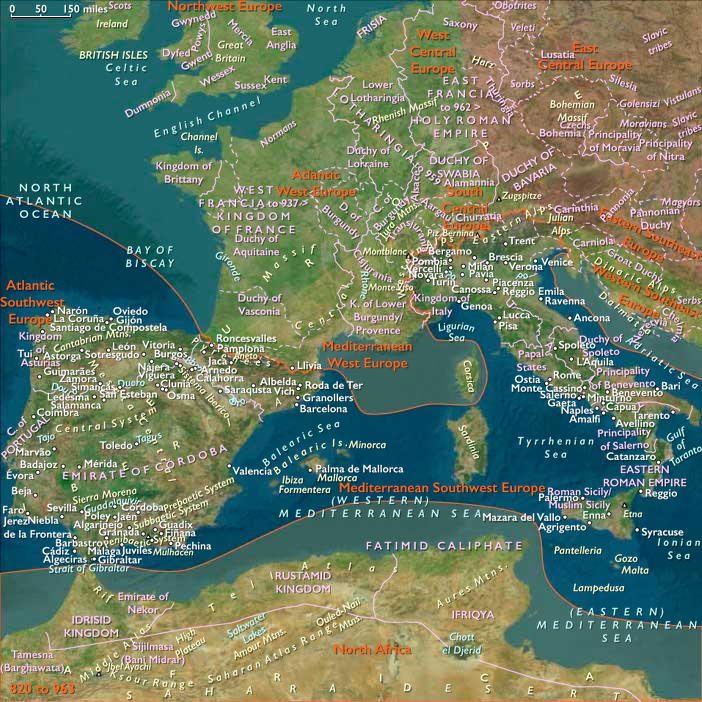
The era 820–831 CE in Mediterranean Southwest Europe is characterized by continued stability under Frankish rule in Italy, a significant cultural and administrative revival within Umayyad-controlled Iberia, and ongoing religious and cultural interactions influenced by the region's diverse populations.
Carolingian Continuity and Italian Stability
Under Emperor Louis the Pious (r. 814–840 CE), Charlemagne's son and successor, the Carolingian Empire maintains firm governance and stability across northern and central Italy. Louis reinforces administrative structures established by his father, preserving Frankish influence and ensuring sustained political cohesion throughout the region. The alliance with the Papal States remains central to this stability, further solidifying papal authority and influence.
Cultural Revival in Umayyad Iberia
In Al-Andalus, Emir Abd al-Rahman II (r. 822–852 CE) initiates a significant cultural revival marked by extensive patronage of the arts, sciences, and architecture. Under his rule, Córdoba flourishes as a leading intellectual and cultural center, drawing scholars, artists, and scientists from across the Islamic world. Abd al-Rahman II's patronage enhances urban life, supporting advancements in architecture and infrastructure that deeply influence the region’s prosperity.
Mozarab Communities and Cross-Cultural Exchange
Mozarab communities continue to thrive, significantly influencing Iberian culture through their unique position between Islamic rulers and Latin-Christian traditions. They play an increasingly prominent role in fostering scholarly exchange, translating and preserving classical texts, and maintaining vibrant Christian cultural expressions within Islamic Iberia.
Religious Pluralism and Societal Cohesion
The period sees sustained religious pluralism and relative tolerance under Umayyad rule. The Jewish communities continue to contribute actively to commerce, scholarship, and culture, reinforcing Al-Andalus as a hub of diverse intellectual and religious traditions. Mozarabs, Jews, and Muslims coexist, each community contributing distinctively to the dynamic cultural fabric of Iberia.
Economic Prosperity and Technological Growth
Economic vitality persists throughout Mediterranean Southwest Europe, particularly supported by continuing technological advancements such as the widespread adoption of the Catalan forge. Increased iron production drives economic development, bolstering agricultural yields and enhancing military capabilities, thereby underpinning the region’s prosperity and stability.
Legacy of the Era
The era 820–831 CE underscores the durability of Carolingian authority in Italy, a cultural and intellectual revival in Umayyad Iberia, and robust cross-cultural exchanges fostered by Mozarab and Jewish communities. These developments significantly influence Mediterranean Southwest Europe's trajectory, setting lasting foundations for the region’s medieval history.
Groups
Commodities
Subjects
Regions
Southwest Europe
View →Subregions
