
Southwest Europe (820 – 963 CE): Umayyad …
Years: 820 - 963
Southwest Europe (820 – 963 CE): Umayyad Splendor, Carolingian Marches, and the Atlantic Pilgrim Frontier
Geographic and Environmental Context
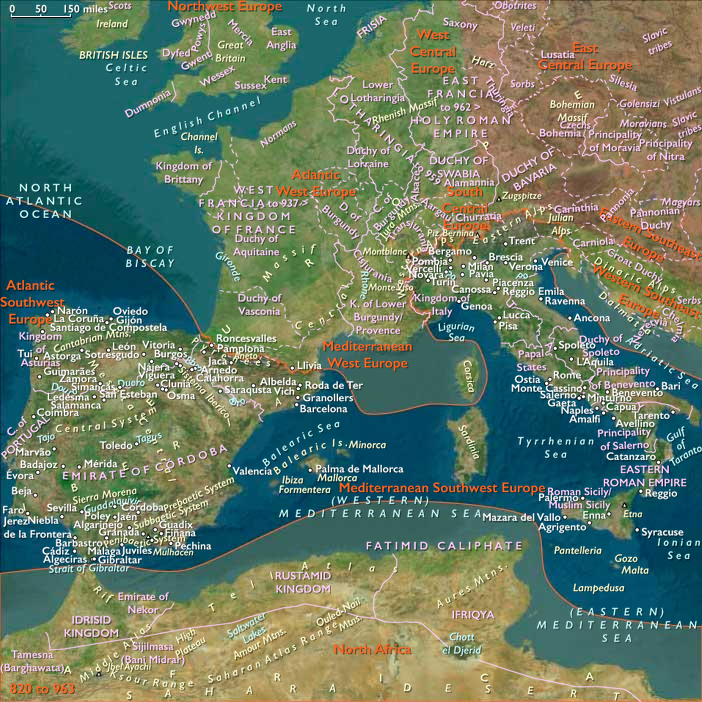
Southwest Europe extended from Iberia and the western Mediterranean islands to the Italian Peninsula, forming a continuum of Islamic, Latin, and maritime worlds.
-
Mediterranean Southwest Europe: from Andalusia and Murcia through Valencia, Aragon, Catalonia, the Balearics, and southern Portugal, across the Languedoc–Andorra corridor to Italy, Sicily, Sardinia, and Malta.
-
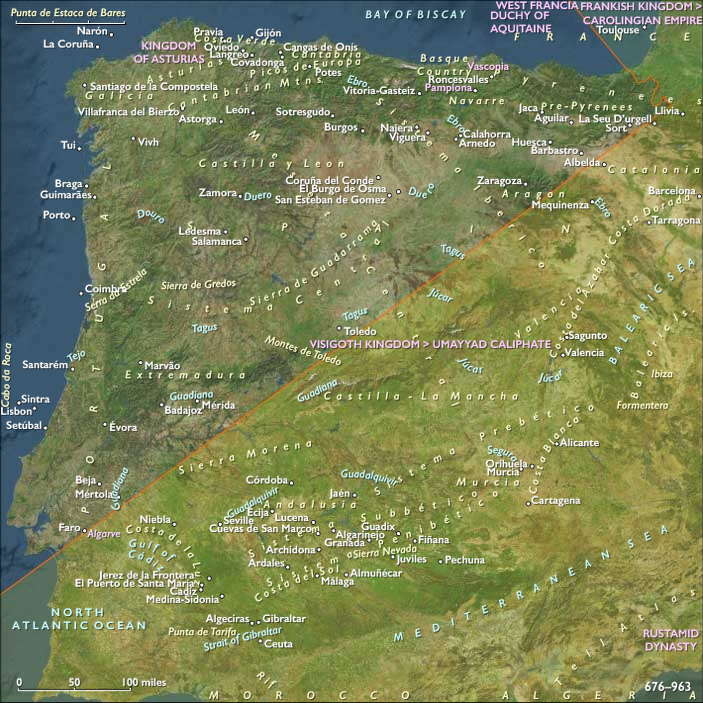
Atlantic Southwest Europe: the Cantabrian–Galician coasts, Duero–Minho valleys, and Atlantic marchesof Asturias, León, Castile, and Portucale, including Lisbon at the frontier of al-Andalus.
The Guadalquivir, Ebro, Tagus, Po, and Duero river basins formed the region’s agricultural arteries, while the Pyrenean passes and Mediterranean–Atlantic harbors tied Iberia and Italy to the broader Carolingian and Islamic worlds.
Climate and Environmental Shifts
The early Medieval Warm Period (c. 850–950) lengthened growing seasons and stabilized harvests across both coasts:
-
Andalusian plains flourished under irrigation; vine–olive–grain regimes prospered from Apulia to Andalusia.
-
Transhumance intensified across Aragon, Castile/La Mancha, and the Apennines, linking mountain pastures with lowland estates.
-
In the Atlantic northwest, high rainfall sustained chestnut–oak woodlands, vineyards, and pastures, while the mid-10th century brought slightly warmer vintages favorable to viticulture and pilgrimage traffic.
Societies and Political Developments
Iberia: Umayyad Córdoba and Christian Frontiers
-
Al-Andalus: The Emirate of Córdoba (756–929) reached its zenith under ʿAbd al-Raḥmān III, who proclaimed the Caliphate of Córdoba (929). Andalusia, Murcia, and Valencia thrived as centers of learning, irrigation, and commerce; Córdoba’s Great Mosque and palatial suburb at Madinat al-Zahra symbolized Islamic sophistication.
-
Northern Iberia:
-
The Kingdom of Asturias under Alfonso II–III expanded southward; in 910, the capital moved to León, marking the birth of the Kingdom of León.
-
The County of Castile, under Fernán González (930s–950s), gained autonomy as a marcher lordship.
-
Galicia integrated into León, energized by the cult of Santiago de Compostela (discovered c. 820), which turned the northwest into a sacred and economic magnet.
-
Portucale (Porto) and Coimbra formed a dynamic Christian frontier under León’s protection, while Lisbon, within al-Andalus, remained a Muslim entrepôt controlling the Tagus estuary.
-
-
Navarre, Aragon, and Catalonia: mountain kingdoms and Carolingian marches negotiated between Córdoba, León, and Frankish Burgundy, maintaining vital Pyrenean diplomacy.
Italy and the Central Mediterranean
-
Post-Carolingian Italy fragmented into regional powers—Lombard duchies, papal lands, and emerging maritime communes.
-
Venice, Amalfi, Genoa, and Pisa rose as commercial ports, trading grain, timber, salt, and slaves in exchange for silks, spices, and ceramics from the Levant and al-Andalus.
-
Sicily, conquered by the Aghlabids (827–902), became a Muslim emirate integrating African, Arab, and Byzantine influences in irrigation and architecture.
-
Sardinia evolved toward judicati autonomy under Byzantine and later Italian influence; Malta oscillated under Muslim and Latin control.
Economy and Trade
-
Andalusi agriculture: advanced qanat and acequia irrigation supported citrus, sugarcane, rice, and cotton; granaries and silos (al-finaʿ) sustained urban markets.
-
Northern Iberia: mixed cereal and vine cultivation; oak–chestnut forests supplied wood and mast; monastic and royal estates organized transhumant herding.
-
Pilgrim commerce: after Santiago’s discovery, pilgrims and artisans crossed from Aquitaine, fueling regional markets and urban growth along the Camino de Santiago.
-
Italian maritime economy: Venetian and Ligurian merchants exported Adriatic grain, timber, and salt; imported Byzantine and Islamic luxuries.
-
Interregional exchange:
-
Mediterranean cabotage linked Valencia–Barcelona–Genoa–Venice–Palermo–Cagliari–Malta, forming the skeleton of medieval seaborne commerce.
-
Atlantic trade connected Porto and Lisbon with Bordeaux, Bayonne, and Rouen, transmitting wine, salt, wool, and pilgrims between Iberia and the Frankish north.
-
Subsistence and Technology
-
Irrigation and farming: Andalusi and Sicilian engineers refined waterwheels, norias, and qanats; Carolingian and Leonese estates deployed heavy plows on loess soils.
-
Shipbuilding: clinker-built Atlantic coasters and Mediterranean galleys (with lateen sails) expanded both cabotage and cross-sea trade.
-
Fortifications: castillos on the Duero frontier and urban walls in Córdoba, Zaragoza, and Palermo defined a dual landscape of Christian marches and Islamic cities.
-
Urban growth: Córdoba exceeded 100,000 inhabitants; Venice and Naples grew as mercantile hubs; Burgos, León, and Porto emerged as inland market nodes.
Movement and Interaction Corridors
-
Ebro–Pyrenees passes connected the Catalan and Aragonese marches to Andorra and Languedoc.
-
Tagus–Guadalquivir–Duero river corridors structured Iberia’s military and commercial movement.
-
Po Valley and Adriatic formed Italy’s main inland–maritime axis centered on Venice.
-
Tyrrhenian sea routes linked Sardinia–Sicily–Malta with Rome and Iberia, while Atlantic sea lanes carried pilgrims and merchants from Galicia–Portugal to Aquitaine and Brittany.
Belief and Symbolism
-
Islamic Córdoba fused theology, science, and art—its Great Mosque, libraries, and translation movement diffused knowledge into Christian Europe.
-
Christian Iberia: the cult of Santiago de Compostela anchored the spiritual geography of León, fostering international pilgrimage and monastic expansion.
-
Latin monastic revival: centers like Ripoll in Catalonia and Monte Cassino in Italy preserved learning and manuscripts.
-
Sicily and al-Andalus: became conduits of Greek–Arab science, transmitting astronomy, medicine, and philosophy across the Mediterranean.
-
Religious coexistence: Jews, Christians, and Muslims interacted in Andalusian cities, creating hybrid forms of law, poetry, and architecture.
Adaptation and Resilience
-
Cultural symbiosis: Islamic, Latin, and Byzantine influences intertwined in architecture, law, and trade.
-
Agrarian diversification: irrigated Andalusi estates, Carolingian vineyards, and Alpine–Apennine transhumance balanced climatic shifts.
-
Frontier flexibility: fortified marches, pilgrimage roads, and monastic estates ensured recovery from raids and war.
-
Maritime continuity: when inland warfare disrupted Iberia, Italian and Provençal routes sustained trade.
-
Urban resilience: Córdoba, Venice, and León anchored regional economies, buffering crises through stored surpluses and long-distance exchange.
Long-Term Significance
By 963 CE, Southwest Europe stood at a tri-continental crossroads:
-
Córdoba embodied the zenith of Islamic Iberia, radiating science, architecture, and governance.
-
Asturias–León, Castile, and Portucale defined the Christian frontier, inspired by the Santiago cult and fortified along the Duero line.
-
Sicily, Sardinia, and Malta bridged North Africa, Byzantium, and Latin Christendom.
-
Venice, Amalfi, Genoa, and Pisa were emerging as the architects of Mediterranean commerce.
Southwest Europe thus united the Latin, Islamic, and maritime worlds into a dynamic frontier of innovation—its Andalusi irrigation, Carolingian pilgrimage, and Italian seamanship laying the groundwork for the Mediterranean ascendancy of the High Middle Ages.
People
Groups
- Italian city-states
- Jews
- Christianity, Chalcedonian
- Friuli, (Lombard) duchy of
- Benevento, Lombard Duchy of
- Tridentum, (Lombard) duchy of
- Islam
- Naples, Duchy of
- Al-Garb Al-Andalus
- Venice, Duchy of
- Gaeta, Republic of
- Papal States (Republic of St. Peter)
- Córdoba, Umayyad Emirate of
- Italy, Carolingian Kingdom of
- Marca Hispanica
- Urgell, County of
- Ifriqiya, Aghlabid Emirate of
- Barcelona, County of
- Malta
- Roman Empire, Eastern: Phrygian or Armorian dynasty
- Sicily, Emirate of
- Amalfi, Republic of
- Salerno, Lombard Principality of
- Roman Empire, Eastern: Macedonian dynasty
- Capua, Lombard Principality of
- Capua-Benevento, Lombard Principality of
- Arborea, Giudicato of
- Logudoro, Giudicato of
- León, Kingdom of
- Córdoba, (Umayyad) Caliphate of
- Kalbids
- Amalfi, Duchy of
- Italy, Kingdom of (Holy Roman Empire)
Topics
Commodoties
- Glass
- Domestic animals
- Oils, gums, resins, and waxes
- Grains and produce
- Fibers
- Textiles
- Ceramics
- Strategic metals
- Slaves
- Sweeteners
- Beer, wine, and spirits
- Manufactured goods
- Aroma compounds
- Spices
Subjects
- Commerce
- Architecture
- Watercraft
- Painting and Drawing
- Decorative arts
- Conflict
- Faith
- Government
- Scholarship
- Custom and Law
- Theology
Regions
Subregions

Years: 820 - 963
People
Groups
- Italian city-states
- Jews
- Christianity, Chalcedonian
- Friuli, (Lombard) duchy of
- Benevento, Lombard Duchy of
- Tridentum, (Lombard) duchy of
- Islam
- Naples, Duchy of
- Al-Garb Al-Andalus
- Venice, Duchy of
- Gaeta, Republic of
- Papal States (Republic of St. Peter)
- Córdoba, Umayyad Emirate of
- Italy, Carolingian Kingdom of
- Marca Hispanica
- Urgell, County of
- Ifriqiya, Aghlabid Emirate of
- Barcelona, County of
- Malta
- Roman Empire, Eastern: Phrygian or Armorian dynasty
- Sicily, Emirate of
- Amalfi, Republic of
- Salerno, Lombard Principality of
- Roman Empire, Eastern: Macedonian dynasty
- Capua, Lombard Principality of
- Capua-Benevento, Lombard Principality of
- Arborea, Giudicato of
- Logudoro, Giudicato of
- León, Kingdom of
- Córdoba, (Umayyad) Caliphate of
- Kalbids
- Amalfi, Duchy of
- Italy, Kingdom of (Holy Roman Empire)
Topics
Commodoties
- Glass
- Domestic animals
- Oils, gums, resins, and waxes
- Grains and produce
- Fibers
- Textiles
- Ceramics
- Strategic metals
- Slaves
- Sweeteners
- Beer, wine, and spirits
- Manufactured goods
- Aroma compounds
- Spices
Subjects
- Commerce
- Architecture
- Watercraft
- Painting and Drawing
- Decorative arts
- Conflict
- Faith
- Government
- Scholarship
- Custom and Law
- Theology
Regions
Subregions