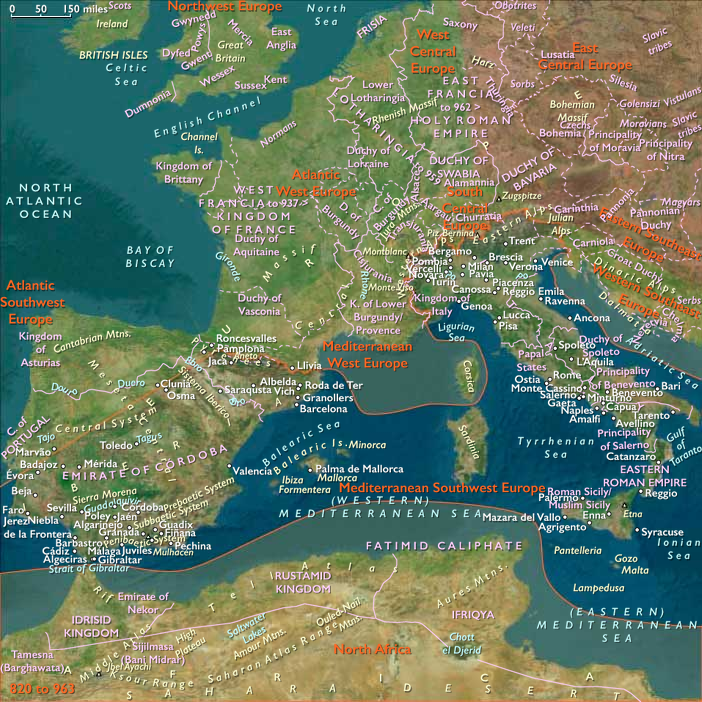
Mediterranean Southwest Europe (892–903 CE): Political Fragmentation,…
892 CE to 903 CE
Mediterranean Southwest Europe (892–903 CE): Political Fragmentation, Andalusian Instability, and Cultural Resilience
The era 892–903 CE in Mediterranean Southwest Europe is marked by deepening political fragmentation within Carolingian Italy, continuing internal strife and decentralization in Umayyad Al-Andalus, and sustained cultural resilience among diverse communities.
Political Fragmentation in Carolingian Italy
Following continued divisions after the Carolingian Empire's fragmentation, Italy witnesses increased political decentralization, as local nobility and regional powers assert greater autonomy. The papacy, while retaining spiritual and diplomatic influence, navigates complex alliances with emerging local rulers, maintaining Rome as a central intellectual and ecclesiastical hub despite the weakening of imperial authority.
Instability and Decentralization in Al-Andalus
Under Emir Abdallah ibn Muhammad (r. 888–912 CE), Al-Andalus experiences heightened decentralization and political instability, characterized by frequent revolts and the growing autonomy of regional governors and powerful local families. Internal conflicts among Muladis, Mozarabs, Arabs, and Berbers contribute to a fragmented political landscape, weakening central authority and prompting shifts in regional power dynamics.
Mozarab and Jewish Communities: Cultural Persistence
Despite political unrest, Mozarab communities persist as vital cultural intermediaries, preserving Latin-Christian traditions while adapting to the Islamic context. The Jewish community, especially in scholarly centers such as Lucena, continues flourishing intellectually, maintaining significant roles in trade, finance, and intercultural scholarship, thus sustaining regional cultural vitality.
Artistic and Intellectual Life in Rome
Rome remains an active intellectual and artistic center, continuing its ninth-century revival influenced by Greek Byzantine traditions. Artistic achievements, particularly in mural painting techniques featuring intricate highlighting, reflect ongoing cultural exchanges with the Eastern Mediterranean and underscore Rome’s sustained importance as a center of intellectual and artistic production.
Economic Stability and Technological Advances
Technological advancements, notably the widespread use of the Catalan forge, continue supporting economic resilience and regional prosperity. Enhanced iron production underpins agricultural improvements, urban development, and military capacities, providing a solid economic foundation despite broader political uncertainties.
Legacy of the Era
The era 892–903 CE underscores the continuing fragmentation of political power in Carolingian Italy and Umayyad Iberia, counterbalanced by enduring cultural and economic resilience. These conditions set the stage for future regional developments, significantly influencing the medieval historical trajectory of Mediterranean Southwest Europe.
Groups
Commodities
Subjects
Regions

Southwest Europe
View →Subregions