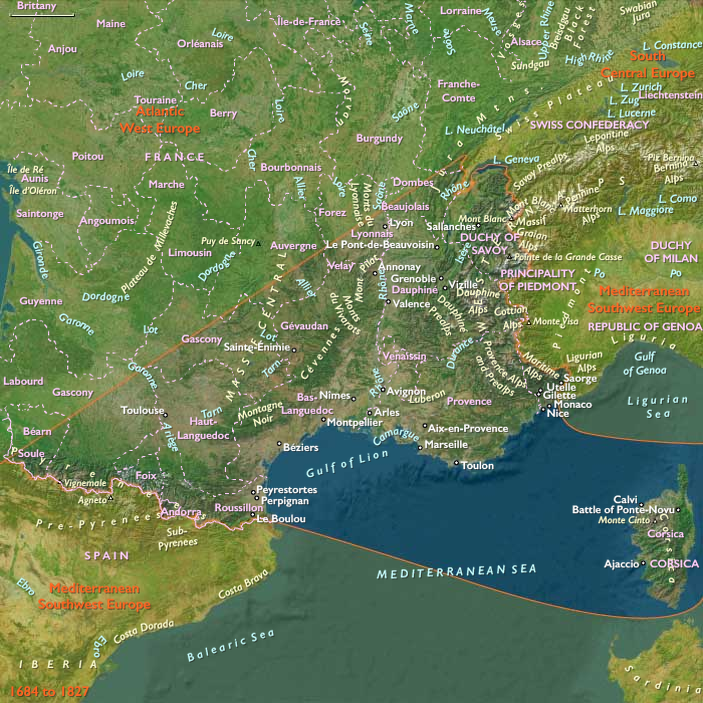
Mediterranean West Europe (1684–1827 CE): Revolution, Restoration,…
1684 CE to 1827 CE
Mediterranean West Europe (1684–1827 CE): Revolution, Restoration, and Changing Allegiances
Between 1684 and 1827 CE, Mediterranean West Europe—encompassing southern France (below an imaginary line from approximately 43.03476° N, 1.17208° W to 46.45234° N, 6.07689° E), Corsica, and Monaco—undergoes profound transformations shaped by revolutionary upheavals, imperial ambitions, and shifts in political allegiances, laying the groundwork for modern national identities.
Monaco: Revolution and Restoration
In 1793, revolutionary forces capture the Principality of Monaco, ending the longstanding rule of the Grimaldi dynasty and placing the territory under direct French administration. This period aligns with broader European turmoil triggered by the French Revolution and subsequent Napoleonic Wars. Monaco remains occupied by French forces for more than two decades, during which traditional institutions are disrupted, and governance integrated with revolutionary France.
Following Napoleon's defeat and exile, the Congress of Vienna in 1815 restores Monaco’s sovereignty, returning the principality to the Grimaldi family. However, Monaco is simultaneously designated a protectorate under the Kingdom of Sardinia, signifying a notable political realignment within the shifting post-Napoleonic European order.
Southern France: Revolutionary Shifts and Imperial Integration
The late 18th century sees southern France deeply affected by the sweeping changes of the French Revolution (1789–1799). Revolutionary ideas find fertile ground in urban centers like Marseille, a hub of revolutionary fervor. The region experiences radical political and social transformations, including the secularization of institutions, the redistribution of noble and ecclesiastical lands, and increased centralization under revolutionary and subsequently imperial governments.
Under Napoleon’s Empire (1804–1815), southern France becomes a strategically important region, integrated into imperial administrative and military structures. Post-Napoleonic restoration of the monarchy in 1815 reinstates stability but also rekindles political tensions and local demands for autonomy.
Corsica: Between French Integration and Local Identity
Corsica, annexed by France in 1768, witnesses significant integration during this era. Corsican-born Napoleon Bonaparte rises dramatically to prominence, first as a revolutionary general and ultimately as Emperor of France. Napoleon's rule brings Corsica to the center of European affairs, intensifying its integration into French political and administrative structures.
Despite this integration, local identity and resistance persist. Post-Napoleonic restoration intensifies tensions between Corsican autonomy and French centralization, contributing to ongoing political complexity on the island.
Economic and Cultural Realignments
Economically, Mediterranean West Europe adjusts to post-revolutionary conditions and increasing European integration. Maritime commerce flourishes in port cities like Marseille, supported by expanding Mediterranean and transatlantic trade networks. Cultural life evolves under Enlightenment influences, shifting toward greater secularization and civic consciousness.
Foundations for Modern Identity
By 1827, Mediterranean West Europe has navigated revolutionary upheavals, imperial ambitions, and shifting political allegiances. The restoration of Monaco under Sardinian protection, Corsica’s deeper French integration, and southern France’s adaptation to revolutionary legacies lay critical foundations for modern national identities, setting the stage for the profound political and social transformations of the ensuing modern era.
People
Groups
Topics
Commodities
Subjects
Regions
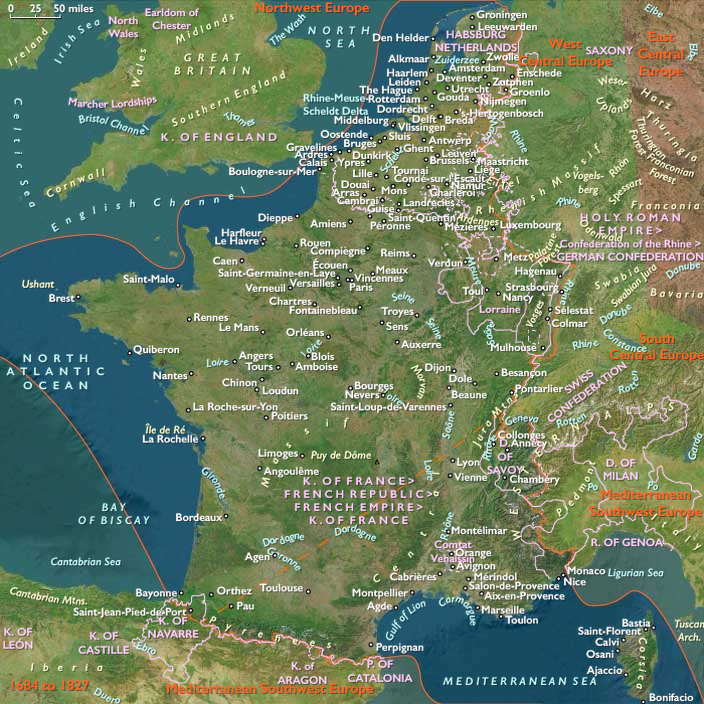
West Europe
View →Subregions