West Europe (1684 – 1827 CE) Revolution,…
1684 CE to 1827 CE
West Europe (1684 – 1827 CE)
Revolution, Restoration, and the Making of the Modern West
Geography & Environmental Context
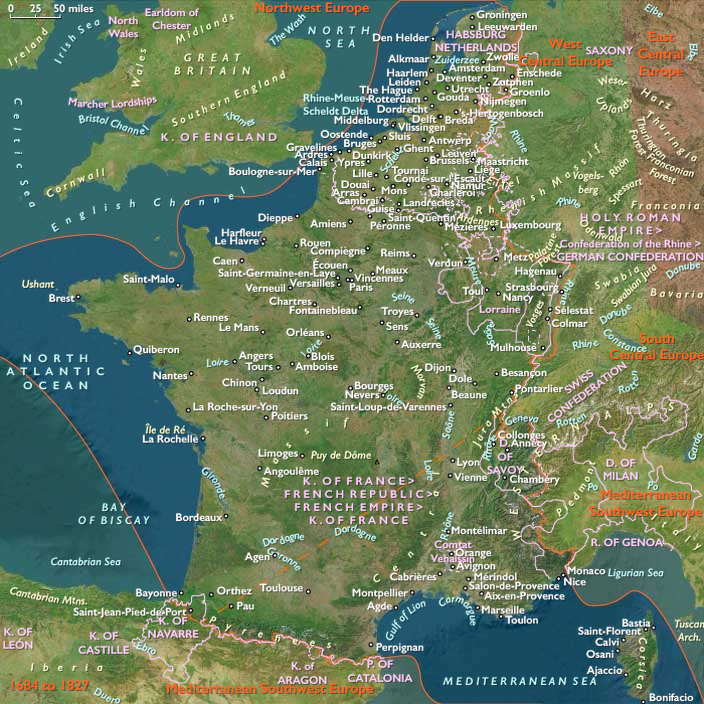
West Europe in this era joined two maritime–Mediterranean worlds: the southern French littoral with Corsica and Monaco, and the Atlantic–Channel belt of France and the Low Countries. Anchors stretched from the Loire, Seine, and Rhine–Meuse–Scheldt deltas to the Provence coast and Corsican mountains, enclosing a corridor of fertile basins, vineyards, polders, and ports—Paris, Marseille, Bordeaux, Nantes, Amsterdam, Antwerp, and Rotterdam—that mediated Europe’s exchange with the wider world.
Climate & Environmental Shifts
The closing Little Ice Age brought alternating extremes: the Great Frost (1709), recurring river floods, and later the “Year Without a Summer” (1816–1817). Storm surges tested Dutch dikes; Atlantic gales crippled fleets. Yet temperate rains, silt renewal, and improved drainage sustained steady recovery. Maize, potatoes, and clover diversified diets and fodder, helping stabilize food security.
Subsistence & Settlement
-
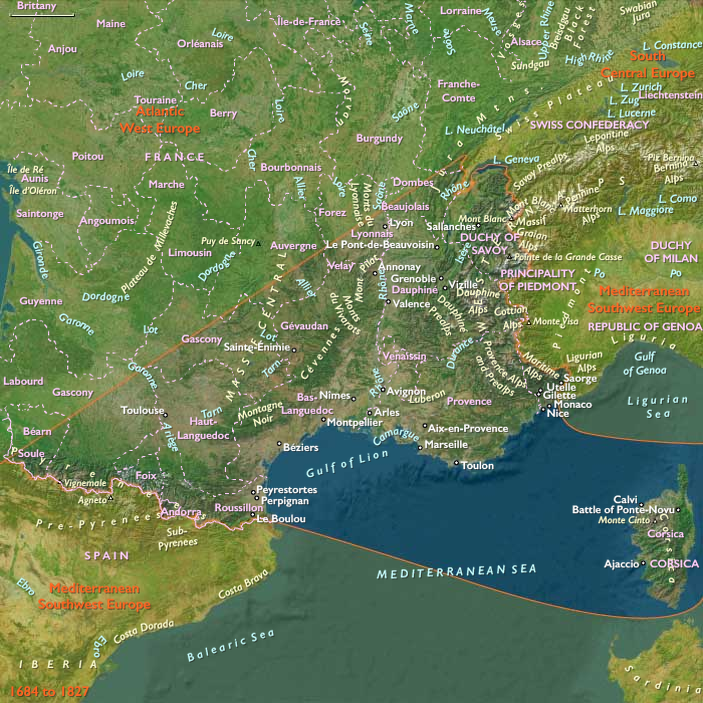
Southern France & Corsica: Mixed grain and wine agriculture, olives and citrus in the Mediterranean valleys; Corsica’s uplands combined chestnut groves, herding, and coastal fishing.
-
Monaco & Provence ports: Depended on maritime trade and services; small gardens and olive terraces supplied local markets.
-
Loire–Burgundy–Île-de-France: Grain belts and vineyards provisioned Paris and exported wine and brandy.
-
Low Countries & northern France: Intensive dairy and grain rotations; butter, cheese, and flax anchored rural prosperity; towns specialized in textiles, lace, and brewing.
-
Urban hubs: Paris grew into the largest continental city; Amsterdam and Antwerp revived post-1670s; Marseille, Bordeaux, and Nantes expanded as Atlantic–Mediterranean entrepôts.
Technology & Material Culture
-
Agrarian improvement: Enclosure, drainage, and polder reclamation in Flanders and Holland; crop rotations and fertilizer use spread after mid-18th century.
-
Infrastructure: Canalization (Briare, Saint-Quentin, Dutch grids) and turnpikes unified river basins; windmills, waterwheels, and early steam engines powered mills.
-
Manufacture: Flemish linens, French printed cottons, Sèvres and Meissen-inspired porcelain, shipbuilding along the Gironde and Dutch estuaries.
-
Architecture & arts: Baroque to neoclassical transitions—from Bordeaux’s quays and Parisian boulevards to Provençal townhouses and Corsican citadels.
Movement & Interaction Corridors
-
Sea lanes & estuaries: The Channel, Bay of Biscay, and North Sea carried colonial staples and manufactures; the Gironde, Loire, and Seine fed Atlantic and Channel ports.
-
Canals & rivers: Linked hinterlands to the sea; Dutch trekvaart passenger boats and French canal barges shortened journeys.
-
Atlantic empires: Dutch and French ports managed global circuits—sugar, coffee, and slaves to Europe; wine, salt, and textiles outward.
-
Napoleonic highways: Imperial road systems and conscription routes integrated provinces; the Continental System redirected commerce toward continental markets.
Cultural & Symbolic Expressions
-
Enlightenment & Revolution: Parisian salons, academies, and presses disseminated new philosophies; revolutionary festivals and tricolor symbolism replaced dynastic ritual.
-
Napoleonic order: The Code civil standardized law across annexed territories, reshaping property and family relations.
-
Religious life: Secularization closed many monasteries; later Restoration revived Catholic and Protestant institutions under tighter state control.
-
Art & letters: Rococo refinement gave way to Neoclassical and Romantic forms—David, Ingres, and Géricault; literary ferment from Voltaire and Rousseau to Chateaubriand and Lamartine.
-
Low-Country culture: Catholic processions, guild festivals, and mercantile cosmopolitanism coexisted with a vigorous print and artistic life in Antwerp and Amsterdam.
Environmental Adaptation & Resilience
Water management defined survival: Dutch and Flemish engineers maintained dikes and sluices; Loire and Garonne levees contained floods. Mixed farming and vineyard diversification spread risk. Port granaries, parish relief, and poor-law institutions mitigated famine; neutral shipping and smuggling sustained trade through blockades.
Political & Military Shocks
-
Wars of Succession and Empire: From the War of the Spanish Succession (1701–1714) to the Seven Years’ War (1756–1763), coastal France and the Low Countries were repeatedly contested.
-
French Revolution (1789–1799): Abolished feudal privileges, nationalized church lands, and recast sovereignty.
-
Napoleonic Wars (1792–1815): France annexed the Low Countries, Corsica became imperial province; Monacowas absorbed (1793–1814); wars and blockades reshaped trade.
-
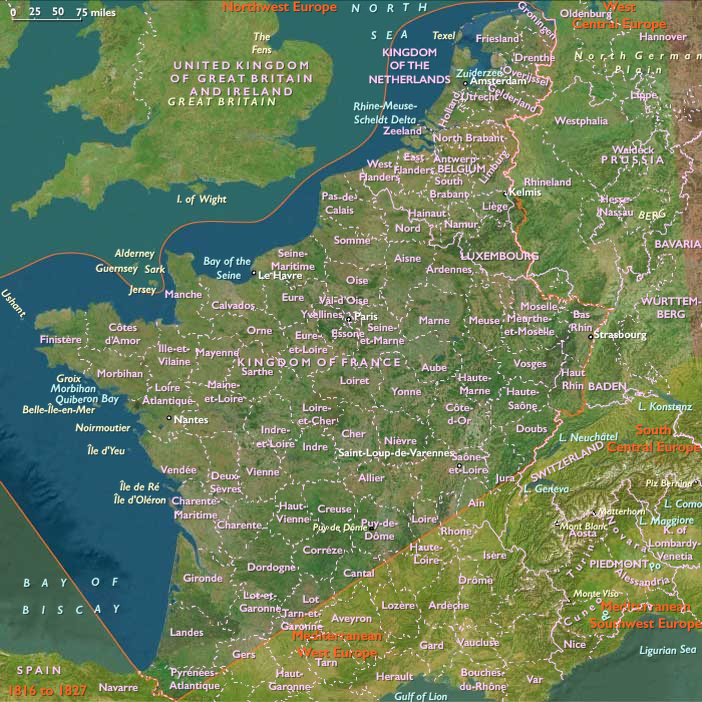
Restoration (1815): The Congress of Vienna reinstated monarchies—France under the Bourbons; Monacorestored under the Grimaldi, yet placed under Sardinian protection.
-
Revolutionary legacy: Constitutionalism, civic equality, and administrative centralization endured despite royal restoration.
Regional Vignettes
-
Monaco: Occupied by revolutionary France (1793), restored 1815 under Sardinian protection—a microcosm of dynastic survival amid upheaval.
-
Corsica: Annexed 1768; birthplace of Napoleon; integration deepened under empire, yet local identity and autonomy debates persisted after 1815.
-
Southern France: Marseille, Lyon, and Nîmes oscillated between revolutionary zeal and royalist reprisals; the region remained militarily and economically vital to both republic and empire.
-
Low Countries: Alternated between French annexation, Batavian client statehood, and post-1815 union under the Netherlands; industrial and banking bases revived rapidly thereafter.
Transition
Between 1684 and 1827 CE, West Europe evolved from a lattice of port polities and seigneurial estates into a crucible of revolution and restoration. Monaco’s reinstatement, Corsica’s integration, and southern France’s transformation reflected a wider metamorphosis in which law, citizenship, and commerce replaced feudal privilege.
Across the Atlantic and Mediterranean rims, canals, polders, and ports bound field to sea, while Enlightenment ideals and Napoleonic codes re-forged governance. By 1827, the region stood rebuilt and restless—its harbors reopened, its monarchs restored, but its societies permanently altered by a century of ideas, wars, and tides.
People
Groups
Topics
Commodities
Subjects
Regions