
Mediterranean West Europe (333–190 BCE): Hellenistic Expansion…
333 BCE to 190 BCE
Mediterranean West Europe (333–190 BCE): Hellenistic Expansion and Celtic Integration
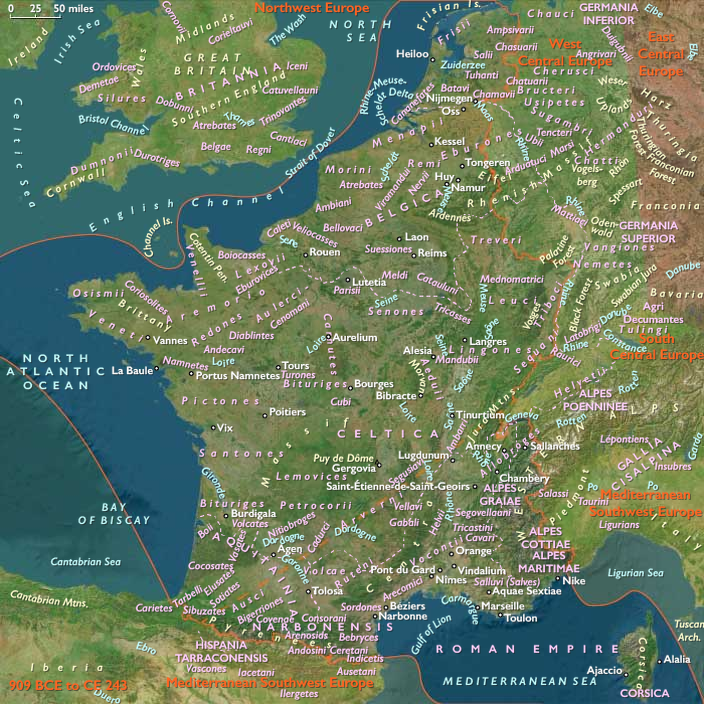
Between 333 and 190 BCE, Mediterranean West Europe—comprising southern France (below an imaginary line from approximately 43.03476° N, 1.17208° W to 46.45234° N, 6.07689° E), Corsica, and Monaco—experiences significant transformations influenced by the broader Hellenistic world and continued developments among Celtic societies. This era sees the height of Massalia’s influence, deeper integration of Celtic tribes into Mediterranean trade networks, and the consolidation of local cultural identities.
Massalia and the Hellenistic Influence
During this period, Massalia reaches its peak influence as a thriving Hellenistic city-state. Benefiting from its strategic coastal location, Massalia becomes a crucial nexus of Mediterranean trade, connecting the Greek and Celtic worlds. The city maintains diplomatic and commercial relationships with prominent Hellenistic kingdoms, facilitating the flow of luxury goods, technologies, and cultural practices throughout the region.
Massalia’s prosperity supports the founding of additional coastal colonies and trading posts, including Agde, Nice, and Antibes. These outposts further cement the Greek presence and extend Hellenistic influence inland through interactions with indigenous Celtic tribes.
Celtic Societal Evolution and Urbanization
Celtic societies in Mediterranean West Europe continue their trajectory toward increased urbanization and complexity. The fortified settlements known as oppida evolve into more elaborate political and economic centers, significantly benefiting from interactions with Massalia and other Greek trading colonies. This period witnesses remarkable growth in metallurgy, especially ironworking, enhancing both agricultural productivity and military capabilities.
The Celts not only engage actively in Mediterranean commerce but also adopt and adapt Hellenistic artistic and architectural styles, evident in elaborate burial practices, pottery, and ornamentation. The Celto-Ligurian peoples, in particular, become intermediaries in the growing trade between Massalia and the inland regions.
Cultural Integration and Identity Formation
Intensified exchanges between Greek and Celtic populations foster a vibrant cultural integration. Greek alphabetic literacy, coinage, and administrative practices spread among elite Celtic groups, while Greek colonists increasingly integrate Celtic religious elements and artistic motifs into their own cultural expressions. These interactions promote the emergence of distinct regional identities, combining local traditions with imported Hellenistic influences.
Corsica and Regional Stability
In Corsica, local communities engage in sporadic but increasing contacts with Hellenistic merchants and sailors. While Corsica remains largely peripheral to intensive Greek colonization, its strategic position in maritime trade routes ensures it benefits from the broader regional economic activity. Communities maintain a largely indigenous character but experience incremental cultural exchanges and economic developments linked to the broader Hellenistic world.
Consolidation and Long-term Significance
By 190 BCE, Mediterranean West Europe has firmly established its position as a significant cultural and economic crossroad within the Mediterranean. Massalia’s extensive trade networks and cultural exchanges profoundly shape Celtic societies, contributing to the development of sophisticated urban centers and vibrant local cultures. This era sets the foundation for continued growth and regional stability, preparing Mediterranean West Europe for subsequent historical developments under the influence of the emerging Roman power.
Groups
Topics
Commodities
Subjects
Regions
West Europe
View →Subregions
