West Europe (6,093 – 4,366 BCE): Middle…
6093 BCE to 4366 BCE
West Europe (6,093 – 4,366 BCE): Middle Holocene — Coastal Farmers and Continental Gateways
Geographic & Environmental Context
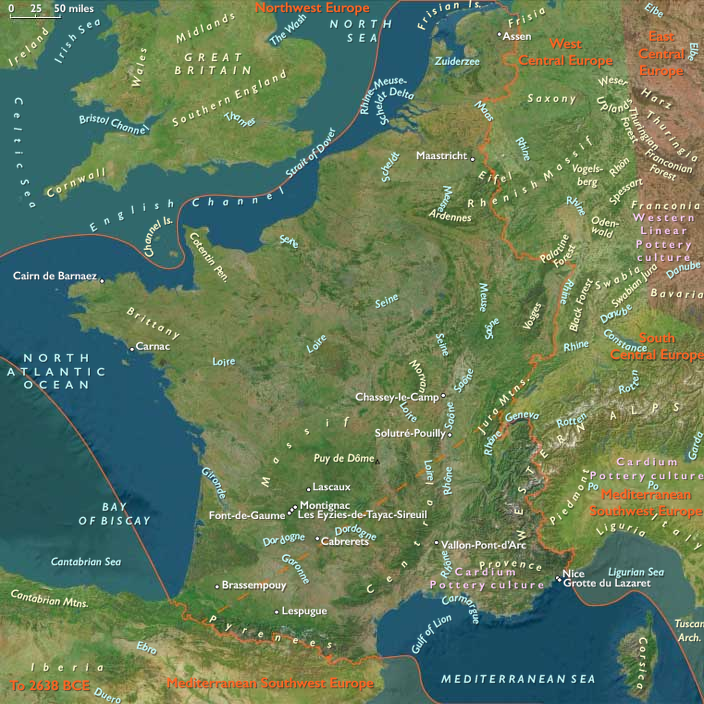
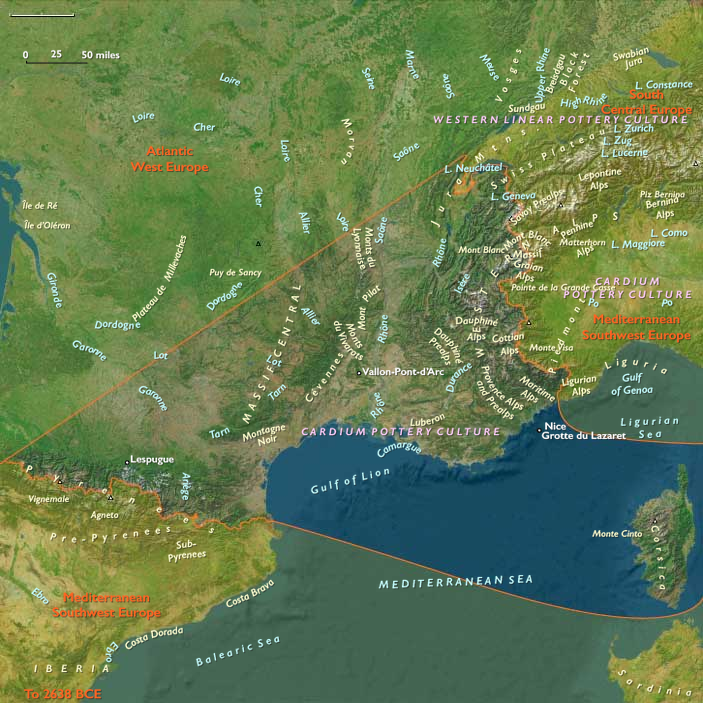
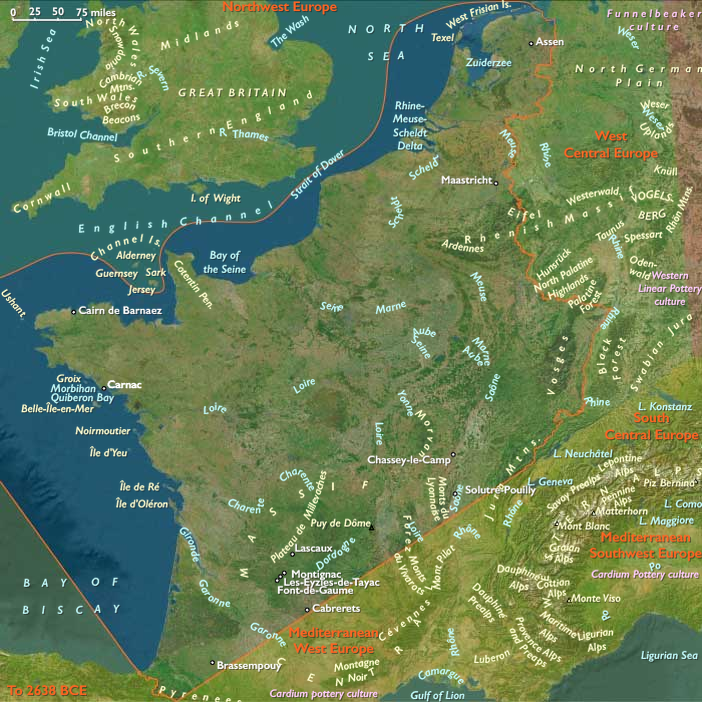
During the Middle Holocene, West Europe—stretching from the Atlantic façade of France and the Low Countries to the Mediterranean coasts of Languedoc, Provence, and Corsica—entered the Neolithic era through two converging fronts: maritime colonization from the Mediterranean and gradual inland diffusion from Central Europe.
-
The Atlantic West (Brittany, Normandy, Aquitaine, Loire, and the Channel and Atlantic coasts) developed along estuaries, tidal plains, and dune systems fed by stabilized mid-Holocene sea levels.
-
The Mediterranean West, centered on the Rhône Valley, Languedoc–Roussillon plains, and Corsica, received direct Cardial/Impressed Ware expansion by sea, establishing the first permanent farming communities of southern France.
Together, these regions bridged the Danubian inland farmers and the Mediterranean seafarers, forming one of the great cultural crossroads of early European agriculture.
Climate & Environmental Shifts
The Holocene Climatic Optimum (c. 7000–4000 BCE) brought warm, moist conditions with reliable precipitation and flourishing vegetation.
River valleys—especially the Rhône–Saône corridor—accumulated fertile silt; lagoons and estuaries along the Languedoc coast stabilized; and temperate forests of oak, elm, and pine flourished inland.
Sea-level highstands shaped new bays and tidal marshes along the Atlantic coast, creating rich shellfish and fish habitats that supported forager–farmer hybrid economies.
The overall environment was predictable and generous, enabling both population growth and experimentation with mixed subsistence.
Subsistence & Settlement
Neolithic lifeways spread across West Europe in waves:
-
Along the Mediterranean rim, Cardial/Impressed Ware farmers arrived by maritime colonization, establishing settlements along the Provençal and Languedoc coasts and Corsican bays. They cultivated wheat, barley, peas, and lentils and herded sheep, goats, cattle, and pigs.
-
In the Rhône Valley, inland farming communities expanded up river terraces and alluvial fans, linking to the Central European Linearbandkeramik (LBK) frontier via the Rhône–Saône–Jura axis.
-
Across the Atlantic façade, indigenous foragers began incorporating domesticated crops and livestock through contact and exchange, maintaining strong traditions of fishing, shellfish gathering, and hunting.
-
Coastal settlements blended sea harvests and farming, using rivers and estuaries as supply routes and interaction corridors between communities.
The result was a region-wide mosaic of agropastoral villages, shell middens, and hybrid economies, each adapted to its immediate landscape.
Technology & Material Culture
Material life combined Mediterranean refinement with local innovation:
-
Pottery styles varied—Cardial Impressed Ware dominated the south, while coarse plain and decorated wares developed inland and along the Atlantic coasts.
-
Polished stone axes and adzes were essential for forest clearance; loom weights and spindle whorls reflect the emergence of flax and wool textiles.
-
Querns and grinding stones were widespread for grain processing.
-
Obsidian, traded from Sardinia and Lipari, and marine shells circulated through Mediterranean ports; flint and jadeite axes moved along the Rhône–Jura trade corridors into the Atlantic interior.
These technologies supported long-term settlement, resource control, and interregional exchange.
Movement & Interaction Corridors
West Europe’s geography encouraged both maritime and overland mobility:
-
The Rhône–Saône–Jura passage linked Mediterranean farmers with the Danubian heartlands, serving as the main overland route for Neolithic diffusion north and west.
-
Coastal cabotage connected Liguria, Provence, Languedoc, and Corsica, moving obsidian, axes, and decorative goods.
-
Along the Atlantic rivers—Loire, Garonne, and Seine—shellfish gatherers and farmers traded foodstuffs and materials, establishing a network of estuarine communities that would later form the foundation for the Atlantic megalithic tradition.
These corridors made West Europe one of the most dynamic zones of Neolithic convergence, blending technologies, crops, and symbolic systems from across the Mediterranean and Central Europe.
Cultural & Symbolic Expressions
Ritual and identity were rooted in both household and landscape:
-
Domestic shrines, hearths, and ancestor burials beneath floors marked continuity between family and field.
-
Early megalithic structures—dolmens and passage graves—emerged first along the Atlantic seaboard, with cultural influence radiating into southern France and the western Mediterranean.
-
Painted and impressed pottery motifs, often spiral or geometric, likely held ritual meaning tied to fertility and the agricultural cycle.
-
Communal feasting and burial rituals reinforced social cohesion, transforming settlements into moral as well as economic communities.
Environmental Adaptation & Resilience
Neolithic farmers in West Europe adapted effectively to varied environments:
-
Mixed farming and herding diversified risk, while coastal foraging and lagoon fishing buffered against crop shortfalls.
-
Storage pits, silos, and granaries conserved cereals through wet winters.
-
Seasonal transhumance between lowland fields and upland pastures maintained soil fertility.
-
Maritime exchange networks distributed goods and knowledge across ecological zones, ensuring redundancy against local resource stress.
This integration of land and sea produced a sustainable rhythm of life that endured for millennia.
Long-Term Significance
By 4,366 BCE, West Europe had become a fully Neolithic landscape, uniting farming villages, coastal foragers, and long-distance traders into a coherent cultural sphere.
The Mediterranean West served as a hub of maritime exchange, while the Atlantic West matured into a center of monument building and seaborne interaction.
Through the Rhône corridor, these worlds merged, creating a continuous frontier between the Mediterranean and the continental interior.
The region’s enduring legacy was its role as Europe’s western bridge—linking the agrarian technologies of the East with the seafaring ingenuity of the Atlantic, and setting the stage for the later megalithic and Chalcolithic expansions that would define prehistoric Europe.
Commodities
Subjects
Regions