
Mediterranean West Europe (477–334 BCE): Expansion of…
333 BCE to 190 BCE
Mediterranean West Europe (477–334 BCE): Expansion of Greek Influence and Consolidation of Celtic Societies
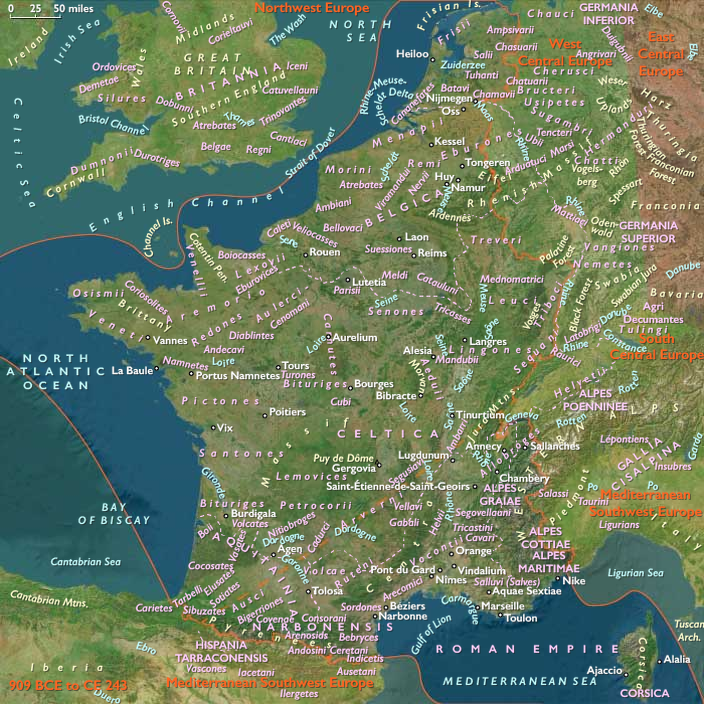
Between 477 and 334 BCE, Mediterranean West Europe—comprising southern France (below an imaginary line from approximately 43.03476° N, 1.17208° W to 46.45234° N, 6.07689° E), Corsica, and Monaco—experiences an expansion and consolidation of cultural interactions initiated in earlier periods. Greek influence radiating from Massalia grows more prominent, while Celtic societies become increasingly structured and influential throughout the region.
Growth and Influence of Massalia
Massalia continues to flourish as a vital Greek colony, becoming an influential center of commerce and culture in Mediterranean West Europe. The city expands its trading networks extensively, establishing outposts and trading stations along the coast, facilitating exchanges with indigenous peoples and Celtic tribes. Massalia's merchants play a critical role in disseminating Greek pottery, wine, olive oil, and cultural practices, further integrating the region into Mediterranean trade networks.
Celtic Consolidation and Societal Development
During this era, Celtic tribes consolidate their presence, forming increasingly organized and hierarchical societies. The Celts establish fortified settlements known as oppida, which serve as political centers, trade hubs, and defensive structures. These oppida become symbols of Celtic wealth and power, reflecting significant advancements in craftsmanship, metallurgy, and agricultural practices. Interaction with Greek colonists contributes to technological exchanges, enhancing local skills in metalwork and pottery production.
Intensified Cultural Exchange
The cultural exchange between Greek settlers and Celtic inhabitants intensifies during this period. Greek literacy, art, and architectural influences permeate Celtic societies, inspiring new artistic forms and facilitating the adoption of advanced economic practices. Concurrently, Greek settlers adapt to local conditions, incorporating Celtic elements into their lifestyles and economic systems, leading to a vibrant cultural synthesis.
Regional Stability and Long-term Impacts
By 334 BCE, Mediterranean West Europe has solidified its cultural and economic foundations through sustained interaction between Greek colonists and Celtic communities. The developments in commerce, agriculture, and metallurgy established during this era create enduring patterns that underpin regional stability and growth. This period firmly establishes the region as a dynamic crossroads of cultural and economic activity in the broader Mediterranean world.
Groups
Topics
Commodities
Subjects
Regions
West Europe
View →Subregions
