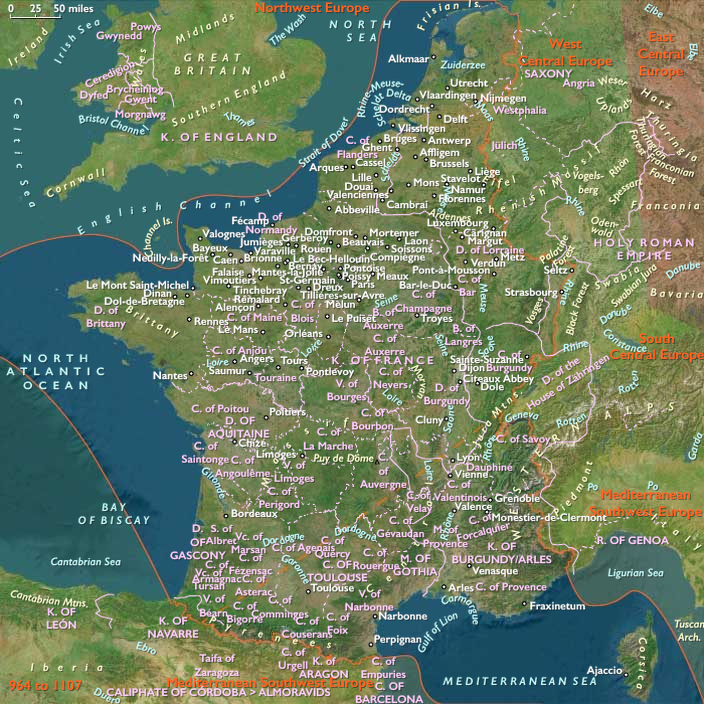
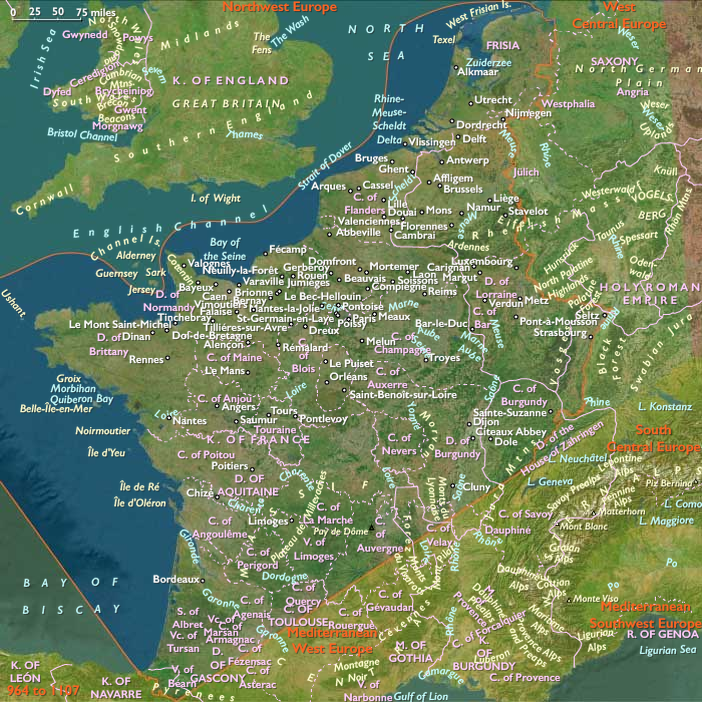
West Europe (964 – 1107 CE): Cluniac…
964 CE to 1107 CE
West Europe (964 – 1107 CE): Cluniac Reform, Capetian Foundations, and the Rise of the Western Kingdoms
Geographic and Environmental Context
West Europe in this age extended from the Rhône Valley and the Provençal coast to the Atlantic shores of Normandy, Brittany, and Aquitaine, encompassing southern and western France, Monaco, Corsica, and the southern Jura uplands.
To the east, Lyon and the Rhône corridor linked Burgundy to the Mediterranean; to the west, the Loire and Seine valleys carried commerce to Paris and Rouen; and southward, the Garonne and Gironde funneled grain and wine to Bordeaux and the Bay of Biscay.
The Languedoc plain, Roussillon marches, and Provençal littoral connected with Barcelona and the Catalan sphere, while the Channel world united Normandy, Flanders, and England.
Climate and Environmental Shifts
The Medieval Warm Period (c. 950–1250) brought stable warmth, mild winters, and longer growing seasons.
-
In the Rhône and Languedoc, vineyards and olive groves expanded.
-
In northern France, grain surpluses and viticulture along the Loire underpinned demographic growth.
-
Marsh reclamation transformed Flanders, Saintonge, and Aunis, while embankments extended the productive coastline.
-
Upland grazing in the Pyrenees and southern Jura supported transhumant economies that supplied wool and cheese to lowland markets.
The rivers—Rhône, Loire, Seine, and Garonne—served as arteries for trade and pilgrimage, connecting the Mediterranean and Atlantic worlds.
Societies and Political Developments
Mediterranean Realms: Provence, Languedoc, and the Catalan Frontier
The Kingdom of Arles/Burgundy, encompassing Provence and Lyon, remained under nominal imperial authority until absorbed into the Holy Roman Empire (1032).
-
The Counts of Toulouse dominated Languedoc, while the Trencavel viscounts ruled Carcassonne and Béziers, balancing feudal autonomy with church reform.
-
In Provence, the Counts of Barcelona extended their reach northward into Roussillon and along the lower Rhône.
-
Lyon emerged as a major ecclesiastical and commercial hub, hosting councils and fairs that connected the Alpine world to the sea.
-
Corsica oscillated between Pisan and Genoese control, its timber and harbors coveted by maritime republics; Monaco and Nice remained in the orbit of Provençal and Ligurian powers.
Atlantic Kingdoms: Capetians, Normans, and Aquitanians
The Capetian monarchy, founded by Hugh Capet (987), gradually consolidated the Île-de-France—a modest core between Paris, Orléans, and Étampes—but wielded symbolic authority across the realm.
-
Normandy, forged under William the Conqueror (r. 1035–1087), became a military and administrative powerhouse; the 1066 conquest of England fused the Channel coasts into a single feudal world.
-
Anjou, under Fulk III “Nerra” and successors, pioneered castle-building and disciplined lordship, influencing political structures from Maine to Touraine.
-
Aquitaine, with its courts at Poitiers and Bordeaux, thrived as a cultural center under William IX and William X, uniting Occitan and northern traditions.
-
Flanders rose as a comital and urban powerhouse, fostering early chartered towns and cloth production based on English wool.
Regional Integrations
Throughout the south, Catalan expansion into Roussillon and Provence, coupled with Byzantine decline in Italy, brought the western Mediterranean more firmly into Frankish and Latin systems.
To the north and west, Norman conquest and colonization bound England, Flanders, and northern France into the first coherent trans-Channel polity.
The monastic networks centered on Cluny and Moissac spread reform and uniformity from Burgundy to the Pyrenees, reshaping religious life and land tenure.
Economy and Trade
West Europe’s economy fused agrarian surplus, riverine commerce, and Mediterranean–Atlantic exchange.
-
Agriculture: cereals, vines, and olives in the south; grain and wine in the Loire and Seine valleys; transhumant flocks in mountain margins.
-
Trade corridors:
-
Rhône–Saône–Lyon–Arles corridor carried goods between north and south.
-
Loire–Seine system linked Tours, Orléans, and Paris to northern ports.
-
Garonne–Gironde–Bordeaux exported wine and salt.
-
Via Domitia and Via Tolosana connected Languedoc to Catalonia and Italy.
-
-
Ports and markets:
-
Marseille, Narbonne, Montpellier, and Aigues-Mortes flourished as maritime entrepôts to the Levant and North Africa.
-
Rouen, La Rochelle, and Bordeaux handled Atlantic trade; Nantes and Bayonne exported salt, wine, and fish.
-
Flanders imported wool and metals, exporting cloth to the Mediterranean via overland fairs and Rhine navigation.
-
-
Coinage: royal, episcopal, and comital mints in Paris, Toulouse, and Bordeaux; deniers of Lyon and Marseille facilitated long-distance exchange.
Belief and Symbolism
Faith and reform shaped the cultural unification of West Europe.
-
The Cluniac Reform (founded 910) radiated from Burgundy, emphasizing monastic discipline, liturgical splendor, and independence from lay control; its influence reached Provence, Languedoc, and Aquitaine.
-
Pilgrimage networks expanded:
-
The Via Tolosana through Arles and Toulouse, and the Via Turonensis through Tours and Poitiers, channeled pilgrims toward Santiago de Compostela, energizing inns, bridges, and shrines.
-
-
Romanesque architecture—thick walls, barrel vaults, and sculpted portals—flourished in Languedoc, Provence, Anjou, and along the Loire.
-
Cathedral and abbey schools revived learning at Chartres, Tours, and Lyon.
-
In Flanders and Normandy, relic cults and parish foundations underscored civic identity, while southern abbeys such as Saint-Gilles and Moissac became centers of pilgrimage art.
Adaptation and Resilience
-
Political resilience: dynastic fragmentation was tempered by strong feudal bonds—homage networks stabilized local governance despite limited royal power.
-
Economic adaptation: reclamation of marshes and rotation of crops underpinned population growth; ports and fairs ensured redundancy when routes shifted due to war or flood.
-
Cultural cohesion: Latin liturgy and Cluniac monasticism bridged regional dialects and lordships, fostering a common spiritual economy.
-
Urban renewal: river and maritime towns adopted communal charters, legalizing self-governance and collective defense.
Long-Term Significance
By 1107 CE, West Europe had entered an age of revival that blended monastic piety, dynastic ambition, and mercantile expansion:
-
The Capetian kings anchored royal legitimacy in the Seine–Loire heartland, laying foundations for later territorial monarchy.
-
The Normans, now masters of the Channel and England, projected French feudal culture across the sea.
-
Aquitaine and Languedoc matured as centers of Occitan literature and Romanesque art, underpinned by maritime wealth.
-
Flanders and Provence, though distant, mirrored each other as hubs of urban industry and Mediterranean trade.
-
Across both south and north, the pilgrimage roads and Cluniac abbeys created a unified spiritual geography linking Lyon, Tours, and Toulouse to Santiago and Rome.
West Europe thus emerged from the 11th century as a dynamic patchwork of reforming abbeys, thriving cities, and resilient lordships—a region poised for the twelfth-century flowering of chivalry, commerce, and crusade that would redefine Latin Christendom.
Images

Mediterranean West Europe (with civilization) ©2024-25 Electric Prism, Inc. All rights reserved.
People
Groups
Topics
Commodities
Subjects
Regions