
Tsar Alexander I of Russia draws up…
August 1823 CE
The existence of the manifesto will be revealed on Alexander's death in 1825.
Groups
Subjects
Regions
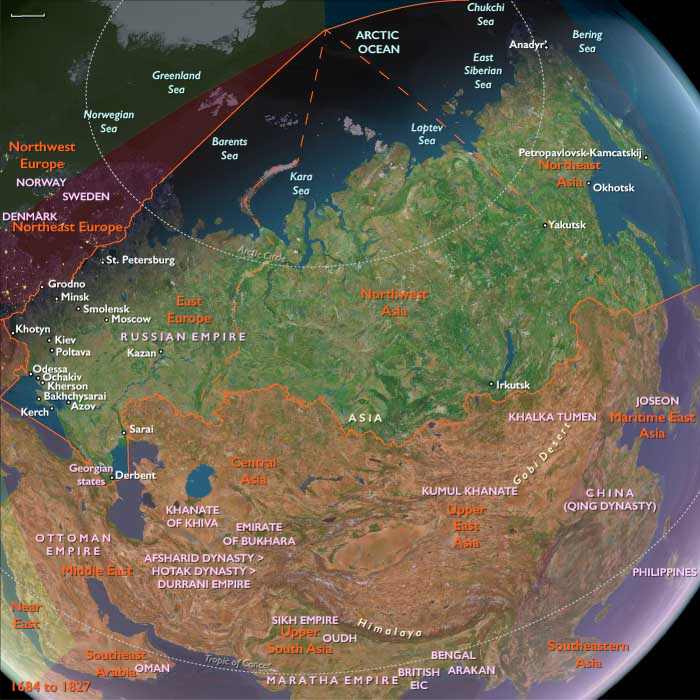
Northeastern Eurasia
View →Subregions
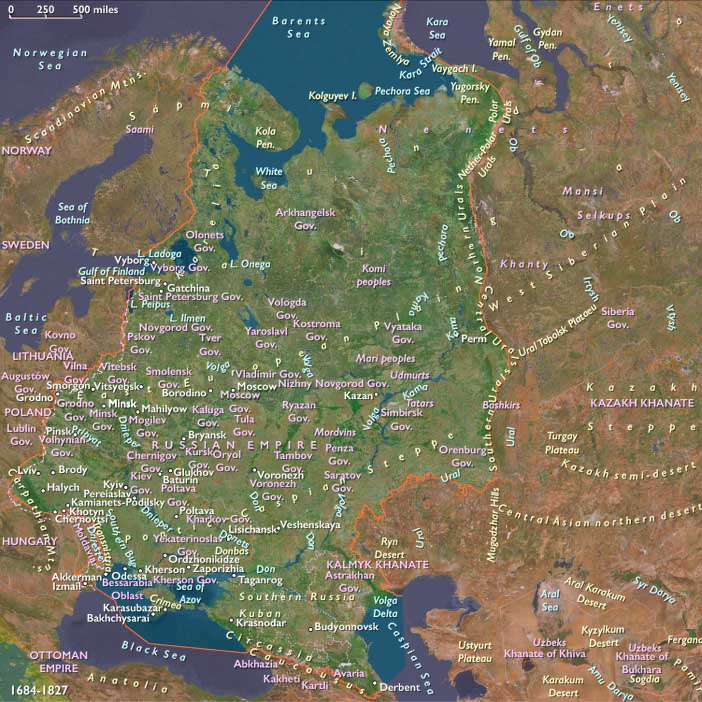
East Europe
View →Related Events
No active filters.
Showing 10 events out of 20218 total
Hongi Hika makes peace with the Waikato iwi in 1823 and invades Te Arawa territory in Rotorua.
In 1822, Wiradjuri warriors attack a station on the Cudgegong River, in which they drive away the stockman, let the cattle out of the yard and kill several of the sheep.
More attacks follow with the murder of convict hut-keepers, scattered herds and speared cattle.
Stockmen are intimidated and will not leave their huts to round up the cattle and bring them in without protection.
The government center at Swallow Creek is soon abandoned in fear of attack.
In late 1823, Windradyne (known as Saturday by the British) is captured for the first time.
Cholera reaches Astrakhan, Zanzibar, and Mauritius in 1823.
The first priority in European Great Power politics after the final defeat of Napoleon in 1815 has been Maintenance of the status quo.
In such an atmosphere, the attention of the Great Powers (primarily France and Britain) can be drawn most quickly by situations that disrupt their common economic interests.
Indeed, in 1823, the war in Greece has already begun curtailing commerce in the eastern Mediterranean, but the European powers realize that the defeat of the Ottoman Empire will leave a power vacuum over a very large, strategically important region.
Therefore, they move cautiously to ensure an advantageous position after the anticipated collapse.
These calculations balance Britain and France ...
Adam Mickiewicz’s second volume of poetry, published in 1823, contains the narrative poem Grazyna and parts two and four of Forefathers' Eve, a new type of drama drawn from the Belorussian folk rite of ancestor worship.
In this same year, Mickiewicz is arrested on charges of belonging to an anti-Russian conspiracy and is exiled to Russia.
The school is founded out of intellectual discontent over the contemporary shallow education of females in the contemporary finishing schools, such as Bjurströmska pensionen.
Wallin convinces Fryxell that girls should be educated "with higher ambitions than to learn to speak French and play the klavér", because also women have the right to serious studies, and that it will surely prove to be needed in the future.
Jöns Jacob Berzelius, accepting Humphry Davy's theory that chlorine is an element, uses the collective name halogen in 1823 for the elements fluorine, chlorine and iodine. (Bromine will be added to the halogens following its discovery in 1826.)