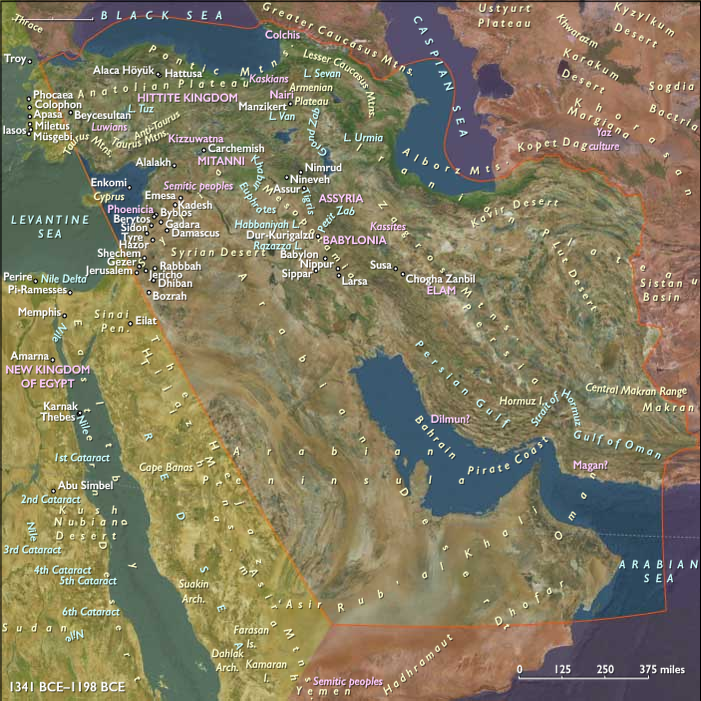
Mitanni (Assyrian Hanigalbat), a Hurrian kingdom in…
1341 BCE to 1198 BCE
Mitanni (Assyrian Hanigalbat), a Hurrian kingdom in northern Mesopotamia from about 1500 BCE, had reached the height of its power during the mid-fourteenth century BCE, encompassing what is today southeastern Turkey, northern Syria and northern Iraq (roughly corresponding to Kurdistan), centered around the capital Washukanni whose precise location has not yet been determined by archaeologists.
Mitannian sources from the late fourteenth century list the Aryan deities Varuna, Mitra, and Indra as well as two Nasatyas, twin gods who represent the productive functions of society.
Although the Mitanni aristocracy is probably more immediately related to the Kassites, their names may reveal an Indo-Aryan origin while their deities specifically betray Indic roots.
The common peoples' language, the agglutinative Hurrian language, is neither Indo-European nor Semitic.
The Hurrian language, and thus the Hurrian people, is related to the future polity of Urartu, but nothing more can be deduced from current evidence.
A Hurrian passage in the Amarna letters—usually composed in Akkadian, the lingua franca of the day—indicates that the royal family of Mitanni is by this time speaking Hurrian as well.
Locations
Groups
Topics
Commodities
Subjects
Regions
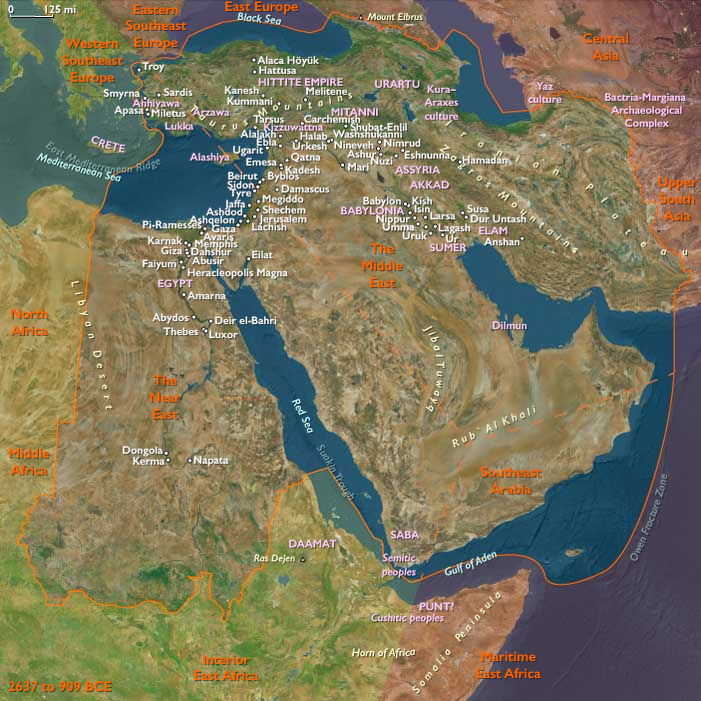
The Near and Middle East
View →Subregions