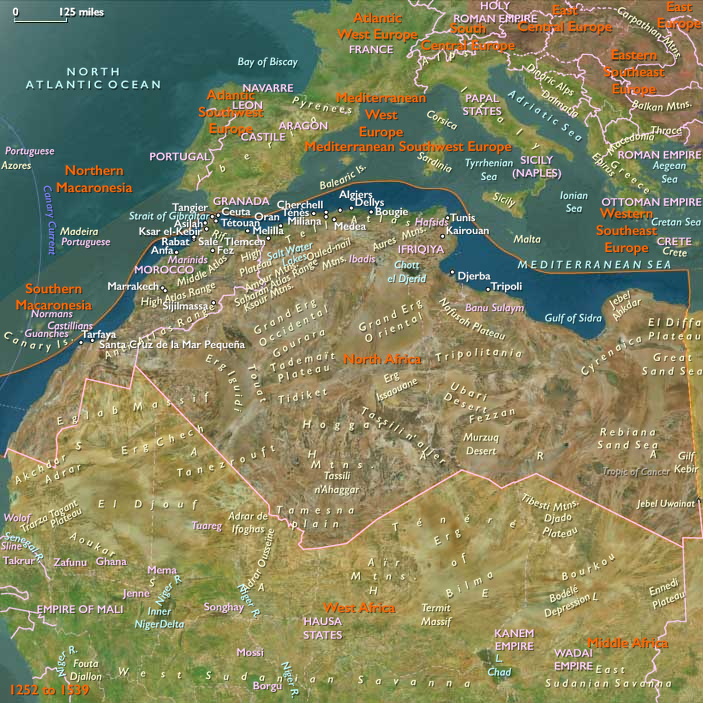
At the eastern end of the Almohad…
1108 CE to 1252 CE
At the eastern end of the Almohad empire, the sultan leaves an autonomous viceroy whose office becomes hereditary in the line of Muhammad ibn Abu Hafs (reigned 1207-21), a descendant of one of Ibn Tumart's companions.
With the demise of the Almohad dynasty in Morocco, the Hafsids adopt the titles of caliph and sultan and consider themselves the Almohads' legitimate successors, keeping alive the memory of Ibn Tumart and the ideal of Maghrebi unity from their capital in Tunis.
Locations
Groups
Topics
Regions
North Africa
View →Subregions
North Africa
View →Related Events
Showing 10 events out of 194 total
The Final Stages of the Portuguese Reconquista (1185–1249 CE)
The Portuguese Reconquista progresses under the successive reigns of Sancho I, Afonso II, Sancho II, and Afonso III, gradually pushing the Muslim frontier southward until Portugal reaches its modern territorial limits.
Sancho I (r. 1185–1211) and Early Southern Campaigns
As the son and heir of Afonso Henriques, Sancho I continues his father’s military campaigns, expanding Portuguese control in the Algarve:
- 1189 – Sancho captures the castle at Alvor, the city of Silves, and the castle at Albufeira.
- However, these territories are soon retaken by the Muslims, requiring future monarchs to reconquer them.
Afonso II (r. 1211–1223) and the Battle of Navas de Tolosa
Sancho I’s son, Afonso II, launches new campaigns in the Alentejo, with the support of his brother-in-law, Alfonso VIII of Castile:
- 1212 – Afonso II participates in the Battle of Navas de Tolosa, a decisive Christian victory that weakens Muslim power in Iberia.
- 1217 – He takes part in the siege and conquest of Alcácer do Sal, one of the largest strongholds in the Alentejo.
Sancho II (r. 1223–1248) and the Algarve Campaigns
Under Sancho II, the Reconquista advances into the Algarve, where major battles take place:
- 1238 – His forces defeat Muslim armies at Tavira and Cacela, further expanding Portuguese control southward.
Afonso III (r. 1248–1279) and the Final Conquest
The final stage of the Reconquista occurs under Afonso III, who:
- 1249 – Launches a campaign against the last Muslim enclave in the Algarve, capturing Faro and securing Portugal’s southern coastline.
This last battle officially completes the Portuguese Reconquista, defining the territorial boundaries of Portugal, which have remained largely unchanged ever since.
The Repopulation of Portugal Under Afonso Henriques and Sancho I
The rapid military expansion of Afonso Henriques, from Coimbra to Lisbon, creates a vast and relatively uninhabited frontier between the north and south of Portugal. To secure these lands and reinforce Christian rule, an immediate repopulation effort begins.
Repopulating the Land with Crusaders and Foreign Settlers
- After the siege of Lisbon in 1147, Afonso Henriques invites many Crusaders to stay in Portugal as settlers. As payment for their military service, they receive land grants, particularly in Atouguia and Lourinhã.
- His successor, Sancho I ("O Povoador"—The Populator), dedicates much of his reign to settling the newly expanded kingdom.
- He actively recruits foreign settlers, especially from Burgundy, his ancestral homeland, sending agents to attract colonists to resettle in Portugal.
Strategic Settlements and Their Impact
- One of the most notable settlements is Vila dos Francos (modern-day Azambuja), which becomes a key hub for Burgundian colonists.
- These new Christian communities spread rapidly, benefiting from royal protection.
- Sancho I sees these settlements not only as a means to populate the kingdom but also as a strategy to reduce the power of the nobility, strengthening royal authority over the realm.
Through these efforts, Portugal transitions from a militarized frontier into a stable, growing monarchy, paving the way for its continued expansion and consolidation.
Afonso Henriques: The Founder of Portugal and the Greatest Christian Conqueror of His Time
A brilliant military commander, Afonso Henriques reconquers more Muslim territory than any other Christian king in Iberia during his reign. His campaigns push the Christian frontier southward, shaping the future Kingdom of Portugal.
Early Expansion and the Establishment of Coimbra as the Capital
- By 1135, Afonso begins securing his newly independent territory, constructing a castle at Leiria as part of his strategy to defend against Muslim incursions.
- He establishes Coimbra as his capital, reinforcing its importance as a political and military stronghold.
The Siege and Conquest of Lisbon (1147 CE)
In 1147, Afonso Henriques capitalizes on internal religious rebellions among the Muslims. With the assistance of a passing fleet of English, Flemish, and German Crusaders, en route to Palestine, he launches a seventeen-week siege of Lisbon, which culminates in the city’s capture.
Expansion into the Alentejo and Papal Recognition
- Taking advantage of continued Muslim infighting and Lisbon’s strategic location, Afonso secures large portions of the Alentejo, advancing south of the Tagus River.
- His relentless military successes lead to official papal recognition in 1179, when Pope Alexander IIIacknowledges Afonso Henriques as King of Portugal. The pope grants him all conquered lands that neighboring kings cannot prove rights over, securing Portugal’s sovereignty.
Legacy: The Birth of a Kingdom
By the time of his death in 1185, Afonso Henriques has carved out an officially recognized Christian kingdom, extending well into Muslim Iberia. His military genius and strategic alliances establish Portugal as a lasting independent monarchy, laying the foundation for its future role in the Age of Exploration.
The Siege and Capture of Lisbon (1147): A Victory of the Second Crusade
While the Second Crusade largely failed in the eastern Mediterranean, it achieved a notable success in Iberia. In October 1147, a fleet of Flemish, Frisian, Norman, English, Scottish, and German crusaders, en route to the Holy Land, fortuitously stopped in Portugal and joined Afonso I of Portugal in his campaign against the Almoravids.
Together, they laid siege to Lisbon, then known as Lixbuna under Moorish rule. After a prolonged assault, the city fell to the combined Portuguese-Crusader forces, marking one of the only significant victories of the Second Crusade and a pivotal moment in the Christian reconquest of Iberia.
...they advanced toward Lisbon, laying siege to the city by land and deploying their naval fleet to blockade its port.
A Daring Act of Heroism
During the siege, a Portuguese soldier carried out a bold and decisive act, swimming to the Almohad fleet’s largest ship and successfully sinking it. This vessel, towering over the harbor, posed a serious threat to Lisbon’s defenses, as it would have allowed the besieging forces to easily scale the city walls.
The Almohad Retreat
With the loss of their most critical naval asset, the Almohads found themselves at a disadvantage. By the next day, they were forced to abandon the siege, though they withdrew with a number of Portuguese civilian captives taken during their retreat.
This failed siege marked an important moment in the ongoing struggle between Christian Portugal and Muslim Al-Andalus, reaffirming Lisbon’s strategic resilience and the growing strength of Afonso I’s kingdom.
Sancho I of Portugal: The Populator and Patron of Learning (1185–1212)
Throughout his reign, Sancho I of Portugal focused on strengthening the political and administrative foundations of the young kingdom, accumulating a national treasury and fostering economic growth. He actively supported new industries and the merchant middle class, recognizing their importance in Portugal’s long-term stability and prosperity.
The Populator: Founding and Repopulation Efforts
Nicknamed "the Populator", Sancho I was instrumental in founding new towns and villages, including Guarda in 1199, and took great care in repopulating remote and strategic northern Christian regions. To achieve this, he encouraged Flemish and Burgundian settlers to migrate to Portugal, strengthening the demographic and economic resilience of these frontier lands.
A Patron of Literature and Education
A lover of knowledge and literature, Sancho I was among the first Iberian monarchs to personally engage in writing poetry, producing several books of verse. He also used the royal treasury to sponsor Portuguese students at European universities, ensuring that Portugal remained intellectually connected to the broader medieval European scholarly tradition.
Succession: The Rise of Afonso II (1212)
When Sancho I died in March 1212, he was succeeded by his eldest surviving son, Afonso II, the second-born of his marriage to Dulce, Infanta of Aragon. At twenty-six years old, the new king, known as "Afonso II the Fat", inherited a kingdom that had been economically strengthened and administratively organized, but he would soon face new political and ecclesiastical challenges.
The Rise of Guilds, Bureaucracy, and Absolutism in Portugal
During the late medieval period, Portugal witnessed the professionalization of royal administration, which gradually shifted power away from the old aristocracy and reinforced the authority of the monarchy. This transformation was driven by two key developments: the rise of guilds in urban governance and the emergence of a new bureaucratic class loyal to the king.
The Role of Guilds in Urban Administration
As artisans and merchants gained economic influence, they organized into guilds, which played a growing role in municipal governance:
- Guilds were permitted to send delegates to the governing chamber of Lisbon, allowing them to participate in the administration of the capital and other cities.
- This shift weakened the traditional aristocracy’s grip on urban affairs, reinforcing the influence of a commercial and professional class.
- Over time, guilds became a political force, supporting the monarchy’s centralization efforts in opposition to feudal lords.
The Rise of Bureaucrats and Royal Centralization
Parallel to the expansion of guild influence, the king increasingly relied on trained legalists to professionalize royal administration:
- These bureaucrats, educated in Roman law at the university, promoted the Caesarist principle that the will of the king has the force of law.
- Their expertise extended royal jurisdiction at the expense of feudal privileges, diminishing the autonomy of the old landed aristocracy.
- They helped establish a centralized legal system, which undermined local feudal courts and reinforced the monarchy’s absolute authority.
The Path to Absolutism and Noble Resistance
This legal and administrative transformation paved the way for absolutism in Portugal:
- By elevating bureaucrats over feudal lords, the monarchy consolidated power and weakened aristocratic influence.
- However, the old nobility resisted these changes, seeking to reclaim their privileges and limit royal authority.
- This ongoing tension between the Crown and the aristocracy would define Portuguese politics for centuries, culminating in the full establishment of absolutist rule in the early modern era.
Thus, the guilds’ participation in governance and the rise of a centralized royal bureaucracy marked a fundamental shift in Portugal’s political structure, strengthening the monarchy and shaping the kingdom’s future absolutist traditions.
Philippa of Lancaster and the Anglo-Portuguese Alliance (1387–1430)
In 1387, Philippa of Lancaster, daughter of John of Gaunt, married King João I of Portugal, sealing the Anglo-Portuguese alliance, one of the longest-standing diplomatic alliances in history. Through this union, João and Philippa became the parents of a remarkable generation of princes, whom poet Luís de Camões would later call the "marvelous generation", responsible for leading Portugal into its golden age.
Philippa’s Influence: Education, Morality, and Commerce
Philippa brought to the Portuguese court the Anglo-Norman tradition of aristocratic education, ensuring her children received a rigorous intellectual and moral upbringing. She reformed the royal court, instilling strict standards of morality and discipline, shaping Portugal’s royal culture for generations.
Beyond courtly influence, Philippa also provided royal patronage for English commercial interests, fostering trade between Portugal and England. English merchants supplied cod and cloth, while Portuguese traders exported wine, cork, salt, and olive oil through English warehouses in Porto, strengthening economic ties between the two nations.
The "Marvelous Generation" and Their Achievements
Philippa’s sons were among the most accomplished figures in Portuguese history:
- Duarte (Edward I of Portugal) – A scholar-king, he authored moral treatises and ruled as King of Portugal from 1433 until his death in 1438.
- Pedro, Duke of Coimbra – A well-traveled intellectual, deeply interested in history and governance, who later served as regent of Portugal after Duarte’s death.
- Fernando, the Saint Prince – A crusader, he participated in the failed 1437 attack on Tangier, where he was captured and later died in captivity.
- Henrique (Prince Henry the Navigator) – Master of the Order of Avis, he became the driving force behind Portugal’s early voyages of discovery, laying the groundwork for the Age of Exploration.
Philippa’s Enduring Legacy
Philippa of Lancaster’s legacy extended beyond diplomacy; through her court reforms, patronage, and maternal influence, she shaped the cultural, political, and economic foundations of Portugal’s golden age. Her children’s military, intellectual, and exploratory achievements propelled Portugal to the forefront of European expansion and discovery in the 15th and 16th centuries.
Lisbon Becomes the Capital of Portugal (1255)
In 1255, Lisbon was officially designated the capital of Portugal, a decision that reflected its strategic, economic, and political importance in the newly consolidated kingdom.
Reasons for the Selection of Lisbon as the Capital
- Central Location – Following the completion of the Portuguese Reconquista in 1249, Lisbon was positioned centrally within the expanded kingdom, making it a natural administrative hub.
- Economic Strength – As Portugal’s largest and most prosperous port, Lisbon was a key center for commerce and trade, particularly with the Atlantic and Mediterranean worlds.
- Strategic Maritime Position – Situated along the Tagus River, Lisbon offered access to international trade routes and became the gateway for Portugal’s emerging naval ambitions.
- Political Stability – By moving the capital from Coimbra to Lisbon, the monarchy sought to reinforce royal authority in a growing urban center and facilitate governance over the increasingly maritime-oriented kingdom.
The Impact of Lisbon’s New Role
- The city became Portugal’s primary political, economic, and military center, shaping the kingdom’s development for centuries.
- It served as the foundation for Portugal’s later overseas expansion, becoming the launch point for many voyages of discovery.
- Lisbon’s rise as the capital also helped solidify Portuguese identity, further distinguishing the kingdom from its Iberian neighbors.
This relocation marked a turning point in Portugal’s history, reinforcing Lisbon’s status as the heart of the Portuguese realm and later, the center of a global empire.
Portugal Secures Its Final Borders and Full Independence (1263)
In 1263, Alfonso X of Castile formally renounced his claim to suzerainty over the Algarve, bringing an end to the longstanding territorial dispute between Castile and Portugal. With this recognition:
- Portugal’s European borders were finalized, reaching their modern territorial limits.
- The kingdom achieved full sovereignty, no longer subject to any foreign feudal claims.
- Lisbon was officially recognized as the permanent capital, solidifying its status as the political and economic center of Portugal.
Afonso III’s Later Years and the Rebellion of Dinis
Although Afonso III reigned until 1279, his later years were not entirely peaceful.
- His assertive policies against the nobility and the Church, as well as his economic reforms, created tensions within the royal court.
- His son and heir, Dinis, dissatisfied with certain aspects of his father’s rule, rebelled against him, challenging his authority in his final years.
Despite this dynastic conflict, Afonso III’s reign marked the completion of Portugal’s territorial consolidation and the strengthening of the monarchy’s independence from both Castile and the Papacy. His legacy would be continued by Dinis, who would later earn the title "O Lavrador" (The Farmer King) for his agricultural, economic, and cultural advancements.