Both France and Russia had been preparing…
February 1812 CE
Both France and Russia had been preparing for war by 1811.
A Russian approach to Prussia for an alliance had been rejected early in the year, but the prospect of French soldiers using Prussia as a launching point for an invasion of Russia had changed Frederick William's mind.
In October, General Gerhard von Scharnhorst had gone to Saint Petersburg and informed the Russians that Prussia was in talks with France and asked for a military alliance.
A Russo-Prussian military convention was then signed in secret.
Russia has promised to come to Prussia's aid in the event of a French invasion, but Prussia is obliged not to defend most of her territory but to make a stand on the Vistula.
Scharnhorst had then approached the Austrians in Vienna for an alliance and was rebuffed.
Tsar Alexander I then informed Frederick William that unless his generals received complete cooperation, Prussia would be abolished in the coming war.
The Prussian foreign minister, Karl August von Hardenberg,had tried to convince the king to sign a public alliance with Russia, but the king had refused.
After the tsar's stern warning and the Austrian rejection, Hardenberg had again proposed an alliance to France.
In January 1812, General Gebhard Leberecht von Blücher had resigned his commission, refusing to fight for France.
The treaty of alliance is signed at Paris on February 24, 1812.
Prussia is to open its borders to French troops and to provide the Grande Armée with twenty thousand eight hundred and forty-two auxiliary troops, plus provisions, including thousands of packhorses and wagons.
This is almost half of the Prussian Army, since the Convention of Paris of 8 September 1808—essentially a codicil to the Treaty of Tilsit of 9 July 1807—had capped its strength at forty-two thousand men.
Prussia is also promised small territorial compensation at Russia's expense.
Locations
People
Regions
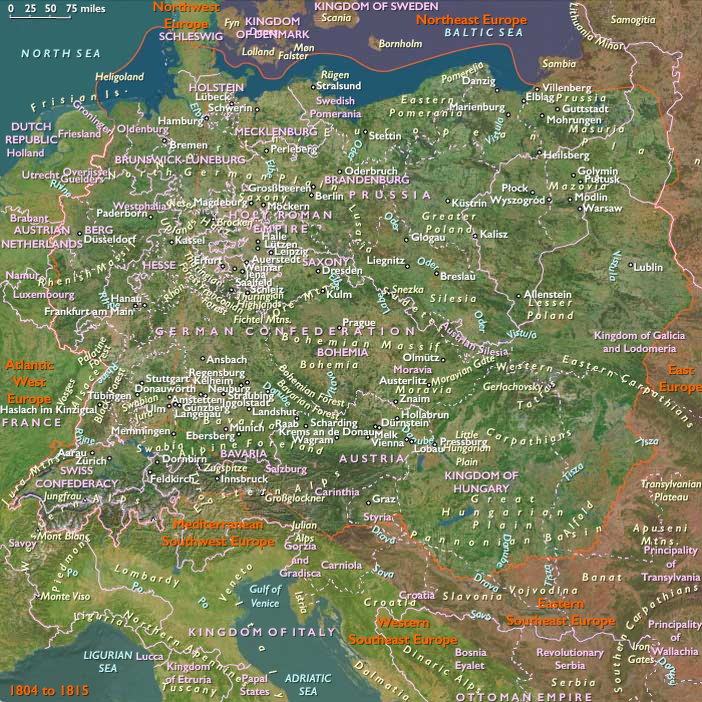
Central Europe
View →Subregions