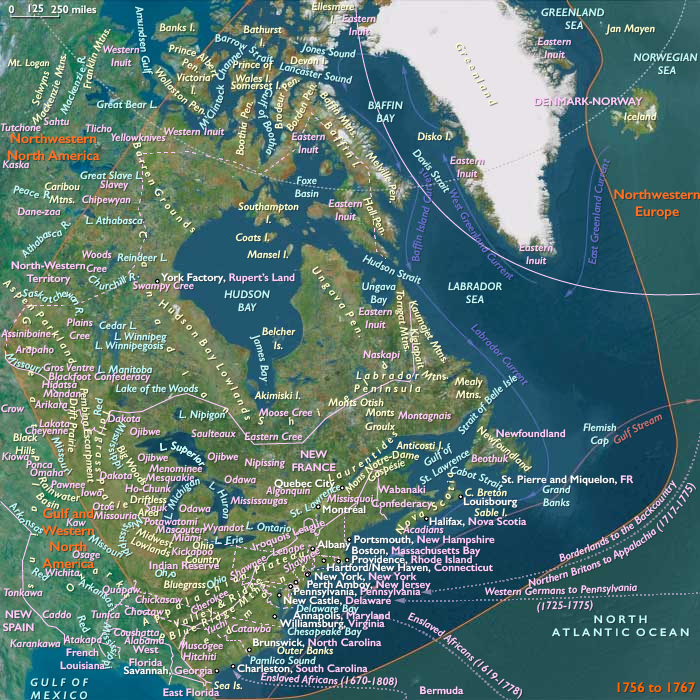
Pontiac and his allies plan a coordinated…
1763 CE
Neolin rejects the uprising, and calls for the tribes to lay down their arms, but Pontiac's War goes ahead, and proves to be one of the first in a series of Native American anti-colonial resistance movements marked by an inspirational combination of religious and political leadership.
The conflict is named after its most famous participant, the Ottawa leader Pontiac; variations include "Pontiac's War", "Pontiac's Rebellion", and "Pontiac's Uprising".
An early name for the war is the "Kiyasuta and Pontiac War", "Kiyasuta" being an alternate spelling for Guyasuta, an influential Seneca/Mingo leader.
The war will become widely known as "Pontiac's Conspiracy" after the publication in 1851 of Francis Parkman's The Conspiracy of Pontiac.
Parkman's influential book, the definitive account of the war for nearly a century, is still in print.
In the twentieth century, some historians will argue that Parkman exaggerates the extent of Pontiac's influence in the conflict and that it is misleading to name the war after Pontiac
For example, in 1988 Francis Jennings will write: "In Francis Parkman's murky mind the backwoods plots emanated from one savage genius, the Ottawa chief Pontiac, and thus they became 'The Conspiracy of Pontiac,' but Pontiac was only a local Ottawa war chief in a 'resistance' involving many tribes."
Alternate titles for the war have been proposed, but historians generally continue to refer to the war by the familiar names, with "Pontiac's War" probably the most commonly used. "Pontiac's Conspiracy" is now infrequently used by scholars.
Groups
Iroquois (Haudenosaunee, also known as the League of Peace and Power, Five Nations, or Six Nations)
View →
Wyandot, or Wendat, or Huron people (Amerind tribe)
View →
Miami (Amerind tribe)
View →
Lenape or Lenni-Lenape (later named Delaware Indians by Europeans)
View →
Ojibwa, or Ojibwe, aka or Chippewa (Amerind tribe)
View →
Odawa, or Ottawa, people (Amerind tribe)
View →
Seneca (Amerind tribe)
View →
Kickapoo people (Amerind tribe)
View →
Potawatomi (Amerind tribe)
View →
Wea (Amerind tribe)
View →
Piankeshaw (Amerind tribe)
View →
Mascouten (Amerind tribe)
View →
Shawnees, or Shawanos (Amerind tribe)
View →
Ohio Country
View →
Britain, Kingdom of Great
View →
Mingo (Seneca-Cayuga Tribe of Oklahoma)
View →
Topics
Commodities
Regions
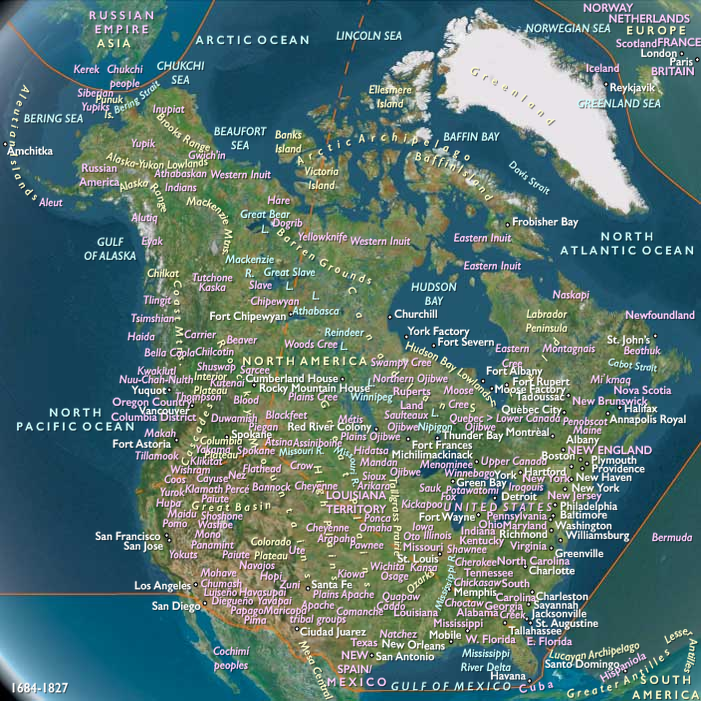
Northern North America
View →Subregions