
New kinds of abbeys in the Norman…
1135 CE
New kinds of abbeys in the Norman style, such as Rievaulx, begun around 1132, and Fountains, begun around 1135, are constructed in Yorkshire.
Regions
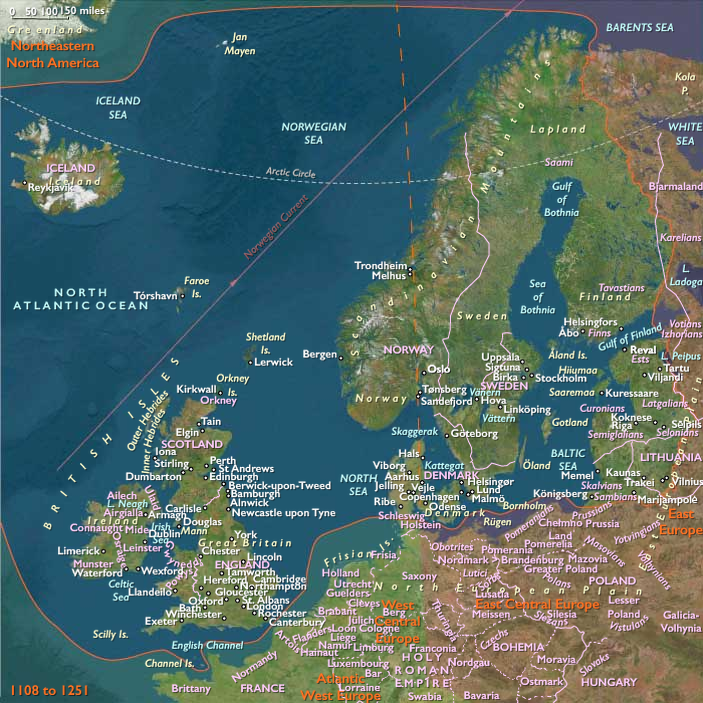
North Europe
View →Subregions
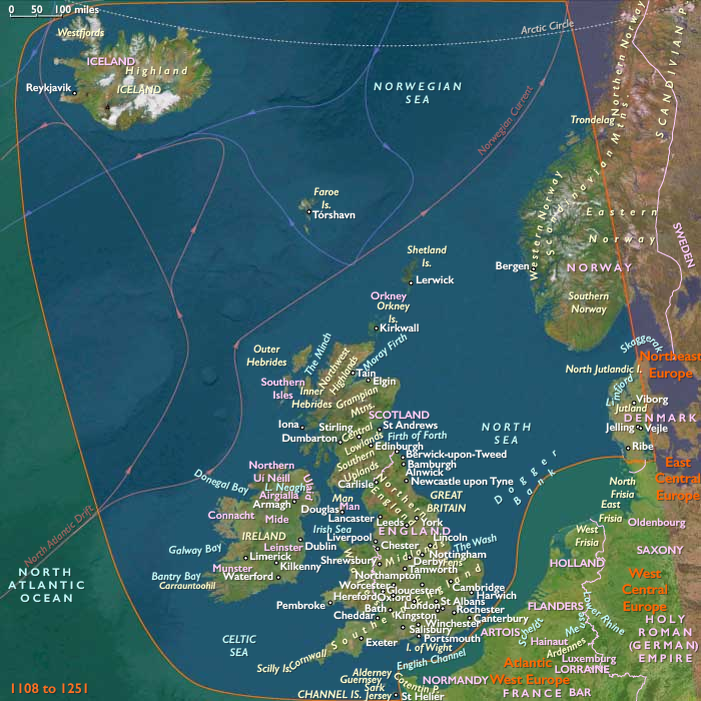
Northwest Europe
View →Related Events
Showing 10 events out of 14 total
Zulu king Shaka’s bloody wars of conquest cause victimized nations to migrate as far as present Zimbabwe and Tanzania, but he maintains cordial relations with the Cape government and Europeans in general.
At this time, King Shaka rules the territory with highly trained warriors.
Leaders of the Natal settlers request permission from Shaka to stay on the land.
When the king witnesses the settlers' technological advances, permission is granted in return for access to firearm technology.
The British begin to settle Natal in 1824.
Francis Farewell, formerly a lieutenant in the British navy, other merchants of Cape Town, had formed a company in 1823 to trade with the natives of the south-east coast.
In the brig Salisbury, commanded by James S. King, who had been a midshipman in the navy, Farewell had visited Port Natal, St Lucia and Delagoa Bays.
The voyage had not been successful as a trading venture, but Farewell had been so impressed with the possibilities of Natal both for trade and colonization that he resolved to establish himself at the port, and had gone on with ten companions, among them Henry Francis Fynn.
All the rest save Farewell and Fynn had speedily returned to the Cape, but the two who remained were joined by three sailors, John Cane, Henry Ogle and Thomas Holstead.
Farewell, Fynn and the others go to the royal kraal of Shaka, and, having cured him of a wound and made him various presents, obtain a document, dated August 7, 1824, ceding to "F. G. Farewell & Company entire and full possession in perpetuity" of a tract of land including "the port or harbour of Natal".
On the 27th of the same month, Farewell declares the territory he had acquired a British possession.
The modern city of Durban dates from 1824, when a party of twenty-five men under British Lieutenant F. G. Farewell arrived from the Cape Colony and established a settlement on the northern shore of the Bay of Natal, near today's Farewell Square.
Accompanying Farewell was an adventurer named Henry Francis Fynn, who had been able to befriend the Zulu King Shaka by helping him to recover from a stab wound he suffered in battle.
As a token of Shaka's gratitude, he had granted Fynn some territory.
During a meeting of thirty-five white residents in Fynn's territory on June 23, 1835, it is decided to build a capital town and name it "d'Urban" after Sir Benjamin d'Urban, governor of the Cape Colony.
The British, feeling that the Natalia Republic threatens their security and authority, annex it as Natal.
They do not want the Dutch speakers to have independent access to the sea and thereby be able to negotiate political and economic agreements with other European powers.
They also fear that harsh treatment meted out to Africans—such as Voortrekker attempts to clear the land by removing Africans from the Republic of Natalia—will eventually increase population pressures on the eastern Cape frontier.
Although acquiescing in the annexation, the great majority of the Voortrekkers effectively abandon Natal to the British and move back to the Highveld in 1843.
The British, having taken Natal for strategic purposes, now have to find a way to make the colony pay for its administration.
After experimenting with several crops, they find that sugar grows well and can be exported without deteriorating.
Attempts to force Africans to endure the onerous labor in the sugar fields will fail, however, and in 1860 the British will begin importing indentured laborers from India to provide the basic work force.
Between 1860 and 1866, six thousand Indians (one-quarter of them women) will be brought to the colony on five-year contracts.
The Voortrekker Republic of Natalia (the basis of later Natal Province) had been established in 1839, and by 1842 there are approximately six thousand people occupying vast areas of pastureland and living under a political system in which only white males have the right to vote.
Dick King, an English trader and colonist at Port Natalrides into a British military base in Grahamstown to warn that the Boers have besieged Durban.
He had left eleven days earlier, traveling a distance of nine hundred and sixty kilometers (six hundred miles) to arrive on June 4, 1842.
The British army dispatches a relief force.
Great Britain takes possession of Natal in 1843, prompting an Afrikaner exodus.
The colony's early population growth had been driven by settlement from the United Kingdom between 1849 and 1851, with approximately forty-five hundred emigrants between 1848 and 1851.
From the time of the coming of the first considerable body of British settlers dates the development of trade and agriculture in the colony, followed somewhat later by the exploitation of the mineral resources of the country.
At the same time schools have been established and various churches have begun or increased their work in the colony.
John Colenso, appointed bishop of Natal, had arrived in 1854.
In 1856 the dependence of the country on Cape Colony is put to an end and Natal constitutes a distinct colony with a legislative council of sixteen members, twelve elected by the inhabitants and four nominated by the Crown.
At this time the population of settlers and their descendants exceeds eight thousand.
While dependent on the Cape, ordinances had been passed establishing Roman-Dutch law as the law of Natal, and save where modified by legislation it will remain in force.
Disraeli's Tory administration in London does not want a war with the Zulus.
"The fact is," writes Sir Michael Hicks Beach, the colonial secretary in November 1878, "that matters in Eastern Europe and India... were so serious an aspect that we cannot have a Zulu war in addition to other greater and too possible troubles."
Sir Henry Bartle Frere, however, had been sent to the Cape Colony as governor and high commissioner in 1877 with the brief of creating a Confederation of South Africa from the various British colonies, Boer Republics and native states.
He concludes that the powerful Zulu kingdom stands in the way of this, and so is receptive to Sir Shepstone's arguments that King Cetshwayo and his Zulu army pose a challenge to the colonial powers’ peaceful occupation of the region.