The Prince, Niccolò Machiavelli’s controversial work written…
1532 CE
The Prince, Niccolò Machiavelli’s controversial work written in 1513, is posthumously published in 1532, five years after his death.
This is done with the permission of the Medici pope Clement VII.
It is generally agreed that it was especially innovative, although it was written as if it were a traditional work in the mirrors for princes' style.
This is only partly because it was written in the vernacular Italian rather than Latin, a practice which had become increasingly popular since the publication of Dante's Divine Comedy and other works of Renaissance literature.
The Prince is sometimes claimed to be one of the first works of modern philosophy, especially modern political philosophy, in which the effective truth is taken to be more important than any abstract ideal.
It is also in direct conflict with the dominant Catholic and scholastic doctrines of the time concerning how to consider politics and ethics.
Although it is relatively short, the treatise is the most remembered of Machiavelli's works and the one most responsible for bringing the word "Machiavellian" into usage as a pejorative.
It also helps make "Old Nick" an English term for the devil, and even contributes to the modern negative connotations of the words "politics" and "politician" in western countries.
In terms of subject matter it overlaps with the much longer Discourses on Livy, which was written a few years later.
In its use of near-contemporary Italians as examples of people who perpetrated criminal deeds for politics, another lesser-known work by Machiavelli which The Prince has been compared to is the Life of Castruccio Castracani.
The descriptions within The Prince have the general theme of accepting that the aims of princes—such as glory and survival—can justify the use of immoral means to achieve those ends.
Unique among political works of the period in examining the real, rather than the ideal, bases of a sovereign's power, The Prince, although partly based on Machiavelli’s reading of classical historians, is the first European work to deal openly with the use of force in the state and to claim that the pursuit of stable government condones amoral actions.
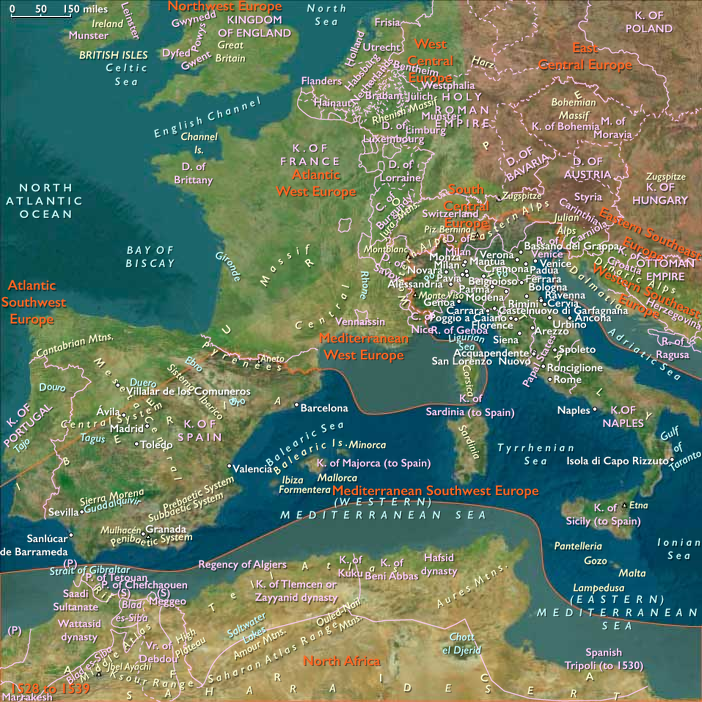
At the book’s conclusion, Machiavelli issues an impassioned call for Italian unity and an end to foreign intervention.
Locations
People
Groups
Regions

Southwest Europe
View →Subregions