North Africa (7,821 – 6,094 BCE) Early…
7821 BCE to 6094 BCE
North Africa (7,821 – 6,094 BCE) Early Holocene — Green Sahara, Capsian Flourishing, and Inland Lakes
Geographic and Environmental Context
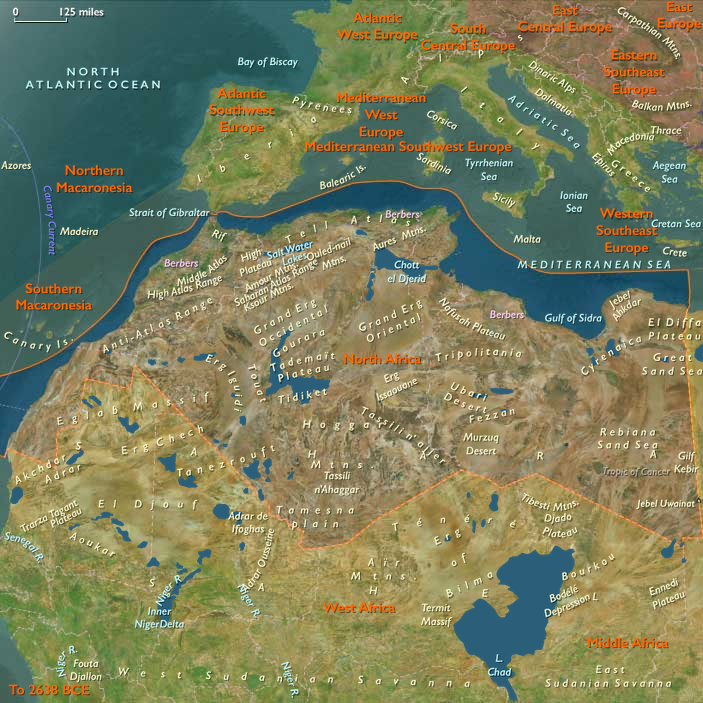
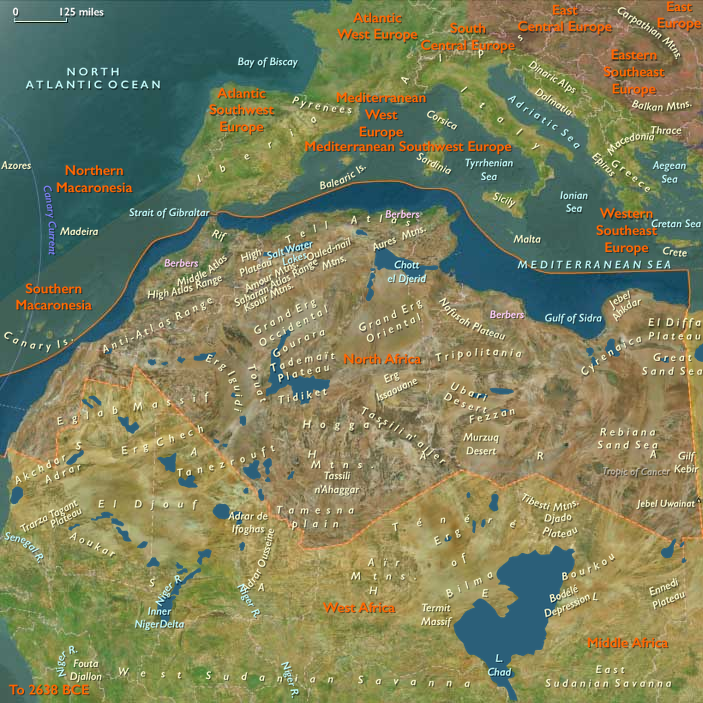
North Africa includes Morocco, Algeria, Tunisia (Ifriqiya), Libya (Tripolitania–Fezzan–Cyrenaica), and Western Sahara.Anchors: the Atlas ranges (High/Middle/Anti-Atlas; Tell Atlas; Aurès), the Tell and Sahel coasts (Atlantic Morocco, Rif/Alboran, Kabylia, Ifriqiya, Syrte/Gulf of Sidra, Cyrenaica), the Saharan platforms and sand seas (Erg Chech, Grand Erg Occidental & Oriental, Tanezrouft), the oases and basins (Tafilalt, Draâ, Touat–Gourara–Tidikelt, M’zab, Wadi Igharghar, Fezzan (Wadi al-Ajyal, Ubari and Murzuq dunes)), and the trans-Saharan corridors toward Lake Chad, Niger Bend, and the Nile.
-
Onset of the African Humid Period: savanna–woodland belts penetrated deep into the central Sahara; playa–paleolake complexes spread (e.g., Tadrart Acacus, Messak, Fezzan basins).
-
Tell and Sahel coasts saw estuaries and wetlands flourish.
Climate & Environmental Shifts
-
Warm, wet monsoons migrated north; dune activity slackened; artesian springs revived across Saharan basins.
Subsistence & Settlement
-
Capsian foragers (c. 10–6 ka BP) proliferated in Algeria–Tunisia: intensive small-game hunting, plant processing, and shellfish collection; cemeteries expanded.
-
Inland lake-shore camps in Fezzan and central Sahara harvested fish, waterfowl, and wetland resources; savanna game included gazelle, hartebeest, giraffe, hippo.
Technology & Material Culture
-
Microlithic toolkits with geometric forms; widespread grindstones and mortars; early pottery appears in Saharan wetland belts by the 9th–8th millennia BCE.
-
Bone harpoons, fishing nets; basketry inferred.
Movement & Interaction Corridors
-
Savanna corridors crisscrossed the Sahara, reconnecting basins; Tell coast–Atlas passes moved shells, pigments, and exotics inland.
Cultural & Symbolic Expressions
-
Rock art in Tassili n’Ajjer and Acacus (wild fauna) proliferated; Capsian cemeteries with personal ornaments; ritual hearths and feasting.
Environmental Adaptation & Resilience
-
Aquatic–savanna economies produced reliable calories; storage pits and fish smoking sustained semi-sedentism.
Transition
By 6,094 BCE, North Africa’s peoples were semi-sedentary fisher–foragers with pottery and intensive plant processing in a Green Sahara.
Topics
Commodities
Subjects
Regions
North Africa
View →Subregions