
North Africa (244–387 CE) Imperial Challenges, …
Years: 244 - 387
North Africa (244–387 CE)
Imperial Challenges, Economic Stability, and Cultural Resilience
Imperial Crises and Regional Adaptation (244–292 CE)
Between 244 and 303 CE, North Africa navigates significant challenges due to the broader Roman Crisis of the Third Century. Despite administrative disruptions, the region maintains coherence, supported by resilient urban centers and infrastructure investments. Notable uprisings occur, including the unsuccessful landowner rebellion of 238 CE against imperial fiscal policies, and sporadic tribal revolts in the Mauretanian mountains from 253 to 288 CE. Economic difficulties affect urban areas, slowing building activities.
Roman military units maintain vigilant frontier defense, countering persistent threats from Berber incursions and Saharan nomadic groups. Economic resilience persists through sustained production of grain and olive oil, commodities vital to the Roman economy. Prominent trade cities such as Utica, Leptis Magna, and Caesarea (Cherchell) sustain active Mediterranean trade networks.
Jewish communities, descended from Punic settlers and deported populations from Palestine following revolts against Roman rule, represent a significant urban presence. Several Berber tribes also embrace Judaism. Christianity, introduced in the second century, rapidly expands among urban populations and slaves. By 256 CE, over eighty bishops, including some from distant Numidian frontier regions, participate in the Council of Carthage.
Diocletian's Administrative Reforms and Africa Byzacena (293–327)
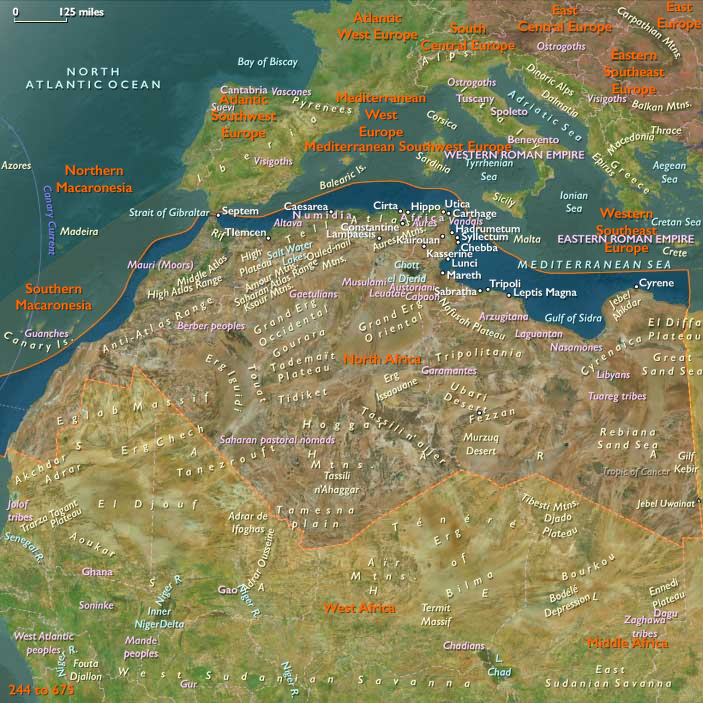
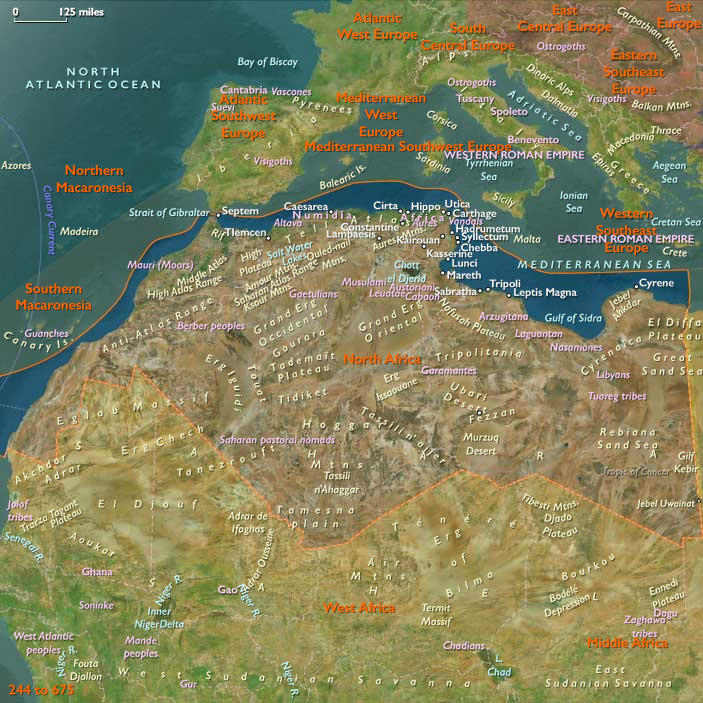
At the end of the third century CE, the Roman Emperor Diocletian reorganizes the great Roman province of Africa Proconsularis into three smaller, more manageable provinces. The northernmost province, Zeugitana, remains under a proconsul, still commonly referred to as Proconsularis. Directly to its south, the province of Byzacena is created, roughly corresponding to the modern Tunisian region of the Sahel, with its capital established at Hadrumetum (modern Sousse). Further to the southeast lies Tripolitania, corresponding approximately to modern southeastern Tunisia and northwestern Libya.
Byzacena quickly emerges as a major economic and administrative center. Renowned for its olive oil production and vibrant trade networks, it rapidly becomes one of the wealthiest and most strategically vital provinces of Roman Africa. Hadrumetum, the provincial capital, rises to prominence not only as an economic hub but also as an ecclesiastical center. By the late third century, the Metropolitan Archbishopric of Byzacena ranks as the most significant Christian community in Roman North Africa after Carthage, playing a critical role in shaping regional religious and cultural developments.
Under Diocletian and later Constantine the Great, North Africa benefits from significant administrative reforms that enhance stability and economic prosperity. Improved governance structures and reinforced defenses ensure security and sustained agricultural productivity.
Numidia and Mauretania experience infrastructure improvements that promote economic integration and social stability. Under Emperor Diocletian at the close of the third century CE, the extensive Roman territory known as Mauretania undergoes significant administrative reorganization. Initially, the region is divided into two provinces: Mauretania Caesariensis, with its capital at Caesarea (modern Cherchell), and Mauretania Tingitana, centered on Tingis (modern Tangier). This division reflects Rome's intent to improve administrative control, frontier defense, and economic management along the extensive North African coast and its hinterlands.
Further subdivision occurs under Emperor Constantine the Great around 314 CE, when a third province, Mauretania Sitifensis, is carved out of the eastern regions of Mauretania Caesariensis. This new province, with its capital at Sitifis (modern Sétif), serves to enhance administrative oversight and frontier security, particularly against persistent incursions by Berber tribes from the adjacent mountainous areas.
The establishment of these provinces—Mauretania Caesariensis, Mauretania Tingitana, and Mauretania Sitifensis—strengthens Roman control and fosters regional economic growth, laying a stable administrative foundation that would persist through the late Roman period and significantly influence the political and cultural landscape of North Africa.
Cyrenaica and Tripolitania thrive, sustaining robust trade networks, intellectual pursuits, and cultural preservation, particularly in cities like Cyrene and Leptis Magna.
Christian communities endure the Great Persecution (303 CE), demonstrating remarkable resilience and strengthening social cohesion. A significant schism within the Christian church, known as Donatism, arises in 313 CE. Donatists emphasize church purity, reject sacramental authority from those who complied with Diocletian’s anti-Christian measures, and oppose Constantine’s involvement in church affairs.
Sustained Stability and Cultural Flourishing (328–363 CE)
Between 328 and 363 CE, North Africa maintains stability amid imperial transitions following Constantine’s death. Effective governance, continuous economic productivity, and vigilant defenses ensure regional coherence.
The region remains economically robust, especially in grain and olive oil production. Urban centers continue to flourish. By the late fourth century, most settled regions are predominantly Christian, and several Berber tribes convert en masse.
Persistent cultural syncretism continues among diverse communities, integrating indigenous Berber traditions with Roman, Greek, Phoenician, and Saharan influences, reinforcing cultural vibrancy and adaptability.
Imperial Challenges and Persistent Resilience (364–387 CE)
From 364 to 387 CE, North Africa encounters increased imperial instability, notably after the Battle of Adrianople (378 CE). Nevertheless, the region exhibits considerable resilience, bolstered by stable governance structures, effective military vigilance, and sustained economic prosperity.
Numidia and Mauretania continue stable economic and social integration, while Cyrenaica and Tripolitania maintain intellectual vibrancy and prosperous trade links. The Garamantes and pastoral communities such as the Mauri remain essential in trans-Saharan trade.
Christianity maintains a robust role, adapting to changing dynamics and reinforcing regional cohesion. Jewish populations continue thriving, significantly contributing to the region’s cultural diversity.
Overall Regional Resilience and Strategic Importance
By 387 CE, North Africa demonstrates impressive stability, successfully navigating complex imperial dynamics. Sustained economic productivity, vigilant defense strategies, vibrant urban centers, and dynamic cultural interactions underline its enduring strategic significance within the Roman Empire.
People
Groups
- Polytheism (“paganism”)
- Berber people (also called Amazigh people or Imazighen, "free men", singular Amazigh)
- Numidians
- Garamantes
- Jews
- Tripolitania (Roman province)
- Africa proconsularis (Roman province)
- Crete and Cyrenaica (Roman province)
- Mauretania Caesariensis (Roman province)
- Mauretania Tingitana (Roman province)
- Roman Empire (Rome): Non-dynastic
- Roman Empire: Tetrarchy
- Africa Byzacena (Roman province)
- Donatism
- Mauretania Sitifensis (Roman province)
- Roman Empire: Constantinian dynasty (Nicomedia)
- Christianity, Nicene
- Roman Empire: Constantinian dynasty (Constantinople)
- Roman Empire: Valentinian dynasty (Rome)
- Roman Empire: Theodosian dynasty (Constantinople)
Topics
- Crisis of the Third Century (Roman Civil “War” of 235-84)
- Diocletianic Persecution
- Adrianople, Battle of
Commodoties
- Fish and game
- Gem materials
- Grains and produce
- Fibers
- Textiles
- Ceramics
- Strategic metals
- Salt
- Slaves
- Beer, wine, and spirits
Subjects
- Commerce
- Architecture
- Sculpture
- Conflict
- Mayhem
- Faith
- Government
- Scholarship
- Custom and Law
- Metallurgy
- Theology
- Philosophy and logic
Regions
Subregions
Related Events
Showing 10 events out of 60511 total
Years: 244 - 387
People
Groups
- Polytheism (“paganism”)
- Berber people (also called Amazigh people or Imazighen, "free men", singular Amazigh)
- Numidians
- Garamantes
- Jews
- Tripolitania (Roman province)
- Africa proconsularis (Roman province)
- Crete and Cyrenaica (Roman province)
- Mauretania Caesariensis (Roman province)
- Mauretania Tingitana (Roman province)
- Roman Empire (Rome): Non-dynastic
- Roman Empire: Tetrarchy
- Africa Byzacena (Roman province)
- Donatism
- Mauretania Sitifensis (Roman province)
- Roman Empire: Constantinian dynasty (Nicomedia)
- Christianity, Nicene
- Roman Empire: Constantinian dynasty (Constantinople)
- Roman Empire: Valentinian dynasty (Rome)
- Roman Empire: Theodosian dynasty (Constantinople)
Topics
- Crisis of the Third Century (Roman Civil “War” of 235-84)
- Diocletianic Persecution
- Adrianople, Battle of
Commodoties
- Fish and game
- Gem materials
- Grains and produce
- Fibers
- Textiles
- Ceramics
- Strategic metals
- Salt
- Slaves
- Beer, wine, and spirits
Subjects
- Commerce
- Architecture
- Sculpture
- Conflict
- Mayhem
- Faith
- Government
- Scholarship
- Custom and Law
- Metallurgy
- Theology
- Philosophy and logic
Regions
Subregions