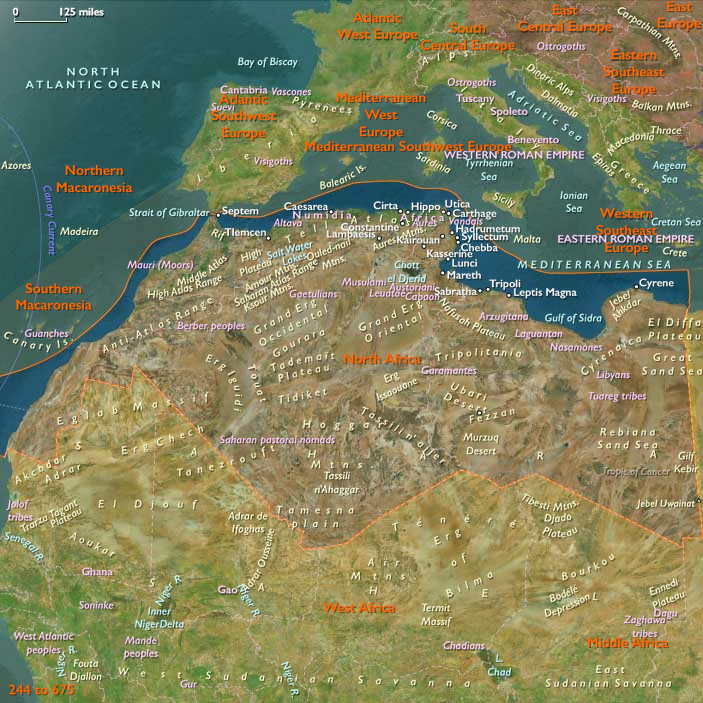
North Africa (496–507 CE) Dynastic Stabilization, Religious…
496 CE to 507 CE
North Africa (496–507 CE)
Dynastic Stabilization, Religious Moderation, and Cultural Adaptation
Between 496 and 507 CE, North Africa experiences a period of cautious stabilization within the Vandal Kingdom, characterized by moderated religious policies, relative dynastic continuity, and persistent frontier tensions.
In 496 CE, King Gunthamund dies and is succeeded by Thrasamund, marking a relatively smooth dynastic transition compared to earlier periods. Under Thrasamund’s rule, the kingdom seeks a pragmatic middle path between strict religious enforcement and internal stability. Thrasamund maintains the dominance of Arian Christianity but notably adopts a less aggressively persecutory stance toward the orthodox majority. Rather than overt coercion, he employs diplomatic methods to promote Arianism, engaging orthodox bishops in theological debates and reducing direct physical persecution. While still limited in freedoms, orthodox communities cautiously emerge from underground worship, experiencing slight relief and cautiously rebuilding their social influence.
Many Vandals under Thrasamund’s rule significantly adopt elements of Roman culture, embracing the administrative structures, language, urban lifestyles, and social customs of their Roman predecessors. Despite this substantial cultural adaptation, the Vandals retain their distinctive Germanic identity, ensuring their cohesion and distinction from the local Romanized populations.
The kingdom’s economy remains anchored in its well-developed Mediterranean commercial network, centered on Carthage. Agriculture, particularly grain and olive oil exports, continues to flourish despite political and religious uncertainty, supporting urban prosperity in major coastal cities such as Leptis Magna and Caesarea (Cherchell). Vandal administration, while centralized, increasingly depends on collaboration with remaining Roman-influenced elites, reflecting pragmatic governance strategies to maintain regional stability.
Culturally, this era sees an uneasy but functional coexistence among Roman, Vandal, and indigenous Berber traditions. Roman culture and orthodox Christian practices remain influential, subtly persisting alongside dominant Vandal Arian customs. Urban populations particularly reflect this cultural hybridity, demonstrating resilience despite prolonged periods of political and religious disruption.
The kingdom's periphery continues to face significant instability, with autonomous Berber tribes persistently asserting independence. Despite repeated Vandal military efforts to reinforce authority, Berber groups retain effective control over many interior regions, frequently disrupting frontier security, agricultural activities, and trade routes. Thrasamund’s attempts to pacify or ally with certain Berber tribes achieve limited success, as tribal autonomy remains robust.
By the end of 507 CE, North Africa is cautiously stable yet marked by ongoing challenges. Vandal rule, though more moderate and diplomatically managed under Thrasamund, remains contested internally and externally. Economic prosperity persists, but persistent frontier conflicts, complex religious dynamics, and the nuanced cultural adaptations of the Vandals ensure the region remains politically fragile and poised for further instability.
Groups
Subjects
Regions
North Africa
View →Subregions