North Africa (513–502 BCE) Carthaginian Consolidation, Cyrene’s…
513 BCE to 502 BCE
North Africa (513–502 BCE)
Carthaginian Consolidation, Cyrene’s Resurgence, and Cultural Vibrancy
Continued Carthaginian Maritime Expansion
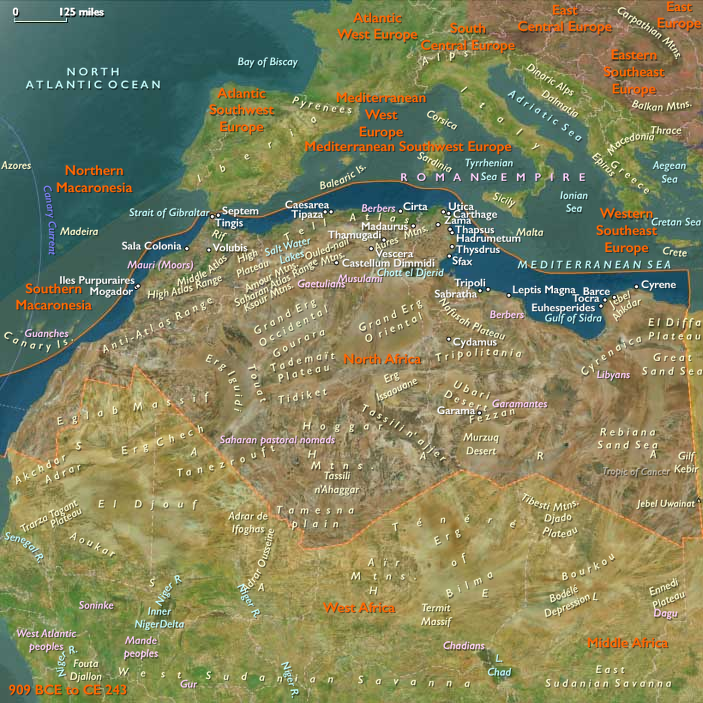
Between 513 and 502 BCE, Carthage, nominally under Tyrean control but increasingly independent, continues its maritime and economic expansion across the Western Mediterranean. The city intensifies strategic colonization in western Sicily, Sardinia, the Balearics, Iberia, and parts of North Africa, significantly enhancing its geopolitical reach. Carthage’s robust naval fleet secures extensive trade networks, reinforcing the city's status as a dominant economic power. Judahite settlers constitute a significant proportion of the population, highlighting the city's multicultural character.
Strategic Diplomacy and Treaties
Carthage actively engages in diplomacy, notably concluding treaties with several regional powers. In 509 BCE, Carthage signs a significant treaty with the nascent Roman Republic, marking a crucial division of commercial interests and spheres of influence. This agreement notably confirms Carthaginian dominance over Sicily, Sardinia, Emporia, and regions south of Cape Bon in Africa. Rome, at this point a relatively minor player, likely attracts Carthage’s diplomatic attention due to its existing treaties with Phocaeans and Cumae, who aid Rome in its struggle against the Etruscans. Carthage also holds similar treaties with Etruscan, Punic, and Greek cities across Sicily.
Additionally, Carthage demonstrates its military capability by successfully thwarting a colonization attempt near Leptis Magna in Libya led by the Spartan prince Dorieus, who is subsequently defeated and killed around 510 BCE at Eryx in western Sicily during another colonization effort.
Cyrene’s Economic and Cultural Resurgence
Following its brief Persian subjugation, Cyrene swiftly recovers, resuming its prosperity anchored in exports of grain, fruit, horses, and particularly the valuable medicinal plant Silphium. Wealth accumulation facilitates substantial temple-building projects, underscoring the city's economic strength and cultural vitality.
Cyrene reinforces its connections with daughter cities—Barce (al-Marj), Taucheira (Tukrah), and Euhesperides (Benghazi)—forming the Pentapolis. These independent yet interconnected cities significantly enhance regional prosperity, maintaining careful diplomatic interactions amid competitive tensions concerning trade and regional influence.
Berber Economic Integration and Cultural Adaptation
Coastal Berber populations continue deepening their integration within Carthaginian commerce networks, extensively adopting Phoenician agricultural techniques, maritime expertise, and artisanal innovations. This economic interdependence promotes prosperity while enabling coastal Berber groups to maintain their cultural identities.
Inland Berber communities sustain autonomy, preserving traditional societal structures and cultural practices. Their indirect economic interactions with coastal trade centers facilitate ongoing regional stability without compromising their cultural distinctiveness.
Enhanced Cultural Exchange and Syncretism
The era sees intensified cultural exchanges among Berber, Carthaginian, and Greek communities, creating a dynamic cultural tapestry. Artisanal crafts, notably pottery, textiles, and metalwork, exhibit increased sophistication and cultural hybridization. Religious syncretism flourishes, integrating indigenous Berber beliefs with Phoenician and Greek traditions, enriching regional cultural complexity.
Foundation for Sustained Influence
By 502 BCE, North Africa demonstrates sustained economic prosperity and stable regional dynamics, underpinned by Carthage's maritime dominance and Cyrene's economic resurgence. Diplomatic balance between these powers, strategic treaties, and integrated Berber communities ensure enduring stability and growth. These developments lay a robust foundation for North Africa’s continued geopolitical prominence and cultural flourishing within the broader Mediterranean context.
People
Groups
Regions
North Africa
View →Subregions