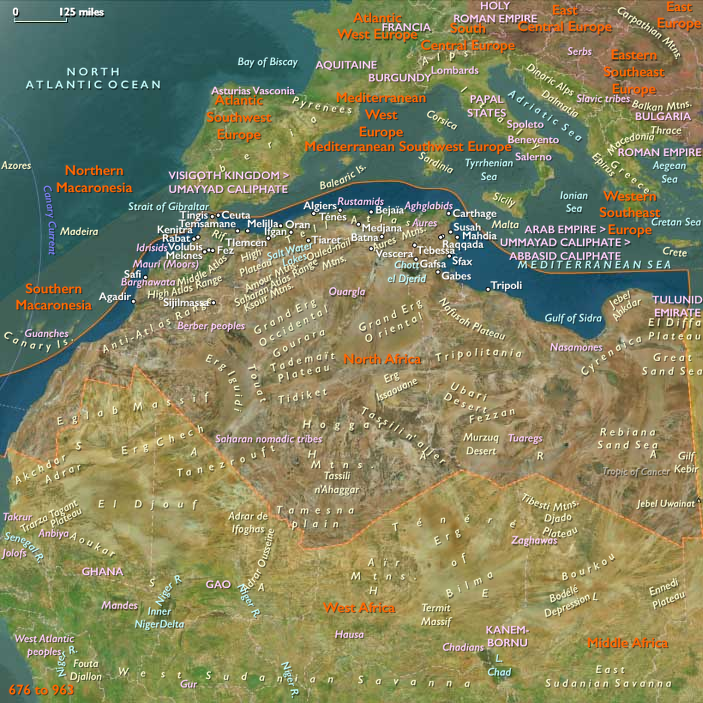
Atlantic Southwest Europe (736–747 CE): Asturian Expansion, Islamic Pressures, and Regional Identity
Between 736 and 747 CE, Atlantic Southwest Europe—covering Galicia, northern and central Portugal, Asturias, Cantabria, and northern Spain south of the Franco-Spanish border (43.05548° N, 1.22924° W)—further stabilized under the early rulers of the Kingdom of Asturias. The region solidified its role as the primary center of Iberian Christian resistance against Islamic rule, reinforcing political organization, strengthening regional economies, and fortifying a distinct cultural identity. Yet the kingdom continued to face periodic military pressure from al-Andalus, testing the resilience of these emerging structures.
Political and Military Developments
Asturian Expansion under Alfonso I
After the brief reign of King Favila (737–739 CE), who maintained continuity but achieved little expansion, the Asturian kingdom experienced significant growth under King Alfonso I (739–757 CE). Alfonso, a capable military leader, expanded Asturian territories significantly, pushing southward into Galicia, northern Portugal, and territories bordering the Cantabrian Mountains. His policy of depopulating border regions—creating a strategic defensive "Desert of the Duero"—limited Islamic incursions and provided a defensible buffer zone.
Continuing Regional Resistance
Galician and northern Lusitanian aristocrats supported Asturian military efforts, effectively maintaining regional autonomy while acknowledging Alfonso’s authority. Frequent skirmishes with Islamic forces continued, but the mountainous terrain and fortified settlements provided considerable defensive advantage, allowing Asturias to firmly entrench itself as the leading Christian political power in the Iberian Peninsula.
Economic Developments
Economic Stabilization and Regional Autonomy
The consolidation of Asturian territories facilitated economic stabilization. Rural villa-based economies recovered steadily, supporting agriculture (grain, olives, vineyards), livestock husbandry, artisanal crafts, and mining activities, particularly gold and silver extraction in Galicia and Asturias. The security provided by the Asturian military presence encouraged increased local production and trade.
Localized Maritime Trade and Economic Networks
Coastal settlements such as Bracara Augusta (Braga) and smaller port towns in Galicia and northern Portugal sustained modest maritime commerce. Although trade remained largely localized, the ongoing exchange of goods provided essential economic continuity and reinforced regional prosperity.
Cultural and Religious Developments
Ecclesiastical Influence and Organization
Influential bishoprics—Braga, Lugo, Asturica Augusta, and Iria Flavia—further reinforced their civic leadership roles. Bishops provided essential administrative oversight, social cohesion, and moral leadership, deeply embedding Christian orthodoxy into regional governance.
Monastic Expansion and Cultural Preservation
Monastic communities continued expanding, becoming prominent cultural, educational, and economic centers. They preserved manuscripts, sustained literacy and scholarship, promoted agricultural improvements, and served as essential repositories of regional historical memory and identity.
Persistence of Cultural Syncretism
In rural Galicia, Asturias, and northern Portugal, the enduring blend of orthodox Christianity and indigenous Celtic and Iberian traditions remained vibrant. These cultural traditions reinforced distinctive regional identities and provided important unity amidst political and military challenges.
Civic Identity and Governance
Strengthening of Regional Governance Structures
King Alfonso I’s successful territorial expansion and defensive strategies began transforming local aristocratic autonomy into more coherent royal administrative structures. While significant regional autonomy persisted, the Asturian kingdom increasingly resembled a centralized medieval polity, with civic identities shaped by loyalty to the Asturian royal house and emerging ecclesiastical institutions.
Notable Tribal Groups and Settlements
-
Astures and Cantabri: Formed the military and political backbone of Asturian expansion and defensive strategy, strongly defining regional identity and cohesion.
-
Galicians and Lusitanians: Continued their effective local governance and economic resilience, pragmatically supporting Asturian leadership while preserving significant autonomy.
-
Vascones: Maintained their traditional neutrality, territorial independence, and cultural distinctiveness, largely unaffected by broader Iberian conflicts.
Long-Term Significance and Legacy
Between 736 and 747 CE, Atlantic Southwest Europe:
-
Experienced substantial territorial expansion under the Asturian kingdom, reinforcing Christian resistance against Islamic Iberia and creating defensive boundaries that endured for generations.
-
Solidified regional economic stability, resilient governance structures, and enduring ecclesiastical leadership, significantly shaping medieval Iberian politics and society.
-
Maintained distinctive regional cultural identities, providing a robust foundation for subsequent historical and cultural developments across northern Iberia.
This era represented a significant phase in the Asturian kingdom's early growth, decisively influencing the enduring trajectory of Atlantic Southwest Europe throughout the medieval period.