Event
North Africa (909–478 BCE) Archaic Antiquity: Phoenician…
North Africa (909–478 BCE)
Archaic Antiquity: Phoenician Expansion, Cyrenaic Settlement, and the Formation of North Africa's Maritime Landscapes
Geographic and Environmental Context
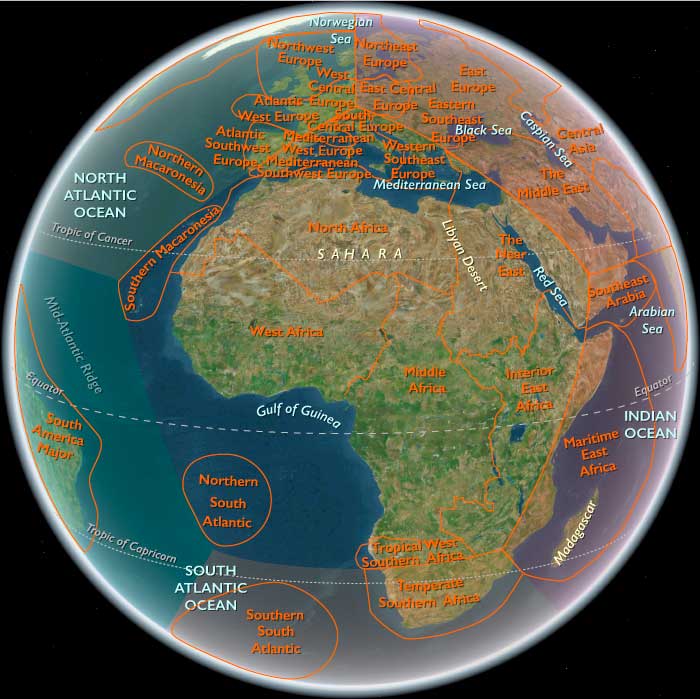
North Africa comprises Morocco, Algeria, Tunisia, Libya, and Western Sahara. Throughout Archaic Antiquity, its history was shaped by four enduring environmental systems: the Mediterranean and Atlantic littorals; the Rif, Tell Atlas, High Atlas, Middle Atlas, Anti-Atlas, Kabylia, and Aurès uplands; the semi-arid steppes lying south of the mountains; and the oasis networks of the northern and central Sahara.
The Mediterranean coast supported fertile plains suitable for grain, olives, vines, orchards, and fishing. The Atlas ranges and adjoining plateaus combined mixed agriculture with seasonal pastoralism and woodland management. South of the mountains, extensive steppe landscapes linked cultivated districts to the desert margins through mobile herding. Beyond them, oasis systems centered on regions such as Tafilalt, Touat, Gourara, Tidikelt, M'zab, and Fezzan transformed scarce groundwater into productive agricultural landscapes connected by long-established desert routes.
These complementary environments created a resilient regional economy long before any single political power dominated the Maghreb.
The Expansion of Mediterranean Exchange
During the ninth through sixth centuries BCE, Phoenician merchants progressively expanded maritime exchange throughout the western Mediterranean. Existing coastal anchorages developed into increasingly permanent trading communities at locations including Utica, Lixus, Mogador, and eventually Carthage. These settlements formed part of a wider commercial network linking North Africa with the Levant, Sicily, Sardinia, Iberia, and the Atlantic coast.
The traditional foundation date of Carthage in 814 BCE became central to later Punic identity, although archaeological evidence indicates that its urban development occurred gradually during the eighth century BCE. By the close of the period, Carthage had become the leading Phoenician center in the western Mediterranean, coordinating maritime commerce through negotiated alliances, agricultural production, and expanding coastal infrastructure rather than extensive territorial conquest.
In eastern North Africa, the Greek foundation of Cyrene around 631 BCE established a second major maritime frontier. Together with neighboring settlements that would later form the Pentapolis, Cyrene prospered within the fertile uplands of the Jebel Akhdar, exporting grain, horses, wine, and the highly prized silphium plant while maintaining close relationships with surrounding Amazigh communities.
Amazigh Landscapes and Regional Organization
Throughout the period, Amazigh-speaking communities remained the principal inhabitants of North Africa. Political authority rested primarily with villages, clans, tribal groups, and regional confederations whose organization reflected local environmental conditions rather than centralized kingdoms.
Mountain communities combined cultivation with seasonal livestock movement, while pastoral groups used the steppe as a corridor linking uplands and cultivated plains. Coastal populations increasingly participated in Mediterranean commerce without abandoning long-established agricultural traditions. The resulting pattern was one of gradual regional differentiation rather than political unification.
By the end of Archaic Antiquity, influential local leaders and confederations had begun laying the foundations for the later kingdoms of Numidia and Mauretania, although these states had not yet fully emerged.
Fezzan and the Early Oasis Networks
Across the central Sahara, oasis communities developed increasingly sophisticated systems of water management based upon wells, springs, and early underground irrigation. In Fezzan, the communities that would later form the Garamantian kingdom expanded permanent agriculture while strengthening exchange between the Mediterranean, neighboring Saharan populations, and regions farther south.
These routes did not yet constitute the large-scale trans-Saharan commerce of the medieval period, but they established enduring patterns of oasis settlement, caravan movement, and environmental adaptation that would shape Saharan history for centuries.
Religion and Cultural Landscapes
Religious life reflected North Africa's environmental diversity. Amazigh communities maintained sacred landscapes centered on mountains, springs, caves, ancestral burial grounds, and locally revered natural places. Phoenician settlers introduced the worship of deities such as Melqart, Baal Hammon, Tanit, and Astarte, while Greek colonists established temples and civic sanctuaries in Cyrenaica.
Rather than replacing indigenous traditions, these religious systems developed alongside them, producing a culturally varied landscape in which commerce, diplomacy, and migration encouraged interaction without cultural uniformity.
Legacy of the Period
By 478 BCE, North Africa had become one of the Mediterranean world's great environmental crossroads. Carthage had emerged as the leading Punic maritime center, Cyrenaica had established a prosperous Greek agricultural frontier, Amazigh communities continued to organize the Atlas, steppe, and coastal landscapes, and the oasis societies of Fezzan had begun to transform the Sahara into a connected world of engineered settlements and caravan routes. The environmental systems established during this period would endure throughout every subsequent political transformation, providing the durable framework upon which Punic, Numidian, Roman, Byzantine, and Islamic North Africa would all be built.
-
{# Image navigates to the detail page; the magnifying-glass chip is the only Fancybox lightbox trigger (kept a separate sibling — anchors can't nest). #}
 The Middle of The Earth
World
-
{# Image navigates to the detail page; the magnifying-glass chip is the only Fancybox lightbox trigger (kept a separate sibling — anchors can't nest). #}
 North Africa
Region
-
{# Image navigates to the detail page; the magnifying-glass chip is the only Fancybox lightbox trigger (kept a separate sibling — anchors can't nest). #}
 North Africa
Subregion