North Polynesia (1252–1395 CE): Chiefly Consolidation and…
1252 CE to 1395 CE
North Polynesia (1252–1395 CE): Chiefly Consolidation and Ridge-to-Reef Governance
Geographic Parameters
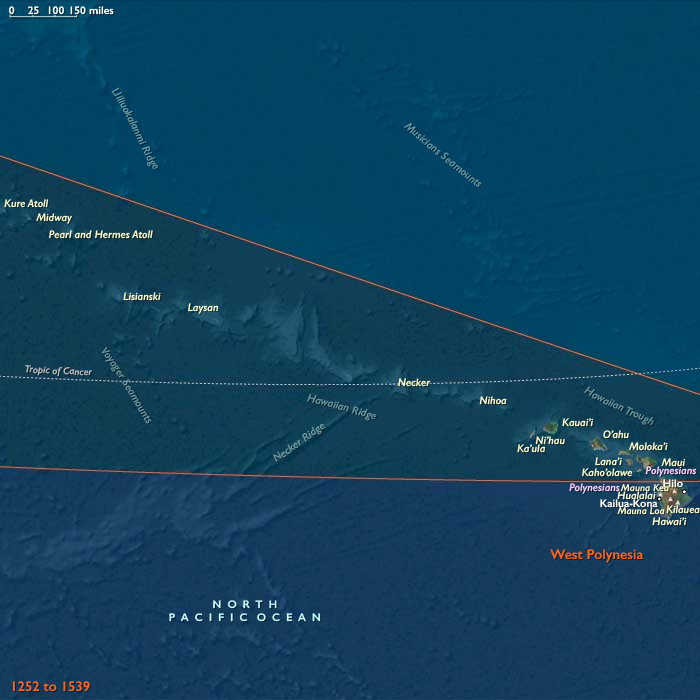
North Polynesia comprised Kauaʻi, Niʻihau, Oʻahu, Molokaʻi, Lānaʻi, Kahoʻolawe, Maui, and the Northwestern Hawaiian Islands extending through Nihoa, Mokumanamana, French Frigate Shoals, Laysan, Lisianski, Pearl and Hermes Atoll, Midway, and Kure. Hawaiʻi Island remained part of the adjoining West Polynesian subregion while participating in the broader Hawaiian cultural and political sphere.
The archipelago continued to consist of ecologically complementary landscapes. High volcanic interiors captured trade-wind rainfall, sustaining perennial streams that descended into fertile valleys before reaching reefs, estuaries, and protected embayments. Dry leeward plains supported productive field systems adapted to limited rainfall, while extensive upland forests continued to regulate watershed health and provide essential timber, fiber, birds, and other resources.
Environmental Continuity
The ecological relationships that had matured during previous centuries remained the foundation of Hawaiian society. Forests, streams, irrigated valleys, dryland fields, wetlands, fishponds, reefs, and offshore fisheries functioned as interdependent systems whose productivity depended upon careful stewardship across entire watersheds.
Although cultivated landscapes expanded in favorable districts, most of the islands remained dominated by forests, cliffs, lava flows, reefs, beaches, and open ocean. Human communities occupied selected portions of these environments without fundamentally altering the volcanic character of the archipelago.
Environmental continuity remained stronger than political change.
Mature Ahupuaʻa Landscapes
The defining historical development of this age was the consolidation of ahupuaʻa as durable systems of ecological governance.
Districts increasingly operated as well-established ridge-to-reef territories linking upland forests, springs, irrigation systems, dryland agriculture, settlements, fishponds, canoe landings, reefs, and offshore fisheries under coordinated stewardship. Boundaries increasingly followed ridgelines, drainage systems, and natural coastal divisions, reflecting environmental realities rather than arbitrary political frontiers.
Responsibility for maintaining streams, forests, agricultural terraces, fishponds, and fisheries became more closely coordinated among local leaders, skilled specialists, and chiefly representatives. Productive landscapes increasingly functioned as integrated administrative units while preserving substantial local autonomy in everyday management.
The ahupuaʻa became not simply a territorial division but a practical expression of Hawaiian ecological organization.
Agriculture and Aquaculture
Agricultural production continued expanding through refinement rather than geographical expansion alone. Irrigated taro valleys became increasingly interconnected through extensive ʻauwai networks, while regular maintenance ensured dependable water distribution among successive terraces.
Dryland agriculture also reached a high level of sophistication. Sweet potato, dryland taro, gourds, sugarcane, bananas, breadfruit where conditions permitted, coconuts, and household gardens remained regionally diversified according to rainfall, elevation, and soil conditions. Stone alignments, mulching, terracing, and carefully managed fallow cycles stabilized production under variable climatic conditions.
Fishpond systems likewise expanded and matured. Stone-walled loko iʻa became important features of many sheltered coastlines on Oʻahu, Molokaʻi, Maui, and Kauaʻi. Improved mākāhā sluice gates regulated fish recruitment and harvest with increasing precision.
Despite these developments, fishponds remained only one component of a broader marine economy. Reef fisheries, offshore fishing, shellfish collection, estuarine harvesting, and seasonal marine gathering continued to provide essential food resources throughout the islands.
Settlement and Productive Landscapes
Settlement became increasingly continuous across the most productive valleys without producing urban centers. Residential compounds, irrigated terraces, orchards, fishponds, canoe landings, pathways, and ritual sites formed extensive cultural landscapes that remained visually dominated by vegetation and water.
Population growth was greatest on Oʻahu, Kauaʻi, Maui, and eastern Molokaʻi, while drier islands maintained lower settlement densities adapted to local environmental constraints.
Households continued to organize most productive activity. Extended families cultivated fields, maintained irrigation systems, harvested fisheries, built canoes, produced barkcloth, repaired houses, and participated in communal labor organized through both kinship and chiefly obligations.
The landscape expressed increasing organization without losing its ecological character.
Economic Organization
Agricultural surpluses supported increasingly complex systems of redistribution. Chiefs collected tribute primarily in food, fish, barkcloth, feathers, cordage, canoes, timber, and labor rather than through monetary exchange.
Specialists became more numerous and influential. Canoe builders, navigators, irrigation supervisors, fishpond managers, featherworkers, healers, priests, stoneworkers, and master craftsmen increasingly served districts extending beyond individual households.
Interisland exchange intensified further. Salt from Niʻihau and leeward districts, preserved fish, canoe timber, basalt tools, feather regalia, fine mats, barkcloth, and agricultural produce circulated widely through regular canoe networks linking the principal islands.
Economic integration remained rooted in ecological productivity rather than commercial markets.
Movement and Maritime Networks
Interisland voyaging remained central to Hawaiian society. Canoe routes linked all of the principal inhabited islands through frequent exchange of goods, labor, ritual specialists, marriage partners, and diplomatic delegations.
Navigational traditions continued to rely upon sophisticated Indigenous knowledge of stars, swells, currents, winds, cloud formations, and bird behavior. Voyaging beyond the Hawaiian archipelago had become uncommon, while internal maritime integration reached its greatest extent.
The Northwestern Hawaiian Islands remained ecologically significant but only episodically visited. Bird harvesting, fishing, feather collection, and ritual observances occasionally extended into the nearer islands, while Midway and the more distant atolls remained without permanent settlement.
Institutions and Sacred Landscapes
Institutional life expanded gradually alongside productive landscapes. Heiau became more numerous across agricultural districts, fisheries, and chiefly centers, serving specialized ceremonial functions associated with agriculture, healing, navigation, fishing, and warfare.
Temple construction remained geographically dispersed rather than concentrated into monumental ceremonial centers. Most districts possessed modest ritual facilities integrated naturally into surrounding agricultural and ecological settings.
The kapu system became increasingly comprehensive in regulating water use, fishing seasons, forest access, ceremonial obligations, and chiefly authority. Ecological stewardship, social hierarchy, and religious practice became progressively more intertwined.
Ritual institutions reinforced environmental management rather than replacing it.
Chiefly Consolidation
The principal political development of this age was the consolidation of larger island chiefdoms.
Powerful aliʻi nui increasingly coordinated multiple ahupuaʻa across substantial portions of Oʻahu, Maui, Kauaʻi, and Molokaʻi. Their authority rested upon successful management of productive landscapes, redistribution of surplus, ritual legitimacy, and the ability to organize large communal labor projects.
Competition among chiefly lineages intensified through alliance, marriage, diplomacy, tribute, and periodic warfare. Nevertheless, no single island established lasting supremacy over the archipelago.
Political authority increasingly rested upon the successful integration of environmental systems rather than simply military conquest. Chiefs who maintained productive landscapes gained greater legitimacy than those who relied solely upon force.
Adaptation and Resilience
North Polynesian resilience continued to derive from ecological diversity. Integrated ahupuaʻa combined forests, irrigated valleys, dryland agriculture, orchards, fishponds, reefs, offshore fisheries, and interisland exchange into highly redundant food systems.
Communities regularly repaired irrigation channels, fishpond walls, canoe fleets, agricultural terraces, and trails after storms or floods. Seasonal restrictions protected fisheries and forests while allowing ecological recovery.
Growing chiefly coordination improved the capacity to redistribute food and labor following localized disasters without undermining the autonomy of individual communities.
The landscape itself remained the principal source of resilience.
Legacy of the Age
Between 1252 and 1395 CE, North Polynesia entered an era of mature ecological governance. Fully developed ahupuaʻa integrated forests, watersheds, agriculture, fisheries, and settlements into remarkably stable productive districts, while increasingly influential aliʻi nui coordinated these landscapes across much larger territories.
Political authority expanded, yet it remained fundamentally dependent upon ecological stewardship, agricultural abundance, and successful management of ridge-to-reef systems. Monumental institutions grew gradually without overwhelming the productive landscape.
By 1395, North Polynesia possessed highly organized agro-marine chiefdoms whose environmental integration, administrative maturity, and expanding chiefly networks established the conditions for the increasingly formal sacred and political landscapes of the following age.
Images

North Polynesia in the Late Medieval (Lower) age
Groups
Commodities
Subjects
Regions
Polynesia
View →Subregions