North Polynesia (1396–1539 CE): Sacred Landscapes and…
1396 CE to 1539 CE
North Polynesia (1396–1539 CE): Sacred Landscapes and Mature Ahupuaʻa Systems
Geographic Parameters
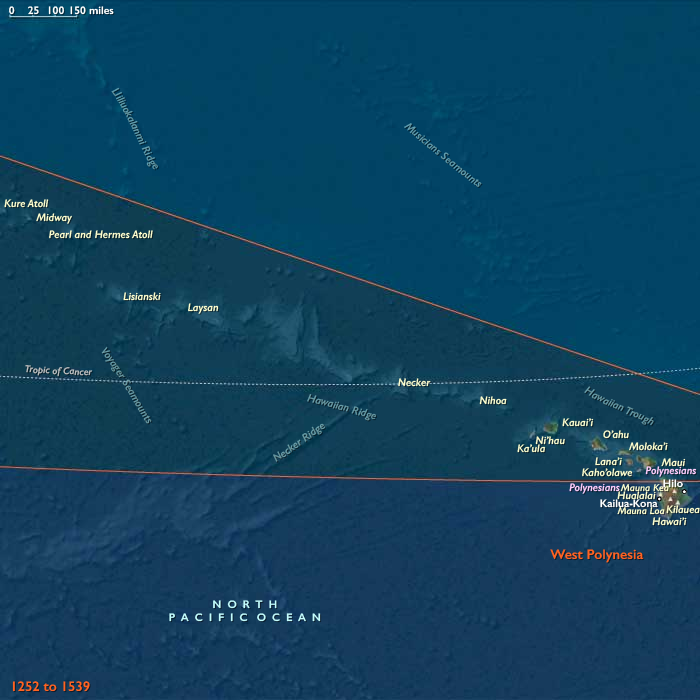
North Polynesia comprised Kauaʻi, Niʻihau, Oʻahu, Molokaʻi, Lānaʻi, Kahoʻolawe, Maui, and the Northwestern Hawaiian Islands extending through Nihoa, Mokumanamana, French Frigate Shoals, Laysan, Lisianski, Pearl and Hermes Atoll, Midway, and Kure. Hawaiʻi Island remained part of the adjoining West Polynesian subregion while sharing the broader Hawaiian cultural world.
The archipelago continued to be defined by volcanic mountain ranges, deeply eroded valleys, perennial windward streams, leeward agricultural plains, coral reefs, sheltered embayments, and productive coastal fisheries. Distinct ecological zones remained interconnected through mature ridge-to-reef systems that linked forests, watersheds, settlements, cultivated land, and marine environments.
Environmental Continuity
Despite growing social complexity, the physical landscape changed relatively little. Native forests continued to cloak mountain watersheds, preserving stream flow and stabilizing valley ecosystems. Irrigated terraces occupied favorable valley bottoms, while dryland agriculture spread across selected leeward slopes without overwhelming the surrounding natural landscape.
Reefs, lagoons, estuaries, beaches, cliffs, and volcanic uplands remained dominant visual features throughout the archipelago. Human activity became denser in productive districts, yet ecological systems continued to shape settlement far more than political boundaries.
The Hawaiian Islands remained fundamentally landscapes of water, forest, cultivated valleys, and sea.
Mature Ahupuaʻa Landscapes
By this age, ahupuaʻa had become fully mature ecological and administrative landscapes. Most productive districts successfully integrated upland forests, stream systems, irrigated taro valleys, dryland fields, settlements, fishponds, reefs, and offshore fisheries within enduring territorial units.
Daily life increasingly depended upon coordinated management of entire watersheds. Forest protection preserved stream flow; irrigation sustained valley agriculture; wetlands moderated sediment movement; fishponds enhanced coastal production; reefs supplied dependable fisheries; canoe landings connected neighboring districts and islands.
Although local variations remained substantial, the ecological principles underlying ridge-to-reef organization were now widely established across the principal inhabited islands.
Agriculture and Aquaculture
Agricultural productivity remained the foundation of Hawaiian society. Extensive loʻi kalo systems occupied the best-watered valleys of Kauaʻi, Oʻahu, Molokaʻi, and Maui. Well-maintained ʻauwai irrigation channels distributed water efficiently through interconnected terraces before returning it to natural stream systems.
Dryland agriculture remained equally important in appropriate environments. Sweet potato, dryland taro, bananas, gourds, sugarcane, coconuts, breadfruit, and household gardens continued to provide diversified production adapted to local rainfall, soils, and elevation.
Coastal fishponds represented one of the most sophisticated forms of Indigenous aquaculture in the Pacific. Existing loko iʻa were enlarged, repaired, and maintained rather than dramatically multiplied. Carefully managed mākāhā sluice gates regulated fish recruitment and harvesting, while communities continued to depend heavily upon reef fishing, offshore fisheries, shellfish gathering, and marine plants.
The mature agro-marine landscape remained remarkably resilient because no single productive system dominated the economy.
Settlement and Community Life
Settlement patterns changed primarily through increasing continuity rather than urban concentration. Productive valleys contained numerous household compounds interwoven with irrigated fields, orchards, pathways, shrines, work areas, and streams. Coastal villages remained closely associated with canoe landings, fishponds, reef fisheries, and sheltered embayments.
Households continued to serve as the primary units of production. Agriculture, fishing, canoe construction, barkcloth production, weaving, food preservation, house building, and irrigation maintenance remained organized largely through extended families supported by communal labor.
The islands possessed no cities in the Old World sense. Instead, they exhibited broad cultural landscapes where productive environments and dispersed settlements formed continuous inhabited regions.
Economic Organization
Agricultural surpluses increasingly supported stable chiefly administrations and expanding networks of skilled specialists. Canoe builders, navigators, irrigation supervisors, fishpond managers, priests, chanters, healers, featherworkers, woodcarvers, and stoneworkers occupied respected hereditary or semi-hereditary positions within many districts.
Interisland exchange remained vigorous. Canoes transported preserved fish, salt, barkcloth, feather regalia, basalt adzes, canoe timber, cordage, agricultural produce, ritual objects, and valuable food resources among the principal islands.
Redistribution through chiefly households supported ceremonies, public works, ritual obligations, diplomacy, and relief following localized shortages. Commercial markets remained absent; reciprocal exchange and tribute continued to organize most economic relationships.
Movement and Maritime Networks
Interisland navigation remained one of the defining characteristics of North Polynesia. Large double-hulled canoes regularly connected Oʻahu, Molokaʻi, Lānaʻi, Maui, Kauaʻi, and Niʻihau, while maintaining cultural and political relationships with Hawaiʻi Island beyond the subregional boundary.
Voyaging knowledge remained highly sophisticated. Navigators continued to employ stars, ocean swells, prevailing winds, currents, cloud formations, and seabird behavior to maintain reliable movement throughout the archipelago.
Occasional expeditions continued into the nearer Northwestern Hawaiian Islands for bird feathers, fishing, and ceremonial purposes. Midway and the more distant atolls remained ecologically significant but outside the sphere of permanent settlement.
The sea continued to unite rather than divide Hawaiian society.
Sacred Landscapes and Institutions
The principal historical development of this age was the fuller integration of ritual institutions into already mature productive landscapes.
Heiau became increasingly diverse in both size and purpose. Agricultural temples, fishing shrines, healing centers, navigational sanctuaries, and larger chiefly temples appeared throughout the principal islands. These remained widely distributed within valleys, along coasts, beside irrigation systems, and near important settlements rather than concentrated into monumental ceremonial precincts.
The kapu system reached a high level of institutional maturity. Seasonal restrictions regulated water use, fisheries, forest access, agricultural labor, ceremonial observances, and chiefly authority. Religious practice reinforced ecological stewardship by protecting spawning seasons, preserving watershed resources, coordinating communal labor, and synchronizing agricultural cycles.
Genealogical traditions, ritual specialists, chant, hula, and oral history further strengthened the relationship between sacred authority and the landscape itself.
The sacred geography of Hawaiʻi had become deeply embedded within its productive environments.
Political Development
Chiefly authority became increasingly stable during this period. Powerful aliʻi nui exercised durable influence across extensive portions of Oʻahu, Maui, Kauaʻi, and Molokaʻi through networks of subordinate chiefs responsible for individual ahupuaʻa.
Political competition continued through alliances, marriage, tribute, ritual prestige, and limited warfare. Control of fertile valleys, irrigation systems, fishponds, canoe landings, and exchange networks became increasingly important sources of chiefly legitimacy.
Although regional centers of power became more recognizable, no single polity achieved permanent dominance over the archipelago. Political authority continued to arise from successful stewardship of productive landscapes rather than purely military conquest.
Adaptation and Resilience
North Polynesia maintained exceptional resilience through the diversity of its ecological systems. Forest protection, irrigated agriculture, dryland cultivation, orchards, fisheries, fishponds, canoe exchange, and household storage collectively buffered communities against droughts, storms, flooding, and localized crop failures.
Communal labor maintained irrigation channels, terraces, fishpond walls, trails, canoe fleets, and forest resources. Seasonal kapu protected fisheries and allowed ecological recovery, while redistribution through chiefly networks moderated regional shortages.
The landscape itself continued to provide the principal defense against environmental uncertainty.
Legacy of the Age
Between 1396 and 1539 CE, North Polynesia reached the mature expression of its Indigenous agro-marine civilization. The ahupuaʻa system functioned as a fully integrated ridge-to-reef framework linking forests, streams, agriculture, settlements, fishponds, and reefs into remarkably productive ecological districts.
The principal innovation of this age was not the expansion of political authority, but the integration of sacred institutions into these enduring landscapes. Temples, ritual specialists, genealogies, and the kapu order increasingly coordinated ecological stewardship, agricultural production, and social organization while remaining embedded within the productive environment rather than dominating it.
By 1539, North Polynesia possessed one of the Pacific's most sophisticated Indigenous landscape systems—a resilient civilization whose ecological foundations remained stronger than its political divisions, setting the stage for the final centuries of independent Hawaiian development before sustained overseas contact.
Images

North Polynesia in the Late Medieval (Upper) age
Groups
Commodities
Subjects
Regions
Polynesia
View →Subregions