North Polynesia (1540–1683 CE): Island Kingdoms before…
1540 CE to 1683 CE
North Polynesia (1540–1683 CE): Island Kingdoms before Overseas Contact
Geographic Parameters
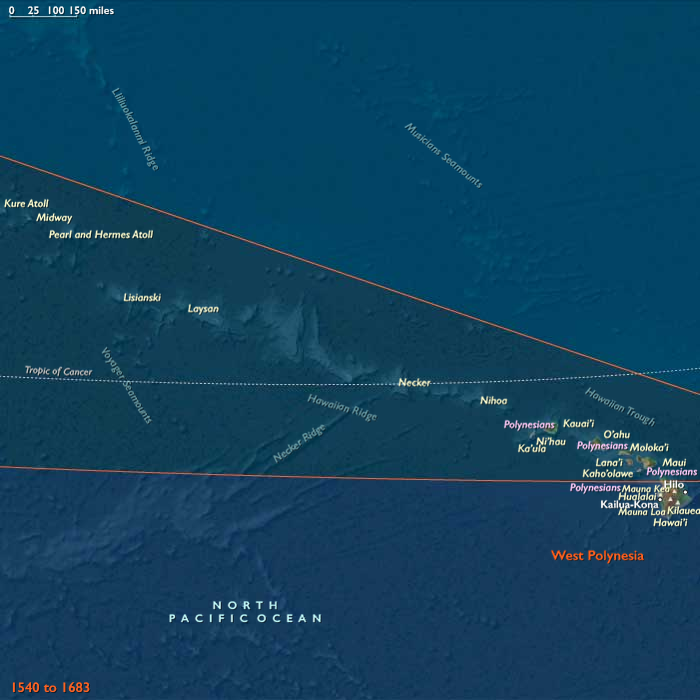
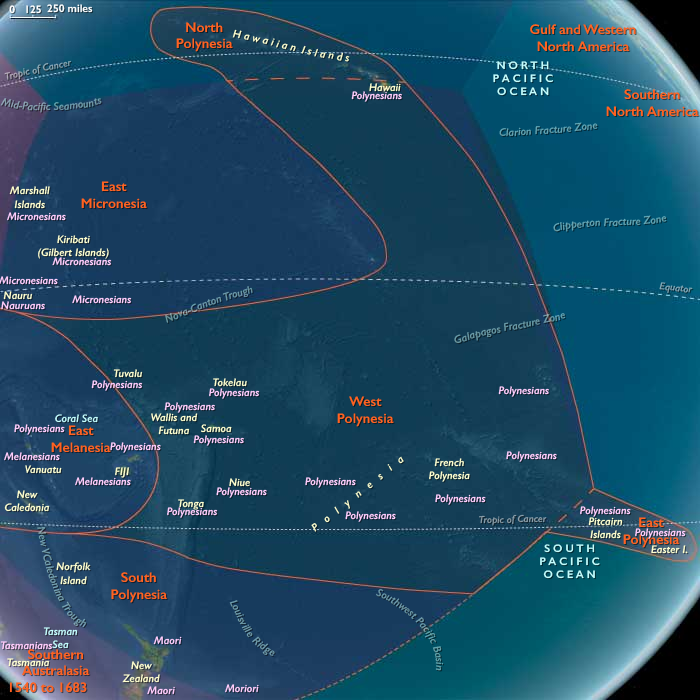
North Polynesia comprised Kauaʻi, Niʻihau, Oʻahu, Molokaʻi, Lānaʻi, Kahoʻolawe, Maui, and the Northwestern Hawaiian Islands extending through Nihoa, Mokumanamana, French Frigate Shoals, Laysan, Lisianski, Pearl and Hermes Atoll, Midway, and Kure. Hawaiʻi Island remained part of the adjoining West Polynesian subregion while sharing the wider Hawaiian cultural, religious, and political world.
The principal islands retained their enduring environmental diversity. Windward mountain ranges intercepted the trade winds, sustaining perennial streams and fertile valleys, while leeward plains supported extensive dryland cultivation. Coral reefs, protected embayments, fishponds, and productive offshore fisheries continued to connect coastal communities with inland agricultural districts through mature ridge-to-reef systems.
Environmental Continuity
The Hawaiian landscape changed only gradually during this period. Native forests still dominated upland watersheds, protecting stream flow and maintaining the irrigation systems upon which valley agriculture depended. Irrigated taro terraces occupied favorable valleys, while dryland fields expanded or contracted according to local rainfall, soil fertility, and population.
Fishponds, reefs, estuaries, beaches, lava flows, cliffs, and open ocean remained the defining visual features of the archipelago. Human modification continued almost entirely within established agricultural districts rather than spreading across the islands as a whole.
The environment remained visibly larger and more enduring than the societies that occupied it.
Mature Agro-Marine Landscapes
By the sixteenth century, Hawaiian ridge-to-reef landscapes had reached a high level of stability. Most productive districts successfully integrated watershed forests, irrigation systems, dryland fields, orchards, settlements, fishponds, reefs, and canoe landings into long-established ecological units.
Agricultural maintenance increasingly mattered more than agricultural expansion. Communities devoted considerable labor to repairing terraces, clearing irrigation channels, rebuilding fishpond walls, maintaining trails, managing forests, and preserving the productivity of established landscapes rather than creating entirely new ones.
The mature ahupuaʻa remained the fundamental framework through which people organized both subsistence and community life.
Agriculture and Fisheries
Irrigated loʻi kalo continued to provide the principal staple in favorable valleys of Kauaʻi, Oʻahu, Molokaʻi, and Maui. Water flowed through carefully maintained ʻauwai systems connecting numerous terraces before returning to streams and wetlands.
Dryland agriculture remained equally important in leeward districts. Sweet potato, dryland taro, gourds, bananas, breadfruit, coconuts, sugarcane, and household gardens diversified production across varying environmental conditions. Stone alignments, mulching, and careful soil management sustained yields without extensive landscape alteration.
Fishponds remained highly productive components of coastal economies. Existing loko iʻa continued to be repaired, enlarged where practical, and managed through established harvest cycles. Open-ocean fishing, reef harvesting, shellfish gathering, and seasonal exploitation of marine resources remained indispensable throughout the islands.
Agriculture and fisheries together continued to form one integrated productive system.
Settlement and Community Organization
Settlement patterns remained remarkably consistent with those established during earlier centuries. Productive valleys contained dispersed household compounds connected by paths, irrigation works, cultivated fields, orchards, fishponds, and canoe landings.
Communities expanded primarily through gradual infilling of established districts rather than by founding entirely new settlements. Forests, wetlands, streams, and cultivated land continued to separate neighborhood clusters, preserving the ecological character of inhabited landscapes.
Households remained the primary centers of production. Extended families cultivated fields, managed fisheries, built canoes, produced barkcloth, maintained irrigation systems, and participated in communal labor organized through both kinship and chiefly authority.
No urban settlements emerged despite continued population growth.
Economic Organization
Agricultural surpluses supported increasingly sophisticated systems of redistribution under established chiefly households. Tribute continued to consist primarily of food, fish, barkcloth, feather regalia, cordage, canoes, timber, and labor.
Specialists occupied increasingly stable social positions. Irrigation supervisors, fishpond managers, canoe builders, navigators, priests, healers, chanters, featherworkers, woodcarvers, and stoneworkers transmitted highly developed knowledge through hereditary or closely associated lineages.
Interisland exchange remained vigorous. Canoes transported preserved fish, salt, barkcloth, basalt tools, feathers, canoe timber, ceremonial goods, and agricultural products throughout the archipelago.
Economic life continued to depend upon reciprocal exchange and redistribution rather than commercial markets.
Movement and Maritime Networks
Interisland navigation remained the principal transportation system. Double-hulled sailing canoes maintained regular communication among Kauaʻi, Oʻahu, Molokaʻi, Lānaʻi, Maui, Niʻihau, and Hawaiʻi Island.
Navigation continued to rely entirely upon Indigenous knowledge of stars, ocean swells, prevailing winds, currents, cloud formations, and seabird movements. Canoes carried agricultural products, ritual specialists, marriage partners, tribute, diplomatic envoys, and skilled labor between islands.
The Northwestern Hawaiian Islands continued to receive occasional expeditions for bird feathers, fishing, and ceremonial purposes. Midway and the distant northwestern atolls remained outside the sphere of permanent habitation.
The Hawaiian archipelago functioned as a highly integrated maritime world sustained entirely through Indigenous navigation.
Institutions and Sacred Landscapes
Religious institutions remained closely integrated with productive landscapes. Agricultural heiau, fishing shrines, healing sites, navigational sanctuaries, and larger chiefly temples continued to occupy selected locations within valleys, beside irrigation systems, near fishponds, and along important coastlines.
The kapu system regulated agricultural seasons, fishing closures, watershed protection, ritual obligations, and chiefly authority. Religious observances synchronized planting, harvesting, redistribution, and environmental stewardship across individual ahupuaʻa.
Genealogical traditions, ritual specialists, chants, hula, and oral histories reinforced relationships between communities, ancestors, and particular landscapes.
Although some temples became architecturally larger, they remained visually subordinate to the surrounding agricultural and ecological systems.
Island Kingdoms
The principal historical development of this age was the increasing stability of large island polities.
Powerful aliʻi nui exercised authority across extensive territories on Oʻahu, Maui, Kauaʻi, and neighboring islands through networks of subordinate chiefs responsible for individual ahupuaʻa. Administrative organization became more regular, tribute systems more dependable, and regional leadership more continuous across generations.
Political rivalry nevertheless remained characteristic of Hawaiian life. Alliances, marriage, ritual prestige, tribute, and periodic warfare continued to reshape relationships among the principal island chiefdoms without producing permanent archipelago-wide unification.
Political authority increasingly rested upon successful stewardship of productive districts, the organization of communal labor, and the maintenance of ecological abundance.
Adaptation and Resilience
North Polynesian resilience remained rooted in environmental diversity. Watershed forests protected streams; irrigated valleys provided dependable staple crops; dryland agriculture buffered regional climatic variation; fishponds and reef fisheries stabilized protein supplies; interisland canoe exchange redistributed food and labor following localized shortages.
Communities continued repairing irrigation systems, fishpond walls, trails, and canoe fleets after storms while preserving productive forests and fisheries through seasonal restrictions.
These mature ecological systems allowed Hawaiian society to remain remarkably stable despite periodic droughts, storms, and local political conflict.
Legacy of the Age
Between 1540 and 1683 CE, North Polynesia reached the mature expression of its independent Indigenous civilization. The agro-marine landscapes established during previous centuries remained highly productive, while ahupuaʻagovernance, irrigation systems, fishponds, canoe networks, and sacred institutions continued to reinforce one another across the archipelago.
The principal development of this age was the consolidation of stable island kingdoms capable of coordinating increasingly large territories without fundamentally altering the ecological foundations of Hawaiian life. Political authority expanded, yet it remained inseparable from stewardship of forests, streams, cultivated valleys, reefs, and fisheries.
By 1683, North Polynesia represented one of the world's most sophisticated Indigenous island societies, possessing resilient ecological systems, mature political institutions, and enduring cultural traditions on the eve of sustained engagement with the wider global maritime world.
Images

North Polynesia in the Early Modern age
Groups
Commodities
Subjects
Regions
Polynesia
View →Subregions