Edward III’s Invasion of France and the…
1346 CE
Edward III’s Invasion of France and the Early English Victories in the Hundred Years’ War
As the Hundred Years’ War (1337–1453) continued, Edward III of England launched a major invasion of France, securing a series of military victories that would solidify English dominance in the early phases of the war.
Edward III’s Strategy and the Resumption of War
- Following the collapse of the Truce of Malestroit (1343) and the failure of the English offensive in Brittany (1345), Edward III renewed his efforts to assert his claim to the French throne.
- His strategy was based on:
- Launching coordinated offensives on multiple fronts—in Gascony, Brittany, and northern France.
- Using fast-moving cavalry raids (chevauchées) to devastate French lands and force Philip VI into battle.
- Securing alliances with Flemish cities, which were vital trade partners of England and opposed French dominance.
Key English Victories in the 1340s
1. The Battle of Auberoche (October 1345)
- Fought in Gascony, this was an important English victory, demonstrating the effectiveness of longbowmenand surprise tactics.
2. The Battle of Crécy (August 26, 1346)
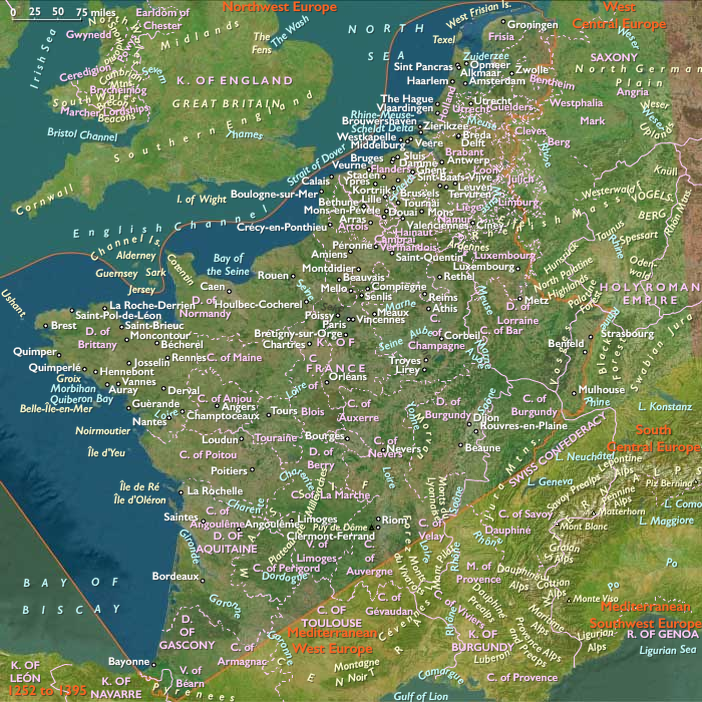
- Edward III led a major invasion of northern France, landing in Normandy in July 1346 with an army of 15,000 men.
- The English decisively defeated Philip VI’s larger force, marking a turning point in medieval warfare:
- English longbowmen devastated the French knights, proving the superiority of ranged attacks over cavalry charges.
- Many high-ranking French nobles were killed, including King John of Bohemia, reinforcing the weakness of the French military leadership.
3. The Siege of Calais (September 1346 – August 1347)
- After his victory at Crécy, Edward III laid siege to Calais, one of the most strategically important ports in France.
- The siege lasted nearly a year, ending when the starving defenders surrendered in August 1347.
- Calais remained under English control for over two centuries, becoming a key base for future invasions of France.
Impact of Edward III’s Victories
- The Battle of Crécy and the fall of Calais confirmed that England had the upper hand in the war.
- Philip VI’s inability to stop Edward’s advances led to growing unrest in France, as the nobility began questioning the effectiveness of the Capetian monarchy.
- The English longbow had proven itself as a dominant battlefield weapon, shifting military tactics away from heavy cavalry charges.
- England secured a foothold in northern France, from which it could launch further offensives.
Edward III’s campaigns in the 1340s demonstrated English military superiority, setting the stage for further conflicts and ensuring that the Hundred Years’ War would continue for decades to come.
Locations
People
Groups
Topics
Subjects
Regions
West Europe
View →Subregions