Northeast Asia (1252–1395 CE): Yuan Frontiers, Ainu…
1252 CE to 1395 CE
Northeast Asia (1252–1395 CE): Yuan Frontiers, Ainu Consolidation, and the Enduring River–Sea World
Geographic Parameters
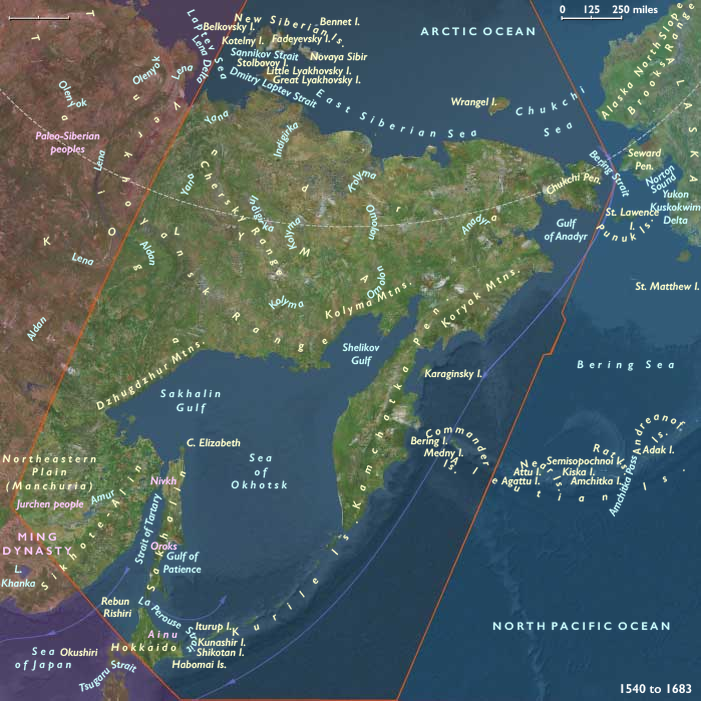
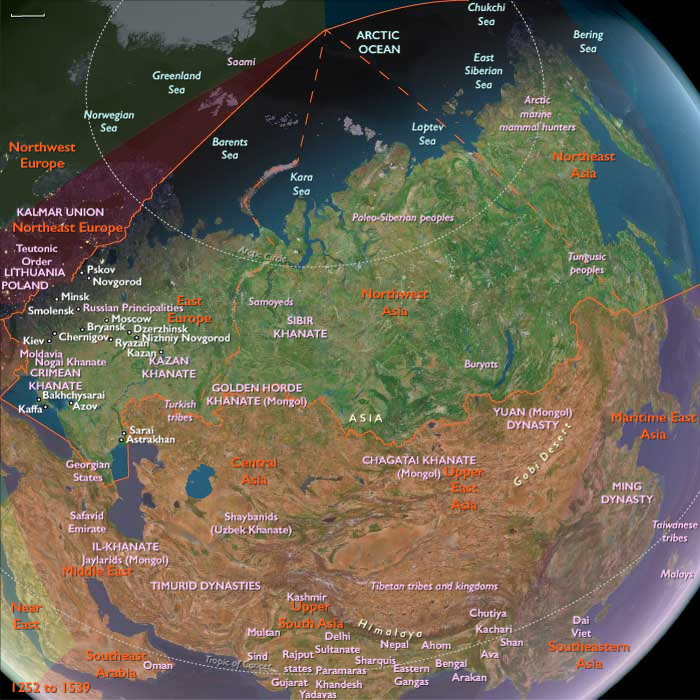
Northeast Asia encompasses eastern Siberia east of the Lena River basin to the Pacific Ocean, the Russian Far East north of southern Primorye, the Amur and lower Ussuri river systems, Sakhalin, Kamchatka, the Chukchi Peninsula, Wrangel Island, the Sea of Okhotsk littoral, the Kuril Islands, and Hokkaidō north of its southwestern peninsula. Vast taiga forests, Arctic tundra, volcanic mountain chains, broad floodplains, and seasonally frozen seas continued to organize settlement and movement. Rivers remained the principal arteries of communication, while coasts and islands formed an interconnected northern maritime world.
Climate and Environmental Conditions
The final centuries of the Medieval Climate Anomaly gradually gave way to cooler and less predictable conditions across the northern Pacific. Although the southern Amur basin retained productive forests and river valleys, growing seasons shortened slightly toward the end of the age, while seasonal sea ice became increasingly important to transportation and marine ecosystems.
Salmon remained the dominant ecological resource throughout the Amur, Sakhalin, Kamchatka, and Hokkaidō, while marine mammals, migratory birds, terrestrial game, and forest resources continued to provide dependable seasonal diversity.
Human Adaptation
Communities throughout Northeast Asia continued to organize life around complementary seasonal economies rather than permanent agricultural intensification.
Along the Amur and lower Ussuri, the ancestors of later Nivkh, Ulch, Nanai, and related peoples maintained prosperous fishing villages supported by salmon harvesting, seal hunting, trapping, gathering, and limited cultivation. Seasonal labor cycles coordinated fishing, preservation, hunting, and river transport.
Interior Evenki, Even, Yukaghir, and related communities sustained mobile lifeways combining hunting, fishing, trapping, and reindeer transport across immense taiga territories.
Kamchatka, Chukotka, and the Bering coast remained the domain of Koryak, Itelmen, Chukchi, and neighboring peoples whose economies integrated salmon fisheries, marine hunting, terrestrial game, and seasonal migration.
Across Hokkaidō, Ainu society matured into a clearly distinct northern cultural tradition. River and coastal settlements became increasingly stable, while exchange, ceremonial life, and territorial relationships strengthened regional identities without producing centralized political institutions.
Economic Organization
The principal historical development of the age was the incorporation of portions of the Amur and Sakhalin frontier into the expanding tributary system of the Yuan Dynasty.
Following the Mongol conquest of the Jin, Yuan authorities extended influence into the lower Amur through tribute relationships, military expeditions, and frontier administration rather than dense settlement. During repeated campaigns against Sakhalin beginning in the late thirteenth century, Yuan officials sought to stabilize relations among Nivkh and Ainu communities while securing tribute in the form of furs, falcons, and other northern products.
For most indigenous societies, however, economic life remained fundamentally ecological rather than imperial. Salmon, sturgeon, marine mammals, furs, medicinal plants, timber, antler, and forest products continued to dominate production and exchange.
Trade between Hokkaidō and northern Honshū expanded steadily. Iron tools, lacquerware, textiles, ceramics, and rice entered Ainu communities through Wajin merchants, while dried fish, furs, eagle feathers, hawks, and marine products moved southward.
Technology and Material Culture
Fishing technologies continued to develop incrementally through improved weirs, basket traps, nets, smokehouses, drying platforms, storage pits, and elevated caches.
Birch-bark canoes, dugout and plank boats, skin-covered craft, skis, snowshoes, dog sleds, and reindeer transport remained indispensable across diverse northern environments.
Imported iron circulated more widely along Amur and Hokkaidō exchange routes, although bone, antler, wood, bark, and stone continued to provide much of the material foundation of daily life. Local craftsmanship increasingly incorporated imported metals into long-established technological traditions rather than replacing them.
Movement and Interaction Corridors
The Amur River remained Northeast Asia's dominant continental corridor, linking interior forests, tributary valleys, lower-river settlements, and the Sea of Okhotsk.
Seasonal navigation connected Sakhalin, the lower Amur, Kamchatka, and Hokkaidō, while winter ice created dependable overland crossings between coastal communities. Forest portages continued to unite inland river systems across the taiga.
The Tsugaru Strait assumed increasing commercial importance as exchange between Ainu communities and Wajin merchants became more regular, while the Kuril chain connected northern maritime societies through seasonal movement and resource harvesting.
Institutions and Political Authority
Clan leadership, customary law, ritual authority, and cooperative management of fishing grounds continued to organize most indigenous communities.
The Yuan Empire introduced the principal new institutional framework of the age through tribute administration along the southern Amur frontier. Rather than replacing local governance, imperial officials generally worked through existing leaders, seeking regular tribute, military cooperation, and secure commercial routes while leaving most internal social organization intact.
Following the collapse of Yuan authority after 1368, Ming influence gradually replaced Mongol administration along the southern frontier, but direct political control remained limited beyond the margins of the Amur basin.
Belief and Cultural Life
Animistic cosmologies continued to structure relationships between communities and their environments. Rivers, salmon, bears, whales, seals, mountains, forests, and weather remained active spiritual participants in everyday life.
Among Ainu communities, ceremonies honoring kamuy, including increasingly formalized bear rituals, reinforced reciprocal obligations between humans and powerful animal beings. Amur societies maintained first-salmon ceremonies and river rituals, while northern coastal peoples continued ceremonial observances associated with whales, sea mammals, and successful hunting.
Imported religious traditions remained confined largely to frontier exchange centers and exerted relatively little influence upon the broader cultural landscape.
Adaptation and Resilience
Communities continued to minimize environmental uncertainty through diversified seasonal resource use. Fishing, hunting, trapping, gathering, limited horticulture, and reindeer transport created flexible economies capable of responding to climatic variation, fluctuating salmon returns, and changing political conditions.
Food preservation, seasonal mobility, extensive kinship networks, and adaptable exchange systems enabled communities to accommodate shifting tributary relationships without sacrificing ecological independence.
Even periods of imperial intervention affected trade and diplomacy more profoundly than the underlying environmental organization of society.
Legacy of the Age
Between 1252 and 1395 CE, Northeast Asia experienced its closest engagement yet with a continental empire through the expansion of the Yuan Dynasty into the Amur and Sakhalin frontier. Tribute relationships, military expeditions, and expanding commerce strengthened links between northern societies and East Asia without fundamentally altering indigenous patterns of settlement or subsistence.
Ainu society continued to consolidate across Hokkaidō, Amur communities refined prosperous riverine economies, and the peoples of Kamchatka, Chukotka, and the Siberian taiga maintained resilient adaptations to some of the world's most demanding environments. By 1395, Yuan authority had given way to the early Ming, but the enduring geography of salmon rivers, frozen seas, forests, and seasonal mobility remained the dominant framework within which the next age would unfold.
Images

Northeast Asia in the Late Medieval (Lower) age
Groups
Commodities
Subjects
Regions
Northeastern Eurasia
View →Subregions