Northeast Asia (964–1107 CE): Liao Expansion, Ainu…
964 CE to 1107 CE
Northeast Asia (964–1107 CE): Liao Expansion, Ainu Consolidation, and Amur River Exchange
Geographic Parameters
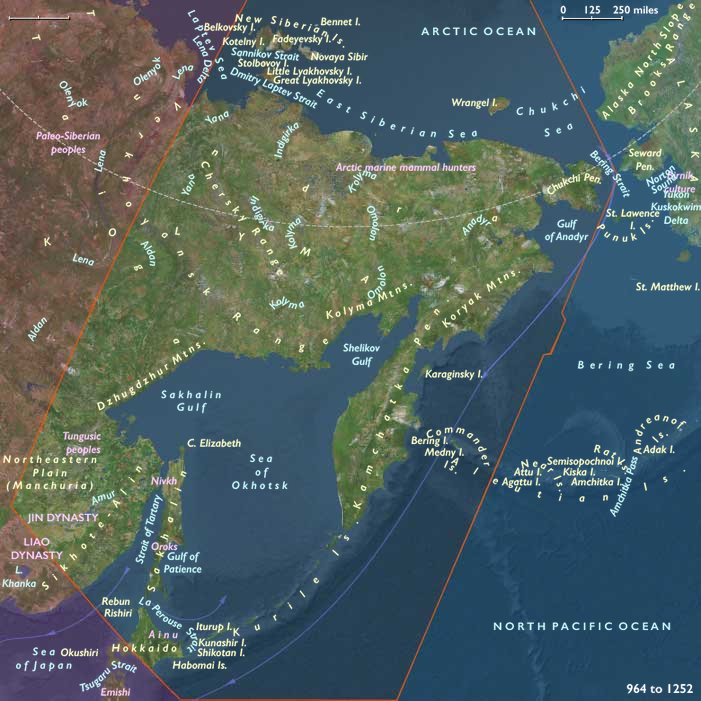
Northeast Asia encompasses eastern Siberia east of the Lena River basin to the Pacific Ocean, the Russian Far East north of southern Primorye, the Amur and lower Ussuri river systems, Sakhalin, Kamchatka, the Chukchi Peninsula, Wrangel Island, the Sea of Okhotsk littoral, the Kuril Islands, and Hokkaidō north of its southwestern peninsula. Vast taiga forests, Arctic tundra, volcanic mountain chains, extensive river systems, and seasonally frozen seas continued to define the environmental framework within which human societies developed. Most settlements remained concentrated along salmon rivers, estuaries, sheltered coasts, and productive hunting territories.
Climate and Environmental Conditions
Relatively mild conditions during the early Medieval Climate Anomaly modestly lengthened growing seasons in the southern Amur basin and parts of Hokkaidō without fundamentally altering the region's subarctic character. Long winters, heavy snowfall, seasonal sea ice, and highly productive marine and river ecosystems continued to govern annual cycles of movement and subsistence. Variability in salmon returns, sea-ice conditions, and terrestrial game reinforced flexible seasonal scheduling across every ecological zone.
Societies and Political Developments
Indigenous societies remained organized primarily through clan authority, customary law, and seasonal cooperation rather than centralized political institutions.
Along the lower Amur and Ussuri, the ancestors of later Nivkh, Ulch, Nanai, and related riverine peoples maintained prosperous fishing communities linked through kinship and exchange. Inland, Evenki, Even, and related Tungusic-speaking peoples continued highly mobile hunting, trapping, fishing, and reindeer-herding lifeways throughout the taiga.
The Mohe-descended peoples of the upper Amur and Heilongjiang increasingly coalesced into larger Jurchen tribal confederations while continuing mixed economies based upon hunting, fishing, livestock, and limited agriculture. Although influenced by the expanding Liao Dynasty, these communities largely retained local autonomy during this period.
Across Kamchatka and the Chukchi Peninsula, Koryak, Itelmen, Chukchi, and neighboring peoples continued marine hunting, fishing, and reindeer-based seasonal movements with little direct involvement in southern political affairs.
On Hokkaidō, interaction between Satsumon communities and the remaining Okhotsk populations culminated in the consolidation of an increasingly distinctive Ainu cultural tradition. Trade with northern Honshū expanded gradually, but local leadership remained rooted in kinship and reciprocal exchange rather than formal political hierarchy.
Economic Organization
Regional economies continued to depend overwhelmingly upon renewable natural resources. Salmon remained the principal economic foundation throughout the Amur basin, Sakhalin, Kamchatka, and Hokkaidō, supported by seal hunting, marine fisheries, deer, reindeer, trapping, and forest gathering.
Long-distance exchange expanded noticeably during this age. Furs, eagle feathers, ginseng, medicinal plants, fish oils, walrus ivory, and marine products moved southward through Liao frontier markets, while iron tools, steel blades, textiles, ceramics, and other manufactured goods reached northern communities through indirect trade.
Winter trade fairs, river junctions, and coastal rendezvous increasingly connected inland hunters with maritime societies, strengthening exchange networks without fundamentally changing indigenous economic organization.
Technology and Material Culture
Technological development continued to emphasize environmental adaptation rather than specialization. Fish weirs, wicker traps, drying racks, smokehouses, and storage facilities supported increasingly sophisticated salmon preservation.
Birch-bark canoes, plank boats, skin-covered craft, sledges, skis, snowshoes, and domesticated reindeer enabled efficient travel across rivers, forests, tundra, and frozen coastlines.
Imported iron became somewhat more common, improving knives, spearheads, woodworking tools, and hunting equipment, although bone, antler, wood, bark, and stone remained indispensable components of everyday technology throughout most of the region.
Movement and Interaction Corridors
The Amur River continued to function as Northeast Asia's principal transportation corridor, linking interior forests with the lower river and the Sea of Okhotsk.
Coastal navigation connected Sakhalin, Kamchatka, and Hokkaidō during ice-free seasons, while frozen rivers and coastal ice created dependable winter travel routes. The Tsugaru Strait gradually assumed greater importance as exchange between Hokkaidō and northern Honshū expanded, while interior portage routes continued to unite neighboring river systems across the taiga.
Belief and Cultural Life
Animistic worldviews and shamanic traditions remained central throughout the region. Rivers, salmon, forests, mountains, sea mammals, and large terrestrial animals continued to occupy central places within ritual life.
Seasonal ceremonies surrounding fishing, hunting, and animal migrations reinforced reciprocal relationships between human communities and the natural world. Among emerging Ainu communities, ritual traditions centered upon bears and other powerful animal beings assumed increasingly recognizable forms, while Amur and Tungusic societies maintained elaborate ceremonies honoring salmon, hunting success, and ancestral spirits.
Adaptation and Resilience
Communities continued to reduce environmental uncertainty through diversified seasonal economies. Fishing, hunting, trapping, gathering, limited cultivation, and reindeer husbandry remained mutually reinforcing rather than specialized activities.
Expanding trade networks increased access to scarce manufactured goods while preserving local economic independence. Mobility between coastal camps, river settlements, forest hunting grounds, and upland pastures continued to provide the principal safeguard against environmental variability.
Legacy of the Age
Between 964 and 1107 CE, Northeast Asia experienced gradual integration into the expanding commercial world of the Liao frontier while preserving the ecological foundations of its indigenous societies. Exchange intensified along the Amur and across the Sea of Okhotsk, Jurchen communities became increasingly organized within the southern forest frontier, and the cultural consolidation of the Ainu accelerated across Hokkaidō. Yet rivers, salmon, forests, sea ice, and seasonal mobility remained the dominant forces shaping daily life. By 1107 CE, Northeast Asia had become more closely connected to neighboring civilizations through commerce and diplomacy while remaining fundamentally a northern landscape organized by ecological adaptation rather than imperial administration.
Images

Northeast Asia in the High Medieval (Lower) age
Groups
Commodities
Subjects
Regions
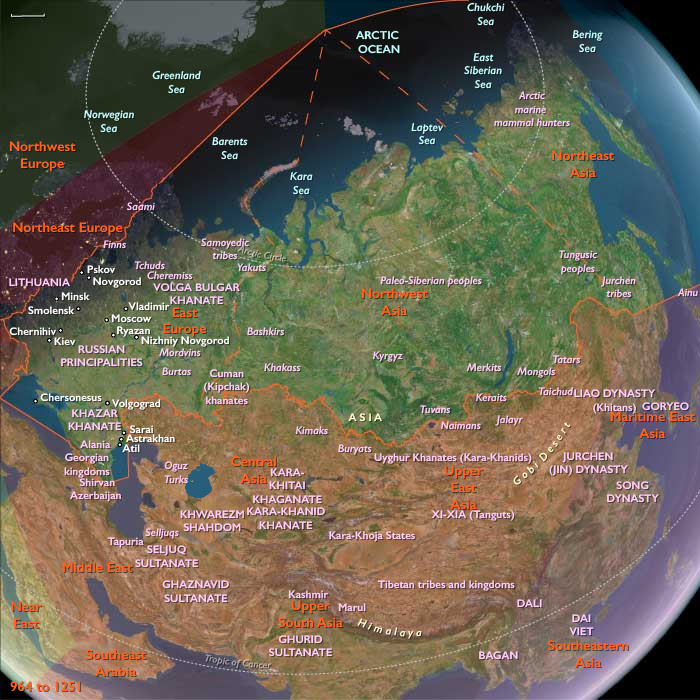
Northeastern Eurasia
View →Subregions