Northeast Asia (1108–1251 CE): Jurchen Power, Amur…
1108 CE to 1251 CE
Northeast Asia (1108–1251 CE): Jurchen Power, Amur Tributary Networks, and Northern Ecological Continuity
Geographic Parameters
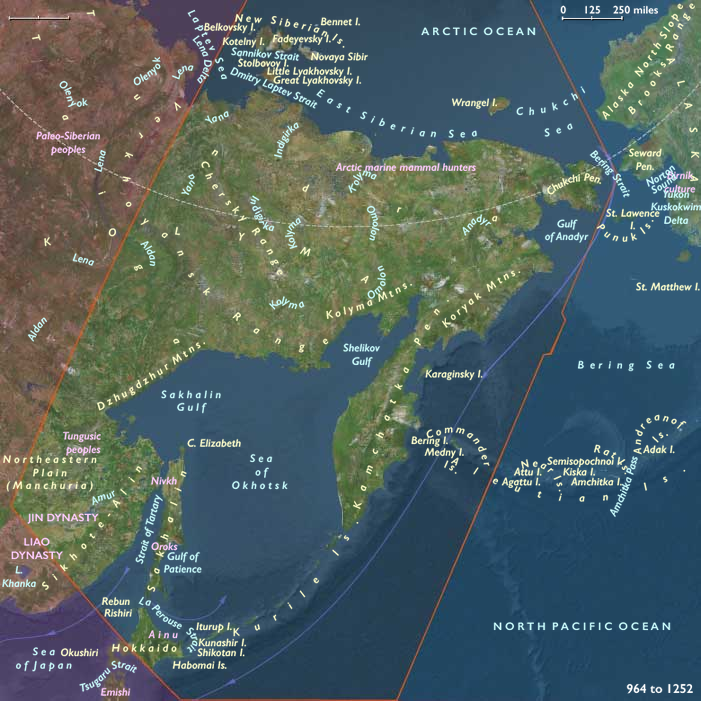
Northeast Asia encompasses eastern Siberia east of the Lena River basin to the Pacific Ocean, the Russian Far East north of southern Primorye, the Amur and lower Ussuri river systems, Sakhalin, Kamchatka, the Chukchi Peninsula, Wrangel Island, the Sea of Okhotsk littoral, the Kuril Islands, and Hokkaidō north of its southwestern peninsula. Taiga forests, Arctic tundra, volcanic uplands, broad river valleys, and seasonally frozen seas remained the enduring framework of regional life. Population continued to concentrate along salmon rivers, estuaries, sheltered coasts, forest margins, and reindeer ranges rather than in large urban centers.
Climate and Environmental Conditions
The relatively mild phase of the Medieval Climate Anomaly continued unevenly across the southern portion of the subregion. Longer frost-free intervals may have supported somewhat more reliable cultivation in the southern Amur basin and parts of Hokkaidō, but most of Northeast Asia remained governed by long winters, heavy snowfall, permafrost, seasonal sea ice, and short summers.
Salmon returns, marine productivity, terrestrial game, and the condition of winter pasture varied from year to year. Communities therefore retained flexible subsistence schedules and dispersed settlement patterns rather than depending upon intensified agriculture alone.
Human Adaptation
Along the lower Amur, Sakhalin, and adjacent coasts, the ancestors of later Nivkh, Ulch, Nanai, and related peoples continued to organize village life around intensive salmon fishing, seal hunting, forest gathering, and trapping. Semi-permanent river settlements contained storage pits, drying structures, smokehouses, and raised caches that supported winter occupation.
Across the interior taiga, Evenki, Even, Yukaghir, and related communities maintained mobile economies combining hunting, fishing, trapping, transport reindeer, and in some areas developing pastoral practices. Seasonal camps shifted between river valleys, upland hunting territories, and winter travel corridors.
Koryak, Itelmen, Chukchi, and Siberian Yupik communities continued to adapt to the contrasting environments of Kamchatka, Chukotka, and the Bering coast. Salmon fishing dominated many river valleys, while coastal settlements relied upon seals, walrus, whales, seabirds, and marine fish. Inland communities followed reindeer and other terrestrial game.
On Hokkaidō, Ainu society became increasingly recognizable as a distinct cultural formation. River and coastal settlements combined salmon fishing, deer and bear hunting, gathering, trade, and limited cultivation. Communities remained locally organized, but exchange leaders and households controlling productive river mouths or coastal routes acquired growing influence.
Economic Organization
The principal new historical system of the age was the stronger incorporation of the southern Amur forest frontier into the tributary and commercial networks of the Jin Dynasty, established by Jurchen rulers in 1115.
Jurchen power emerged from mixed forest and river economies combining agriculture, hunting, fishing, horse breeding, and fur collection. As Jin authority expanded into northern China, its demand for sable, falcons, medicinal products, horses, fish, and other northern resources strengthened exchange throughout the Amur basin.
This expansion did not transform the entire subregion into a directly administered imperial territory. Instead, tribute, seasonal markets, diplomatic gifts, intermediary trade, and negotiated allegiance connected southern river communities to Jin institutions while more distant Amur, Okhotsk, and Siberian societies retained substantial autonomy.
Across Hokkaidō, trade with northern Honshū continued to expand. Dried salmon, marine products, furs, eagle feathers, and hides were exchanged for iron blades, pots, lacquerware, textiles, rice, and other manufactured goods. Iron became more available at major exchange points but remained unevenly distributed.
Technology and Material Culture
Fish weirs, wicker traps, nets, harpoons, drying racks, smokehouses, oil-rendering installations, and storage caches remained central to economic security. Birch-bark canoes served inland rivers, while plank-built and skin-covered boats supported coastal movement.
Skis, snowshoes, dog sledges, and reindeer transport sustained winter mobility across taiga and tundra. Composite bows, bone and antler points, wooden implements, pottery, bark containers, and woven nets remained widespread.
Imported iron increasingly supplemented local materials, especially near Jin and Japanese exchange corridors. Knives, spearheads, adze blades, cauldrons, and woodworking tools could be repaired or reforged locally, extending their useful life far beyond the point of acquisition.
Movement and Interaction Corridors
The Amur remained the dominant continental artery, connecting upland forests, agricultural margins, lower-river fisheries, and the Sea of Okhotsk. Tributaries and portages linked the main river to Evenki hunting territories and to southern frontier markets.
The Amur–Sakhalin–Okhotsk maritime loop connected coastal communities through seasonal navigation and winter ice crossings. Routes along the Kuril chain and Hokkaidō coast supported smaller-scale exchange, fishing, and movement between ecological zones.
The Tsugaru Strait grew in importance as Ainu and Wajin exchange became more regular. In the far northeast, coastal and overland routes continued to connect Chukotka with the Bering Strait world, preserving contacts across the narrow sea without creating centralized control.
Institutions and Political Authority
Local authority continued to arise from kinship, ritual knowledge, control of productive fishing locations, and the ability to organize communal labor. Clan councils, respected hunters, shamans, and exchange leaders coordinated seasonal movements, marriages, conflict resolution, and access to resources.
Jin institutions introduced a broader political layer along the southern frontier through tribute collection, frontier markets, military alliances, and recognition of selected local leaders. This authority weakened with distance from the Jin heartland and remained secondary to local ecological and social organization throughout most of Northeast Asia.
During the early thirteenth century, Mongol expansion began to destabilize the Jin imperial system. Its immediate effects were strongest south of the subregion, but shifting tribute routes, displaced populations, and changing political alliances increasingly affected the Amur frontier before the Jin collapse in 1234.
Belief and Cultural Life
Animistic and shamanic traditions remained central across the region. Salmon, bears, reindeer, whales, sea ice, rivers, mountains, fire, and ancestral beings were understood as active participants in social and ecological life.
Seasonal rites accompanied first catches, communal hunts, food storage, and migration. Among Ainu communities, offerings to kamuy and developing bear-sending traditions reinforced reciprocal relations between humans and powerful animal beings. Amur societies honored salmon and river spirits, while northern coastal peoples maintained ceremonies associated with whales, walrus, seals, and successful sea travel.
Buddhist and other religious influences associated with Jin and neighboring states reached frontier exchange centers, but they remained limited additions to deeply established northern cosmologies.
Adaptation and Resilience
Diversified subsistence continued to protect communities against environmental instability. Salmon harvests were complemented by marine hunting, trapping, terrestrial game, gathering, limited cultivation, and reindeer use. Preserved fish, dried meat, rendered oil, and cached plant foods sustained households through winter and years of poor returns.
Mobility remained essential. Communities shifted between river settlements, coastal hunting camps, inland forests, and tundra pastures according to season and resource conditions. Expanding trade provided iron and prestige goods but did not eliminate local technological knowledge or ecological independence.
When imperial demands or conflicts disrupted established exchange routes, communities could redirect commerce through alternate rivers, coastal passages, and kinship networks.
Legacy of the Age
Between 1108 and 1251 CE, Northeast Asia became more closely connected to a powerful state through the rise of the Jurchen Jin Dynasty. Tributary exchange and frontier commerce strengthened the movement of furs, falcons, medicinal products, iron, textiles, and manufactured goods along the Amur system. Yet imperial power remained concentrated toward the southern edge of the subregion and did not displace the dominant riverine, maritime, taiga, and tundra lifeways of its peoples.
Ainu society continued to consolidate across Hokkaidō, Amur communities preserved prosperous salmon economies, and northern peoples sustained mobile adaptations to reindeer ranges, sea ice, and marine resources. By 1251, Mongol expansion had dismantled the Jin political order and begun reorganizing the southern frontier, but the enduring ecological systems of Northeast Asia remained the primary structure through which the next age of imperial contact would unfold.
Images

Northeast Asia in the High Medieval (Upper) age
Groups
Commodities
Subjects
Regions
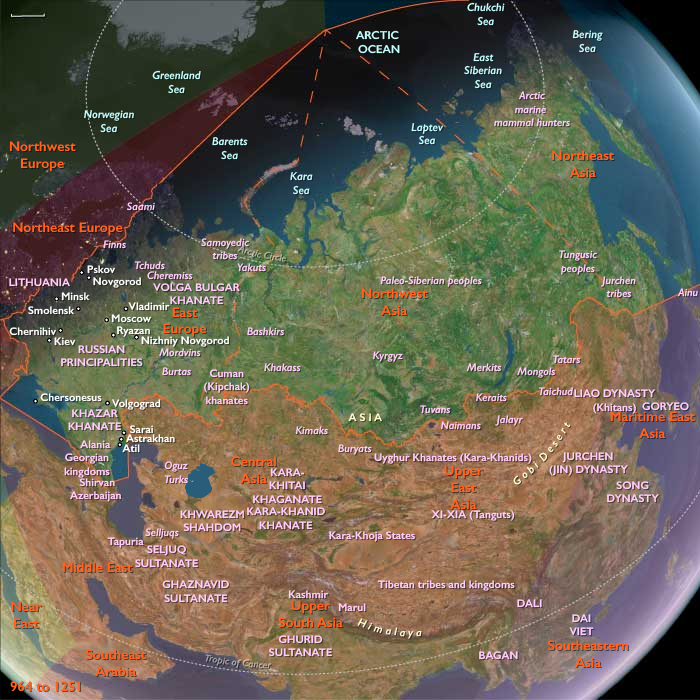
Northeastern Eurasia
View →Subregions