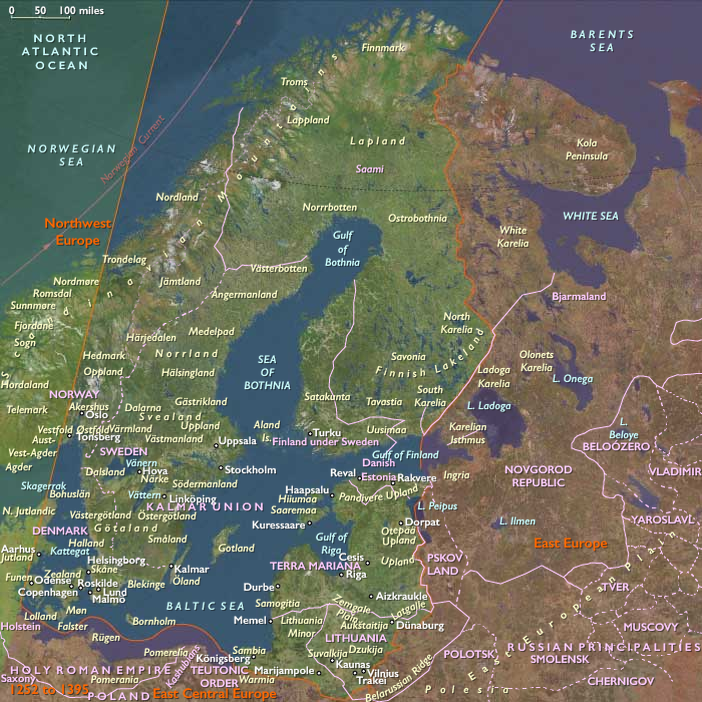
Northeast Europe (1252–1395 CE): Hanseatic Gateways, Territorial…
1252 CE to 1395 CE
Northeast Europe (1252–1395 CE): Hanseatic Gateways, Territorial Lordships, and the Cooling Baltic
Geographic Parameters
Northeast Europe comprised Sweden, Finland, Estonia, Latvia, Lithuania, the Kaliningrad coast, eastern Denmark including Zealand and Copenhagen, and eastern Norway including the Oslofjord. The Baltic Sea remained the subregion’s principal connective environment, linking the Øresund, Mälaren, Gotland, Åland, the Gulf of Bothnia, the Gulf of Finland, the Gulf of Riga, the Estonian islands, and the river corridors leading toward Novgorod, Poland, Lithuania, and the Russian forest zone.
The region remained environmentally divided. Denmark, southern Sweden, Lithuania, Latvia, and parts of Estonia contained the broadest agricultural districts. Finland and central Sweden were dominated by forests, lakes, rocky uplands, bogs, and short growing seasons. Archipelagos created sheltered but intricate sailing routes, while river mouths and winter roads connected inland forest, farming, mining, and tribute districts to coastal markets.
Environmental Continuity
The forest–sea structure of earlier ages endured beneath stronger commercial and territorial institutions. Most people still lived in farms, fishing settlements, forest clearings, island communities, and small fortified districts. Hanseatic ports, castles, bishoprics, and royal towns remained selected nodes rather than a continuous urban landscape.
Forests supplied timber, fuel, charcoal, tar, pitch, wax, game, and furs. Lakes, rivers, marshes, and coastal waters sustained fisheries and transport while separating political jurisdictions. Agriculture expanded in favorable districts but remained interwoven with woodland use, livestock, fishing, and seasonal labor.
Climate and Environmental Change
The later thirteenth and fourteenth centuries brought increasingly variable and colder conditions associated with the onset of the Little Ice Age. Growing seasons shortened in northern and inland districts, while wetter summers, early frosts, and severe winters increased harvest uncertainty. Baltic sea ice sometimes formed more extensively and remained longer into spring, delaying shipping and reinforcing the importance of winter sled routes.
Fishing patterns also shifted. Herring remained central to coastal economies, especially in the southern Baltic and Scania, but shoals varied in location and abundance. Rural households responded through mixed farming, food storage, livestock, fishing, woodland products, and access to commercial grain and salt.
Societies and Political Development
The age’s principal new organizing system was the consolidation of commercial and territorial gateways: ports, castles, bishoprics, toll points, and merchant institutions increasingly coordinated movement without unifying the region politically.
In Sweden, royal authority expanded through law, taxation, fortified towns, aristocratic estates, and ecclesiastical institutions. Stockholm grew as a strategic settlement controlling movement between Mälaren and the Baltic. The Folkunga dynasty and the reign of Magnus Ladulås strengthened aristocratic privilege and royal administration, though succession disputes and noble rivalries repeatedly weakened central authority.
Finland was increasingly incorporated into the Swedish realm, especially in the southwest and along strategic coastal corridors. Turku developed as an episcopal and commercial center, while Viipuri guarded the eastern frontier. Swedish settlement increased along parts of the coast, but Finnic-speaking rural communities remained the demographic and productive foundation of the region.
In Denmark, royal authority recovered after periods of internal conflict. Zealand, Copenhagen, Skåne, and the Øresund formed the core of Danish maritime power. Valdemar IV rebuilt royal control during the fourteenth century, while the herring markets of Scania and traffic through the Danish straits strengthened the connection between crown revenue and Baltic commerce.
Eastern Norway remained centered on the Oslofjord, where royal, ecclesiastical, fishing, and timber systems converged. Norway’s political and demographic strength was deeply weakened by the Black Death beginning in 1349. Farms were abandoned, labor became scarce, and royal and ecclesiastical revenues declined, though fishing, timber, and maritime exchange continued.
In Estonia and Latvia, the Livonian Order, bishops, German-speaking urban councils, and landed elites governed a fragmented territorial system. Riga, Reval, Dorpat, and other towns operated under different political authorities while sharing commercial and cultural ties. Rural Estonian, Livonian, Latgalian, Curonian, and Semigallian communities continued to provide agricultural labor, transport, military service, and local production under increasingly coercive obligations.
The Grand Duchy of Lithuania expanded into a major multiethnic polity. Lithuanian rulers coordinated military followings, tribute systems, dynastic alliances, and control of river corridors across a broad territory extending far beyond the Baltic coast. Samogitia remained central to the struggle against the Teutonic and Livonian Orders.
The Sámi continued hunting, fishing, trapping, reindeer use, and seasonal mobility across northern and interior districts. Swedish, Norwegian, and Novgorodian tribute systems increasingly overlapped in Sámi territories, exposing communities to multiple demands without creating complete state control.
Hanseatic Commercial Organization
The Hanseatic League became the age’s most influential commercial network. It did not function as a unified territorial state. Its power rested on merchant privileges, urban councils, shipping agreements, warehouses, credit, legal protections, and cooperation among cities.
Visby, Riga, Reval, Stockholm, and other Baltic ports linked the subregion to Lübeck, the North Sea, and Novgorod. The Peterhof in Novgorod concentrated German merchant activity within a controlled commercial enclave, while river and overland routes carried furs, wax, honey, hides, and other products from the Russian forest zone toward the Baltic.
Bulk shipping became more important. Cogs and related broad-hulled vessels carried grain, salt, timber, tar, flax, hemp, iron, cloth, fish, and wine. Smaller clinker-built boats remained essential for archipelagic travel, fishing, coastal cabotage, and the transfer of goods between rural landings and larger ports.
Commercial expansion did not eliminate weighed silver, barter, rent in kind, or household exchange. Coinage circulated more widely in towns and tax systems, but rural obligations were still often paid in grain, fish, labor, timber, livestock, or transport service.
Agriculture, Estates, and Rural Labor
Rye, barley, oats, peas, flax, hemp, and livestock remained central to settled districts. Heavy ploughing and strip-field agriculture expanded in southern Sweden, Denmark, and parts of the Baltic lowlands. In Finland and forest districts, swidden cultivation continued alongside permanent fields and meadows.
Ecclesiastical, aristocratic, royal, and military-order estates organized rents, labor obligations, storage, and transport. In Estonia and Latvia, German-speaking landlords increasingly concentrated land and jurisdiction, reducing the autonomy of local rural communities. In Lithuania, noble and princely estates expanded within a still-diverse field of village, forest, and tributary production.
Fisheries supplied towns, armies, monasteries, and fasting markets. Herring, salmon, pike, perch, and other fish were salted, dried, smoked, or transported fresh over short distances. Forest products remained indispensable to both household subsistence and export trade.
Novgorodian Northern Reach
Novgorod maintained a broad northern commercial and tribute system extending through Karelia, the White Sea approaches, and Sámi and Finnic territories. Merchants and tribute collectors sought furs, wax, fish, hides, and other forest products.
Karelia remained contested between Sweden and Novgorod. The Treaty of Nöteborg in 1323 attempted to define a boundary, but the frontier remained porous and imperfectly enforced. Local communities continued to move, trade, fish, and maintain kinship connections across the political line.
Orthodox monasteries and religious institutions expanded along Novgorodian corridors, while Latin Christianity consolidated in Swedish-held Finland. The resulting religious frontier remained layered rather than sharply territorial.
Fortifications and Territorial Administration
Stone and brick castles became increasingly important at strategic nodes such as Stockholm, Turku, Viipuri, Riga, Reval, and Königsberg. These structures coordinated taxation, storage, garrisoning, law, and control of roads, rivers, and harbors.
They remained exceptional concentrations of authority. Much of the surrounding landscape continued to consist of timber farms, villages, fisheries, woodland, marshes, and local roads. Timber-earth fortifications and older hillfort sites persisted alongside newer masonry castles.
Königsberg, founded in 1255 by the Teutonic Order, became a major fortified and commercial center on the Prussian coast. Teutonic and Livonian power depended upon imported settlers, merchant finance, estate production, forced labor, and continuous military pressure against neighboring Baltic and Lithuanian communities.
Religion and Cultural Pluralism
Latin Christianity was institutionally established throughout Scandinavia, Swedish Finland, Livonia, Estonia, and Prussia. Parish churches, bishoprics, monasteries, cemeteries, schools, tithes, and ecclesiastical courts shaped daily life and political authority.
Lithuania remained officially non-Christian through most of the age, despite contact with Catholic and Orthodox institutions. Lithuanian rulers used religious diplomacy strategically while preserving local ritual traditions and political autonomy. The conversion of Jogaila and the formal Christianization of Lithuania in 1387 occurred near the end of the age and did not immediately transform the whole countryside.
Orthodox Christianity remained influential in Karelia, Novgorodian territories, and the eastern districts of Lithuania. Jewish communities contributed to trade, finance, craft, and scholarship in Lithuania and larger towns. Sámi, Finnic, and Baltic sacred practices continued through household rites, sacred places, healing, seasonal ceremonies, and oral tradition.
War, Plague, and Displacement
Conflict persisted among Sweden, Novgorod, Denmark, the Teutonic and Livonian Orders, Lithuania, and regional elites. Campaigns targeted fortresses, river routes, ports, tribute districts, and agricultural resources. Rural communities experienced requisitioning, burned farms, livestock seizure, labor demands, and forced movement.
The Black Death transformed the subregion after the late 1340s. Norway suffered especially severe demographic loss, while Sweden, Denmark, Finland, and the Baltic lands also experienced depopulation and social disruption. Labor shortages altered rents and land use, abandoned farms returned to woodland, and institutions struggled to maintain revenues and services.
The plague did not affect every district equally, and documentary evidence is uneven. Its broad consequences included reduced population, shifts in settlement, weakened lordship in some areas, and intensified attempts at control in others.
Adaptation and Resilience
Trade allowed salt, grain, cloth, and other necessities to move into districts suffering local shortages. Ports and merchant networks increased resilience but also exposed communities to price fluctuations, blockade, epidemic disease, and political coercion.
Rural households continued to diversify among farming, fishing, livestock, forestry, hunting, transport, and craft production. Abandoned fields and reduced labor sometimes increased access to woodland and pasture, even as estate and state demands continued.
Local communities used kinship, parish structures, urban guilds, assemblies, and neighborhood institutions to distribute labor and support. Political authorities survived through negotiated privilege, layered jurisdiction, and control of selected gateways rather than through uniform administration.
Legacy of the Age
By 1395 CE, Northeast Europe had become a network of Hanseatic gateways, fortified lordships, ecclesiastical districts, and contested frontiers. Stockholm, Visby, Riga, Reval, Turku, Viipuri, Königsberg, Copenhagen, and Oslo linked maritime commerce to political authority, but none controlled the Baltic as a whole.
Sweden had established more durable authority in Finland, Denmark had revived its influence over the southern Baltic, the Livonian and Teutonic Orders maintained territorial states, Novgorod retained a broad northern tribute system, and Lithuania had emerged as a major power capable of resisting crusading conquest.
The principal transformation was the concentration of circulation into controlled gateways. Warehouses, merchant courts, castles, toll points, bishoprics, and bulk-cargo shipping coordinated wider regions while remaining dependent upon farms, fisheries, forests, local boats, and rural labor.
The age ended amid climatic cooling, plague mortality, dynastic rivalry, and the approaching union of Scandinavian crowns. These pressures prepared the way for the next age’s Kalmar Union, expanding Baltic monarchies, stronger estate systems, continuing Hanseatic dominance, and the first major fractures of the late medieval religious and political order.
Images

Northeast Europe in the Late Medieval (Lower) age
Groups
Topics
Commodities
Subjects
Regions
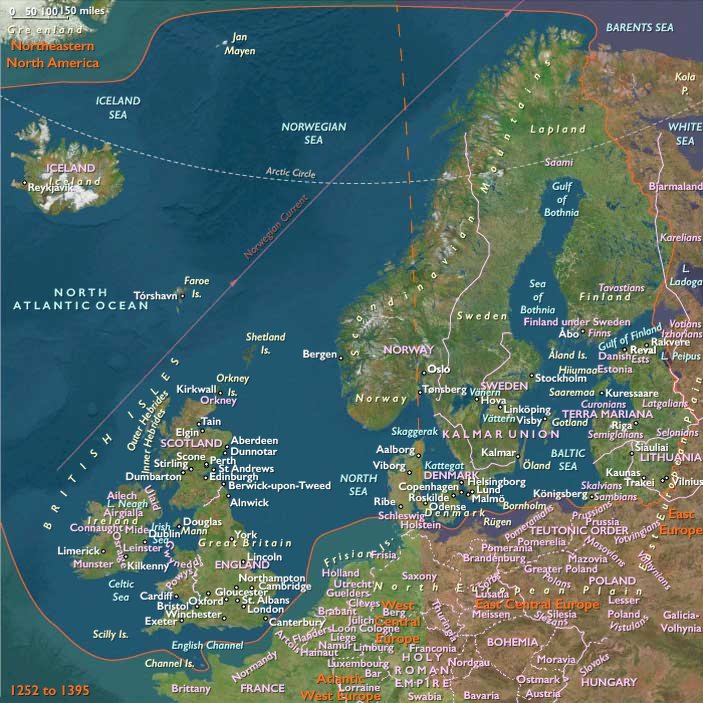
North Europe
View →Subregions