
Northeast Europe (1816–1827 CE): Postwar Stabilization, Territorial…
1816 CE to 1827 CE
Northeast Europe (1816–1827 CE): Postwar Stabilization, Territorial Adjustments, and Socioeconomic Recovery
Between 1816 and 1827 CE, Northeast Europe entered an era characterized by cautious stabilization, territorial realignments, administrative restructuring, and gradual socioeconomic recovery following the upheavals of the Napoleonic period. This period was marked by Sweden and Norway navigating their newly established union, Finland consolidating its status as a stable autonomous Grand Duchy within the Russian Empire, Denmark rebuilding economically and administratively after territorial losses, Prussia continuing its internal strengthening, and significant reforms progressing cautiously within the Baltic territories, particularly Estonia’s emancipation of serfs.
Sweden and Norway: Navigating a Complex Union
Following the establishment of the personal union under King Charles XIII (r. 1809–1818) and subsequently his successor, Karl XIV Johan (Jean-Baptiste Bernadotte) (r. 1818–1844), Sweden and Norway managed their coexistence with relative stability but underlying tensions. Although Norway retained considerable domestic autonomy and its own constitution, Sweden retained authority over foreign affairs, creating lingering dissatisfaction among Norwegians who desired greater independence within the union. Under Karl XIV Johan’s leadership, Sweden emphasized economic reform, infrastructure investment, and internal modernization, promoting recovery and enhancing international standing.
Finland: Consolidation of Autonomy under Russian Sovereignty
Finland continued to prosper as an autonomous Grand Duchy under the Russian Empire, governed by the personal authority of Tsar Alexander I (r. 1801–1825), later succeeded by Tsar Nicholas I (r. 1825–1855). Governance of the Grand Duchy was characterized by careful administrative balance, reflecting both Finnish traditions of self-government and Russian autocracy.
In 1816, the Finnish Government Council, the chief instrument of governance, was renamed the Senate, composed of fourteen Finns appointed directly by the Russian tsar. Complementing this structure in St. Petersburg was the Committee for Finnish Affairs, staffed by Finns, which communicated Finnish requests to the tsar. Finnish civil servants conducted day-to-day governance with minimal interference from Russia, maintaining considerable domestic autonomy.
Although the Finnish Diet was formally the legislative body, it lacked independent legislative power and could only petition the tsar to introduce legislation. Moreover, the tsar had the unilateral authority to summon or dismiss the Senate without consulting the Diet, reflecting a delicate balance between Finnish autonomy and tsarist control. Despite these limitations, Finland retained a separate and independent judicial system, maintained its own customs service, and kept all taxes collected domestically. Additionally, Finns were notably exempt from conscription into the Russian army, contributing to Finnish satisfaction with Russian governance.
The Finnish Diet had been dismissed in 1809, and notably, it would not reconvene for over fifty years. Yet, despite these autocratic elements, Finns experienced sustained internal peace and stability for the first time in centuries, benefiting greatly from the absence of warfare on Finnish soil.
During this era, an embryonic form of Finnish nationalism, originating in the late eighteenth century as an academic and intellectual movement, continued to develop, grounded in linguistic, folkloric, and historical studies. This movement, previously spearheaded by Professor Henrik Gabriel Porthan of the University of Turku, laid foundational elements for Finland’s nineteenth-century national awakening, expressing Finnish skepticism toward previous Swedish rule and strengthening a growing Finnish national identity.
Denmark’s Economic Resilience and Administrative Reforms
Under the stable rule of King Frederick VI (r. 1808–1839), Denmark focused on economic and administrative restructuring following its territorial losses. Investment in agriculture, commerce, industry, and maritime trade helped restore Denmark’s economic strength and internal stability, supporting a gradual but sustained recovery. Danish cultural and educational institutions, particularly those in Copenhagen, thrived during this period, contributing to continued intellectual vibrancy.
Prussia: Continuing Internal Consolidation and Strengthening
Prussia, led by Frederick William III (r. 1797–1840), reinforced its earlier internal reforms by continuing economic modernization, agricultural improvement, and educational enhancement, especially around the strategic region of Königsberg (Kaliningrad). These measures significantly solidified Prussia’s economic foundation and social resilience, preparing it for future prominence in European affairs.
Baltic Territories: Emancipation and Socioeconomic Improvements
In the Baltic territories, particularly Estonia, significant socioeconomic reforms advanced cautiously but meaningfully. Following initial reforms in 1804, serfs in Estonian territories received formal emancipation—first in 1816 in Estland (northern Estonia), and subsequently in 1819in Livland (southern Estonia and northern Latvia). Although complete emancipation was gradual and often accompanied by ongoing hardships for peasants, these developments represented critical milestones in the Baltic region's social transformation.
Under the continued influence of the Baltic-German nobility, economic and administrative stability was largely maintained, ensuring steady growth and moderate prosperity, especially in urban centers such as Riga and Reval (Tallinn), which continued thriving through robust maritime commerce.
Economic Recovery and Urban Development
Major urban centers in Northeast Europe, notably Stockholm, Copenhagen, Oslo, Königsberg, Riga, and Reval, experienced gradual economic revitalization and urban growth. Investments in infrastructure, maritime commerce, and trade expansion facilitated regional economic integration, promoting urban stability and prosperity despite lingering geopolitical uncertainties.
Cultural and Intellectual Continuity
Throughout this period, cultural and educational institutions across Northeast Europe maintained resilience and vibrancy. Finland's autonomous status fostered intellectual growth, emphasizing national linguistic and historical studies that supported emerging Finnish nationalism. In Denmark and Sweden, academic and cultural institutions flourished, reinforcing Enlightenment ideals. Prussian educational reforms significantly enhanced scholarly prestige, sustaining intellectual continuity throughout the region.
Diplomatic Stability and Pragmatic Governance
Diplomatically, Northeast European powers practiced pragmatic neutrality and cautious engagement during this era. The Swedish-Norwegian union prioritized internal governance stability, Finland maintained loyal relations with Russia through conciliatory policies, Denmark prioritized economic stabilization and cautious diplomacy, and Prussia focused on internal reform rather than external aggression, collectively contributing to regional stability.
Legacy of the Era
The period from 1816 to 1827 CE deeply influenced Northeast Europe's subsequent historical trajectory. The cautious stability of the Swedish-Norwegian union, Finland’s autonomous integration within Russia, Denmark’s successful economic recovery, Prussia’s internal consolidation, and Estonia’s milestone emancipation of serfs collectively defined regional socioeconomic evolution. The period's balance between traditional governance structures and emerging national identities, notably in Finland, set foundational precedents for significant future transformations, shaping Northeast Europe's enduring legacy.
People
Groups
Commodities
Subjects
Regions
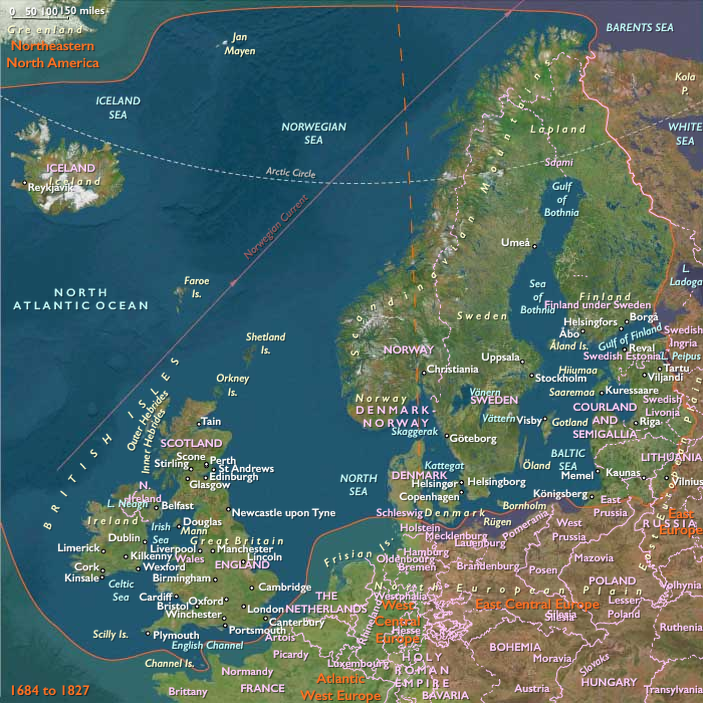
North Europe
View →Subregions
