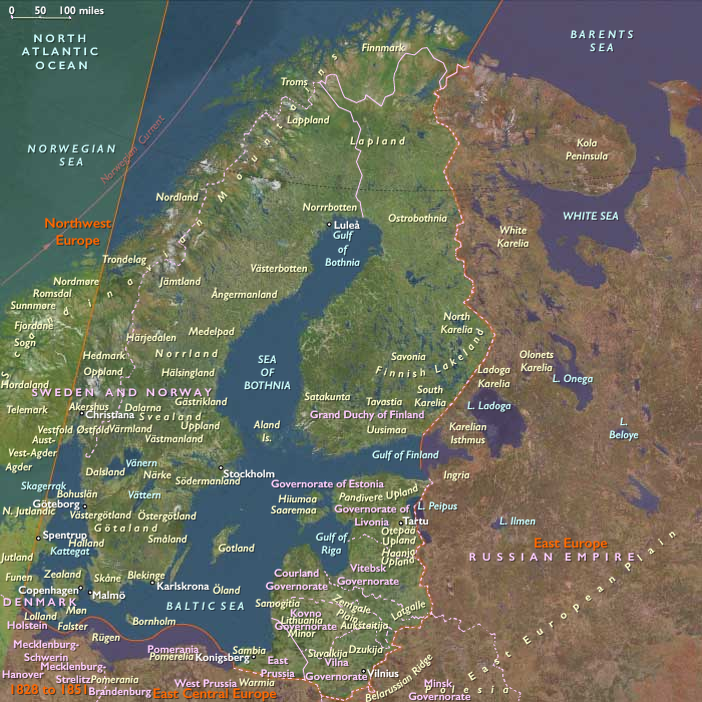
Northeast Europe (1840–1851 CE): Economic Expansion, Cultural…
1840 CE to 1851 CE
Northeast Europe (1840–1851 CE): Economic Expansion, Cultural Flourishing, and Intensifying National Movements
Between 1840 and 1851 CE, Northeast Europe experienced significant economic expansion, intensified national and cultural movements, and rising political tensions that reflected broader European currents. Finland witnessed increasingly contentious linguistic nationalism, while Norway and Denmark faced new political challenges during the revolutionary upheavals of 1848. Sweden navigated internal union tensions, and Prussia continued its socioeconomic reforms. Meanwhile, religious and literary awakenings across the region amplified the era's dynamic societal changes.
Finland: Intensified Language Struggles and National Movements
Under the rule of Russian Tsar Nicholas I (r. 1825–1855), Finland maintained its autonomy as a Grand Duchy, enjoying sustained economic stability. Internally, Finland's political landscape was increasingly defined by intense linguistic and cultural nationalism, marked by the rivalry between two influential movements: the Fennomans and the newly formed Svecomans.
The Fennoman movement, led notably by Johan Vilhelm Snellman (1806–1881), grew increasingly assertive, advocating the Finnish language as essential to national survival and resistance to Russian cultural assimilation. In reaction, Finland’s traditional Swedish-speaking elite established the Svecoman movement, which argued that Swedish-speaking Finns constituted a distinct national community that must preserve its Swedish heritage, language, and cultural identity. Though smaller in number, the Svecomans rapidly became a potent political force, gaining considerable support within the Swedish-speaking community.
Amid these language-based rivalries, the short-lived Liberal Party emerged briefly, advocating reforms such as press freedom, increased self-governance, and economic liberalization. However, the party fractured under the intense linguistic controversy, with its members absorbed largely into either the Fennoman or Svecoman camps.
Culturally, the legacy of Elias Lönnrot’s Kalevala (1835) inspired further literary and artistic development. Significantly, the Swedish-language poet Johan Ludvig Runeberg (1804–1877) contributed to Finland’s national awakening with the publication of The Tales of Ensign Stål (1848), a poetic cycle honoring Finnish valor during war. The first poem, "Our Land," swiftly became Finland’s national anthem, reinforcing a common national identity transcending linguistic divisions.
The rise of religious movements such as Pietism further characterized this era. Pietism, spearheaded by farmer-evangelist Paavo Ruotsalainen (1777–1852), emphasized personal spirituality over the formalistic rituals of Finland’s rationalistic Lutheran state church. Pietism gained widespread popularity among Finland’s rural populations, significantly influencing Finnish religious culture and becoming particularly influential among Finnish emigrants in America, countering political radicalism abroad.
Sweden and Norway: Union Stability, Political Conservatism, and Social Unrest
Under the reign of King Charles XIV John (Karl XIV Johan) until 1844, and subsequently Oscar I (r. 1844–1859), the union between Sweden and Norway maintained economic stability despite underlying tensions. King Charles XIV John, although considered a liberal monarch for his era, suppressed demands for Norwegian independence through stringent press censorship, secret policing, and political surveillance, reflecting conservative governance practices of the Metternich era.
In Norway, societal conservatism and political restrictions limited democratic participation largely to officials, property owners, and urban burghers. Despite political restlessness across Europe during the Revolutions of 1848, Norway saw relatively little revolutionary upheaval due to its conservative, aristocratic governance and the absence of a robust bourgeois class.
Nevertheless, Norway was not immune to social challenges. In 1848, Marcus Thrane, a prominent utopian socialist, mobilized Norway’s working classes through organized labor societies, starting in Drammen and quickly spreading nationwide. Within two years, Thrane’s movement had attracted over twenty thousand urban and rural supporters, united for the first time by shared social grievances. However, authorities swiftly repressed the movement, imprisoning Thrane and sentencing him in 1855 for crimes against the state. Although Thrane’s movement ultimately failed, it marked a significant milestone in Norway’s social and political consciousness.
Denmark: Peaceful Constitutional Transformation
Under Christian VIII (r. 1839–1848) and subsequently Frederick VII (r. 1848–1863), Denmark experienced significant internal change. Amidst Europe-wide revolutionary movements, Denmark transitioned peacefully into a constitutional monarchy on June 5, 1849, following sustained advocacy from the nascent Danish liberal and nationalist movements that had gained momentum since the 1830s. This new constitution established a bicameral parliament, modernizing Danish governance and placing Denmark on a path of cautious political liberalization.
Prussia: Economic Consolidation and Internal Reform
Prussia, under Frederick William IV (r. 1840–1861), furthered its internal socioeconomic reforms, achieving significant economic growth and modernization. Railway construction, agricultural improvements, and educational advancements boosted the region’s productivity, particularly benefiting Königsberg (Kaliningrad). The continued focus on internal consolidation significantly strengthened Prussian social stability and economic foundations, preparing it for later prominence.
Baltic Territories: Social Reform and Urban Growth
The Baltic territories, notably Estonia and Livonia, continued their gradual rural improvements following earlier serf emancipation. Despite persistent socioeconomic disparities and enduring control by the Baltic-German aristocracy, incremental rural reforms improved conditions modestly for former serfs.
Urban centers, including Reval (Tallinn) and Riga, sustained economic prosperity through maritime commerce and trade integration, benefiting from administrative stability and reinforcing broader regional economic growth.
Economic Development and Urban Expansion
Across Northeast Europe, urban centers such as Stockholm, Copenhagen, Oslo, Helsinki, Königsberg, Riga, and Reval experienced significant economic growth, infrastructure enhancements, and deeper integration into European commercial networks. Industrial advancements and infrastructure improvements reinforced regional prosperity, fostering stable economic conditions.
Cultural, Religious, and Literary Flourishing
The period saw extraordinary cultural, literary, and religious developments throughout Northeast Europe. In Finland, literary figures like Runeberg and religious leaders such as Ruotsalainen influenced national identity profoundly. Pietism reshaped religious attitudes, emphasizing individual spirituality and personal piety, significantly impacting Finland’s societal fabric.
In Denmark, constitutional reforms facilitated cultural openness and intellectual expression. Swedish, Norwegian, and Prussian societies similarly continued intellectual growth through thriving educational and scholarly institutions, embodying Enlightenment and Romantic nationalist ideals.
Diplomatic Stability and Regional Pragmatism
Diplomatically, Northeast European states maintained cautious stability, prioritizing internal development over external confrontations. Finland's autonomy under Russia persisted peacefully, while Sweden-Norway, Denmark, and Prussia pursued careful neutrality and domestic reform, maintaining stable geopolitical conditions.
Legacy of the Era
The period from 1840 to 1851 CE significantly shaped Northeast Europe's subsequent history. Intensifying linguistic nationalism in Finland, exemplified by the competing Fennoman and Svecoman movements, laid profound cultural and political foundations, preparing Finland for its eventual national independence. Norway's brief but significant social movement led by Marcus Thrane illustrated rising social consciousness despite conservative governance. Denmark’s peaceful constitutional transition reflected successful liberalization, setting precedents for stable democracy. Prussia’s continued internal reforms enhanced its geopolitical significance, while incremental social transformations in the Baltic territories gradually improved rural societies.
These developments collectively established critical cultural, political, and socioeconomic foundations that would shape Northeast Europe's subsequent trajectory throughout the nineteenth and early twentieth centuries.
People
Groups
Subjects
Regions
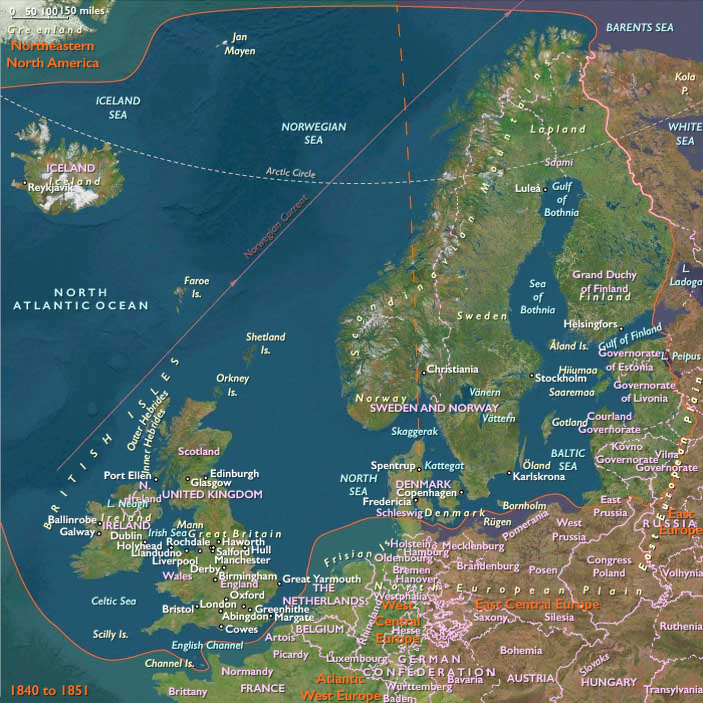
North Europe
View →Subregions