Event
East Europe (28,557–7,822 BCE): Late Pleistocene II…
East Europe (28,557–7,822 BCE): Late Pleistocene II — Mammoth-Steppe Societies, Deglacial Rivers, and the Return of the Forest
Geographic and Environmental Context
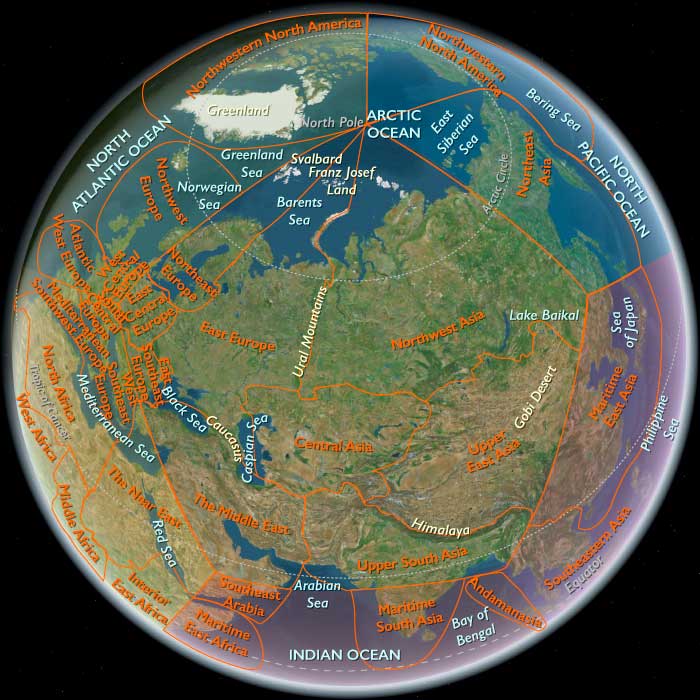
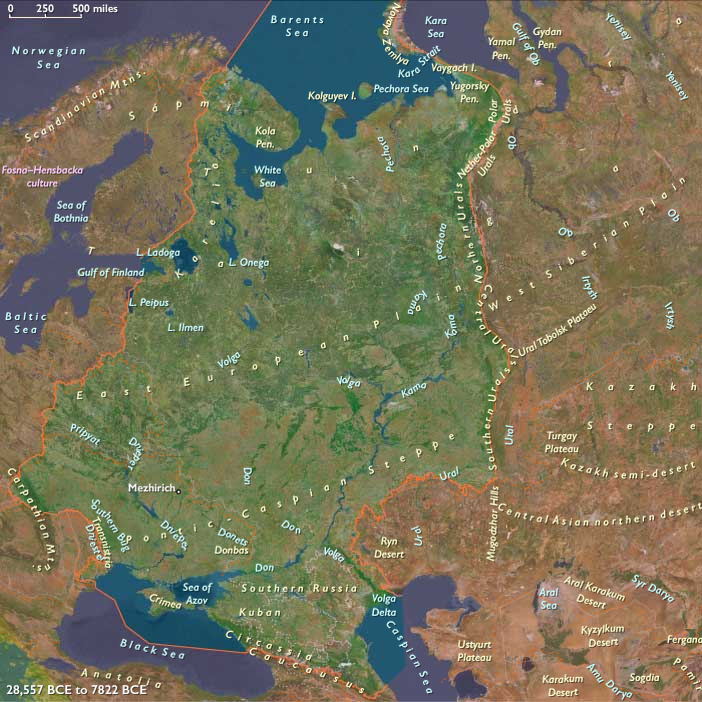
During the interval from 28,557 to 7,822 BCE, East Europe encompassed Belarus, Ukraine, and European Russia west of the Ural Mountains.
Its principal environmental systems included the Dnieper and its tributaries; the Desna and Pripyat basins; the Dniester; the Don system; the Volga and Oka; the northern Black Sea lowlands; the Pontic–Caspian steppe; broad forest-steppe zones; and northern plains approaching the Scandinavian glacial margin.
This was one of Eurasia’s great continental transition zones.
Over the course of the band, much of the region changed from cold, open Late Pleistocene environments into a far more wooded early-Holocene landscape.
Its defining geography emerged from the interaction of ice margin, loess plain, grassland, river valley, wetland, forest refugium, and changing inland-sea margins.
Climate and Environmental Shifts
During the Last Glacial Maximum, approximately 24,500–17,000 BCE, much of East Europe was colder, drier, and more open than today.
The Scandinavian Ice Sheet extended into the northern portion of the wider eastern European plain. Farther south, large areas remained ice-free but strongly periglacial.
Across Ukraine and southern European Russia, broad landscapes supported cold steppe, herb-rich tundra-steppe, sparse shrub, and riverine vegetation.
Permafrost and severe seasonal ground freezing were widespread.
Strong winds transported immense quantities of dust and contributed to the accumulation of loess.
Trees survived mainly in scattered refugia and favorable river valleys rather than as continuous forest.
After the LGM, warming transformed both vegetation and hydrology.
Retreating ice and degrading permafrost altered river discharge, erosion, floodplains, drainage patterns, and lake formation. Meltwater enlarged or redirected channels, while river valleys became increasingly productive ecological corridors.
During the Bølling–Allerød, approximately 12,700–10,900 BCE, substantial warming encouraged the spread of birch, shrubs, wetlands, and increasingly wooded habitats.
The Younger Dryas, approximately 10,900–9,700 BCE, brought renewed cold conditions to much of East Europe. Open vegetation expanded in some sectors, forest development slowed or reversed locally, and cold-adapted fauna remained important in suitable regions.
The Younger Dryas did not recreate the LGM landscape. Hydrology, sea level, vegetation, and animal distributions had already changed too profoundly.
After about 9,700 BCE, early-Holocene warming accelerated forest expansion across much of the region.
Human Presence
Modern humans were well established in East Europe before this band began.
The LGM did not empty the whole region, although population distribution changed substantially.
Human communities remained particularly visible along the major river systems and favorable plains of the Dnieper, Desna, Don, Dniester, and central Russian zones.
The coldest or least productive districts could experience strong population contraction.
Occupation was therefore patchy and highly responsive to resource concentration, rather than either continuous everywhere or absent across the glacial plain.
As northern landscapes became increasingly habitable after ice retreat, people expanded into regions that had previously been marginal or unoccupied.
The Mammoth-Steppe World
The open environments of the earlier part of the band supported a distinctive Pleistocene large-mammal community.
Depending on region and phase, this included woolly mammoth, woolly rhinoceros, reindeer, wild horse, steppe bison, saiga, and musk ox in colder northern settings.
Large predators included wolves and other carnivores.
These animals did not occur everywhere in equal abundance.
The term mammoth-steppe describes an ecological system, not a landscape literally dominated everywhere by mammoths.
Human communities hunted large herbivores in some contexts, but subsistence was broader than megafaunal hunting alone.
Subsistence and Settlement
Large mammals provided meat, fat, hide, bone, sinew, and sometimes ivory.
People also used hares and other small mammals, birds, fish, freshwater resources, roots, seeds, berries, and other plant foods.
River valleys were especially valuable because they concentrated multiple resources within relatively short distances.
Settlement remained mobile or seasonally mobile, but some places were returned to repeatedly over long spans.
The archaeological record therefore preserves both highly mobile occupations and more substantial recurrent settlements.
The Dnieper–Desna World
The Dnieper and Desna basins became especially important centers of Late Pleistocene human activity.
Open grasslands and river terraces supported large herbivore populations, while reliable water and varied habitats encouraged repeated occupation.
Later Late Pleistocene sites in this wider zone preserve striking concentrations of mammoth bone, stone tools, hearths, activity areas, ornaments, and structural remains.
Sites such as Mezhyrich and Mezin belong to this broader late-glacial tradition.
They demonstrate substantial investment in repeatedly used places without requiring permanent village settlement.
Mammoth-Bone Structures
East Europe preserves some of the world’s most remarkable Late Pleistocene structures incorporating mammoth bones.
Large skulls, tusks, mandibles, and limb bones could be arranged into substantial architectural frameworks or structural rings.
These sites demonstrate planning, repeated occupation, intensive use of animal remains, and considerable social coordination.
They were not universal.
Nor does the presence of large quantities of mammoth bone prove that every represented animal was hunted at the site.
Bones could derive from hunting, scavenging, natural deaths, or materials gathered from surrounding landscapes.
Technology and Material Culture
Stone industries varied across the eastern European plain.
Blade production remained important, while toolkits included projectile points, backed or retouched implements, burins, scrapers, and cutting tools.
Bone, antler, and ivory were also worked extensively.
Wood, hide, sinew, and plant fiber almost certainly formed important parts of everyday material culture but preserve unevenly.
Different archaeological traditions occupied different regions and phases.
Labels such as Gravettian and Epigravettian are useful where appropriate, but they should not be treated as one homogeneous culture spanning the entire subregion or the entire band.
Cultural and Symbolic Expressions
Mammoth ivory and other animal materials could be transformed into beads, pendants, tools, and decorated objects.
Pigment use also occurred.
Personal ornamentation, patterned objects, deliberate burials, and selected raw materials indicate complex symbolic and social worlds.
These traditions varied among communities.
The archaeological record does not support reconstructing one shared East European religion or cosmology.
Later ethnic and linguistic identities cannot be projected into this period.
The Don and Volga–Oka Systems
The Don basin and adjoining central Russian plain supported another important concentration of Late Pleistocene occupation.
River terraces offered freshwater, raw materials, movement corridors, and access to open-country game.
As climates changed, the boundary between steppe and woodland shifted repeatedly across this region.
The Volga and Oka connected southern steppe, central plains, and northern environments.
During colder phases, their valleys gave access to migratory ungulates.
During later phases, woodland spread and animals such as elk, deer, wild boar, and beaver became increasingly important.
These river systems remained useful even as the surrounding ecology changed fundamentally.
Northern Glacial Margin
Northern East Europe lay closer to the Scandinavian ice complex.
During maximum-glacial conditions, some northern areas were glaciated or environmentally marginal.
As the ice retreated, newly exposed landscapes passed through sequences of bare mineral surfaces, tundra, shrub vegetation, and eventually birch and pine woodland.
Lakes and meltwater systems were widespread.
Humans gradually expanded into these newly habitable regions.
This was a process of recolonization and northward expansion, not uninterrupted dense occupation.
The Retreat of the Mammoth-Steppe
By the terminal Pleistocene, the continuous mammoth-steppe ecosystem was breaking apart.
Greater warmth and moisture encouraged birch, pine, wetlands, and denser riverine vegetation.
Large open grasslands became increasingly fragmented.
Woolly mammoth and woolly rhinoceros disappeared from most of East Europe, while other species shifted their ranges.
The transition was gradual and ecological rather than one simultaneous megafaunal collapse.
Climate-driven habitat change was fundamental, while human hunting may have added pressure to some already vulnerable populations.
Human economies changed alongside these faunal transformations.
Forest Expansion and Aquatic Resources
After about 9,700 BCE, forest spread rapidly across much of East Europe.
Birch and pine were followed in favorable areas by increasingly diverse temperate woodland.
The south retained broad grasslands and forest-steppe, but northern and central districts became progressively more wooded.
Hunting increasingly focused on elk, red deer, roe deer, wild boar, beaver, and smaller forest animals.
At the same time, rivers, lakes, oxbows, marshes, and wetlands became increasingly important.
Fish, waterbirds, freshwater mollusks, beaver, and edible aquatic plants contributed to local economies.
Fishing grew in significance in some settings, but this should not be transformed into a universal shift toward sedentary fishing settlements.
Mobility remained substantial.
Northern Black Sea and Caspian Margins
The southern margins of East Europe also underwent major hydrological change.
The Black Sea and Caspian did not remain fixed at modern levels throughout the band.
Their shorelines shifted as global sea level, river discharge, and regional basin hydrology changed.
Lowlands appeared or disappeared, river mouths migrated, and wetlands developed along changing margins.
People living in these regions therefore experienced mobile coastlines alongside changing inland landscapes.
Movement and Connectivity
The great East European rivers structured human movement across enormous distances.
The Dnieper, Dniester, Don, Volga, Oka, and Desna linked steppe, forest-steppe, northern plains, and wetland environments.
During colder phases, open steppe also permitted broad east–west movement.
As forests expanded, rivers became even more important as natural corridors through increasingly wooded terrain.
Raw materials, technologies, and social connections moved through these networks.
These were not formal trade routes, but long-lived ecological and human pathways.
Human Diversity and Population Change
Climate repeatedly reorganized East European population geography.
During the LGM, people concentrated in favorable southern and central environments.
As warming opened northern landscapes, populations expanded into formerly marginal territory.
Late-glacial cold reversals could slow, redirect, or fragment those movements.
By the early Holocene, occupation extended through a much broader mosaic of forest, forest-steppe, river valley, wetland, and southern grassland.
No single population replaced all others in one event.
The archaeological record instead points to repeated regional persistence, movement, interaction, and recolonization.
No Farming or Pastoralism
At the close of the band, East Europe remained a hunter-gatherer world.
There were no regional economies based on cereal agriculture, cattle herding, sheep or goat pastoralism, or horse pastoralism.
Wild plant foods could be collected intensively, and forest or aquatic resources could sustain repeated occupation of favorable places.
These developments did not yet constitute agriculture.
The later transformation of East Europe by farming belongs to subsequent Holocene periods.
Environmental Adaptation and Resilience
Human populations survived because they could adapt to radically different ecological systems.
During the LGM, people occupied cold open plains and river refugia.
During deglaciation, they adjusted to unstable rivers, changing animal distributions, and newly opening northern landscapes.
As woodland spread, hunting shifted toward forest prey and aquatic resources became more important.
During the Younger Dryas, communities adjusted again to renewed climatic deterioration.
The common thread was not one technology or one prey species, but flexible mobility across river, steppe, wetland, and forest landscapes.
Transition
By 7,822 BCE, East Europe had changed almost beyond recognition from its maximum-glacial condition.
The Scandinavian ice margin had retreated far north.
Periglacial plains had largely given way to forest, forest-steppe, wetlands, and surviving southern grasslands.
Woolly mammoths and woolly rhinoceroses had vanished from the region.
The Dnieper, Don, Volga, Oka, and their tributaries had become central arteries through increasingly wooded landscapes.
Human populations remained hunter-gatherers, now exploiting a wider mixture of forest game, fish, wetlands, rivers, and plant foods.
The celebrated mammoth-bone settlements belonged increasingly to a vanished ecological world.
At the close of the band, East Europe was a deeply inhabited landscape transformed from cold mammoth-steppe into an early-Holocene mosaic of forest, river, wetland, and surviving southern grassland—a human world reorganized around the same great river systems even as nearly everything surrounding them changed.

-
{# Image navigates to the detail page; the magnifying-glass chip is the only Fancybox lightbox trigger (kept a separate sibling — anchors can't nest). #}
 The Great Crossroads
World
-
{# Image navigates to the detail page; the magnifying-glass chip is the only Fancybox lightbox trigger (kept a separate sibling — anchors can't nest). #}
 Northeastern Eurasia
Region
-
{# Image navigates to the detail page; the magnifying-glass chip is the only Fancybox lightbox trigger (kept a separate sibling — anchors can't nest). #}
 East Europe
Subregion