Northeast Europe (1108–1251 CE): Crusading Corridors, Competing…
1108 CE to 1251 CE
Northeast Europe (1108–1251 CE): Crusading Corridors, Competing Missions, and the Baltic Frontier
Geographic Parameters
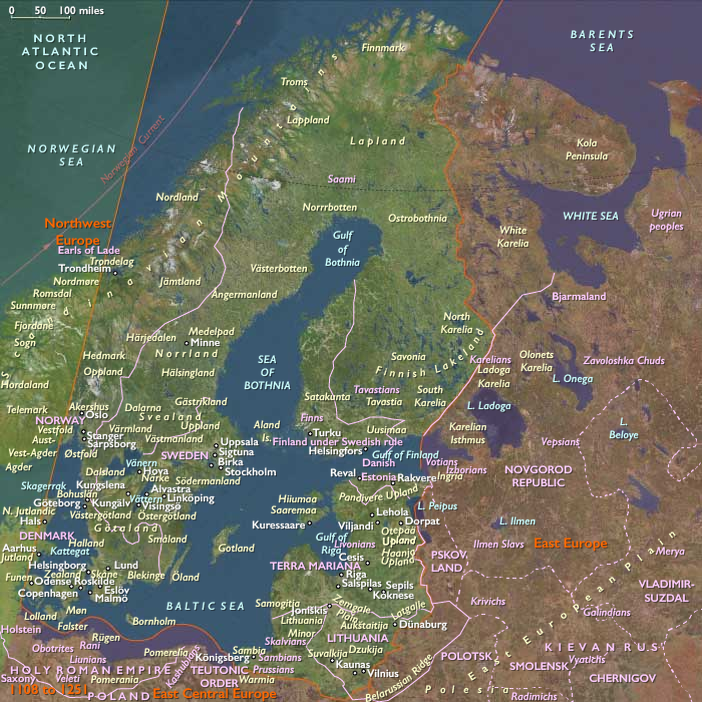
Northeast Europe comprised Sweden, Finland, Estonia, Latvia, Lithuania, the Kaliningrad coast, eastern Denmark including Zealand and Copenhagen, and eastern Norway including the Oslofjord. The Baltic Sea remained the subregion’s principal corridor, linking the Øresund, Mälaren, Gotland, Åland, the Gulfs of Finland and Bothnia, the Estonian islands, the Gulf of Riga, and the river mouths of the eastern Baltic.
The region continued to divide into distinct environmental zones. Denmark, southern Sweden, Lithuania, Latvia, and parts of Estonia contained the broadest agricultural districts. Finland and central Sweden were dominated by forests, lakes, rocky uplands, bogs, and narrow coastal clearings. Archipelagos supported sheltered sailing, while the Neva, Volkhov, Daugava, and Nemunas systems connected the Baltic to Novgorod, Rus’, Poland, and the inland forest zone.
Environmental Continuity
The forest–sea structure established in earlier ages remained intact. Most people still lived in farms, hamlets, fishing settlements, forest clearings, lake communities, and fortified local districts rather than in large towns. Churches, castles, crusading encampments, and commercial ports occupied selected nodes and corridors without transforming the whole landscape.
Water continued to govern movement. Coastal traffic followed islands, headlands, sheltered bays, and river mouths, while winter ice created temporary overland routes. Forests supplied timber, tar, charcoal, fuel, game, furs, and grazing. Wetlands, lakes, and coastal waters sustained fisheries and transport while separating political and religious jurisdictions.
Climate and Environmental Change
The Medieval Warm Period continued to support agricultural expansion in southern Scandinavia and parts of the eastern Baltic. Longer growing seasons encouraged the extension of rye, barley, oats, hay meadows, and livestock raising into favorable districts. New estates, ecclesiastical properties, and fortified centers drew surplus from surrounding farms.
Northern and inland communities remained exposed to early frosts, wet summers, thin soils, and prolonged winters. Finland, Karelia, and the Bothnian interior continued to rely upon mixed farming, swidden cultivation, fishing, hunting, and forest products. Storms and sea ice still constrained maritime campaigning and trade, making military and commercial movement strongly seasonal.
Societies and Political Development
The age’s principal new organizing system was the conversion of religious and commercial competition into territorial crusading corridors.
In Sweden, kings and aristocratic families strengthened their authority through church patronage, law, taxation, military followings, and the development of towns and fortified sites. The Svear and Götar remained regionally distinct, and royal power continued to depend upon assemblies, bishops, major landholders, and local alliances. Expansion toward Finland and the eastern Baltic was real but uneven, combining trade, missionary activity, dynastic ambition, and military expeditions.
In Denmark, royal and ecclesiastical institutions were well established. Zealand, Skåne, Lund, Roskilde, and the Øresund connected agricultural wealth with maritime power. Danish rulers increasingly projected force into the southern and eastern Baltic, especially toward the Slavic and Estonian coasts. Copenhagen grew in importance but had not yet eclipsed older royal and ecclesiastical centers.
Eastern Norway remained integrated into a Christian monarchy whose authority extended through law, church organization, taxation, and maritime defense. Oslo developed as a royal and episcopal center, while the surrounding fjord landscape remained dominated by farms, fisheries, timber, and smaller landing places.
In Finland, regional Finnic communities retained substantial autonomy. Southwest Finland, Tavastia, Karelia, and the lake districts were not politically unified. Coastal groups interacted with Sweden and Gotland, while Karelia and eastern Finland maintained close commercial and religious ties with Novgorod. Latin and Orthodox influence entered through different corridors without immediately replacing local institutions.
Across Estonia, Latvia, and Lithuania, Estonians, Livonians, Curonians, Semigallians, Latgalians, Lithuanians, and related societies continued to organize around hillforts, fortified settlements, river territories, local chiefs, assemblies, and warrior bands. These communities traded and fought with Scandinavians, Germans, Rus’, and one another. Their political systems were not merely remnants awaiting conquest; they were active regional powers capable of alliance, raiding, tribute collection, and sustained resistance.
The Sámi continued to occupy northern and interior territories through fishing, hunting, reindeer use, trapping, and seasonal mobility. Scandinavian taxation and missionary interest expanded slowly, but direct control remained incomplete across most Sámi lands.
Agriculture and Productive Landscapes
Agricultural expansion supported royal, ecclesiastical, and military institutions. Rye, barley, oats, peas, flax, hemp, and livestock formed the productive base of southern and coastal districts. Estates associated with kings, bishops, monasteries, and aristocratic families organized rents, labor, storage, and transport.
In forest zones, swidden cultivation remained important. Burned clearings produced grain for limited periods before becoming pasture, scrub, or secondary woodland. This created irregular mosaics rather than continuous cultivated plains.
Fishing remained central throughout the Baltic and lake districts. Herring, salmon, pike, perch, and other species supported household consumption, urban markets, religious fasting requirements, and regional trade. Seal hunting persisted in northern gulfs and archipelagos.
Timber, tar, charcoal, wax, honey, hides, and furs linked forest communities to towns, fleets, castles, and export markets. Ironworking expanded in Sweden and Finland, supplying agricultural tools, weapons, fittings, and ship rivets. Productive landscapes therefore supported both ordinary households and the new infrastructure of crusade and territorial rule.
Crusading Expansion in Livonia and Estonia
Latin missionary activity in Livonia became increasingly militarized around the turn of the thirteenth century. Clergy, merchants, crusaders, and German-speaking settlers established fortified positions along river mouths and commercial routes. Riga, founded in 1201, became the principal base for ecclesiastical, military, and commercial expansion along the Daugava.
The Livonian Brothers of the Sword, established in 1202, converted crusading ideology into territorial conquest. Campaigns targeted Livonian, Latgalian, Estonian, Curonian, and Semigallian communities through fortified occupation, tribute demands, hostage-taking, alliance-building, baptism, and repeated military expeditions.
Conquest was neither swift nor uniform. Local chiefs allied with crusaders against rivals, accepted baptism for strategic reasons, rebelled against new obligations, or shifted between German, Danish, Rus’, and regional alliances. Fortified hill settlements, forests, bogs, and difficult coastlines supported prolonged resistance.
After the Brothers of the Sword suffered a major defeat at Saule in 1236, their surviving organization was absorbed into the Teutonic Order in 1237 as the Livonian branch. This strengthened the institutional connection between military monasticism, castles, ecclesiastical lordship, and commercial towns.
Danish forces also established power in northern Estonia, especially around Reval. The result was not a single crusader state but a layered field of bishops, military orders, Danish authority, German-speaking towns, local elites, and subordinated rural communities.
Swedish and Novgorodian Competition in Finland
Swedish influence expanded into southwest Finland through ecclesiastical patronage, settlement, political alliances, and military pressure. Later traditions associated this process with formal “crusades,” but the historical expansion was more gradual and uneven than those narratives suggest.
Latin churches, burial grounds, estates, and fortified sites became more visible in southwest Finland. Swedish-speaking settlers increased along parts of the coast, while Finnic communities continued to farm, fish, trade, and govern through local networks.
Novgorod projected influence through Karelia, the Neva corridor, Lake Ladoga, and eastern Finland. Novgorodian merchants sought furs, wax, fish, and tribute, while Orthodox missionaries and monasteries extended religious influence. Karelians participated as traders, allies, tributaries, and military actors rather than functioning simply as subjects of either Sweden or Novgorod.
The competition between Latin and Orthodox spheres remained fluid. Local communities could interact with both systems, and neither side possessed a fully defined territorial border.
Lithuanian Consolidation
Among the Baltic peoples, Lithuanians increasingly coordinated military and political action. Pressure from crusading orders, Rus’ principalities, and neighboring Baltic societies encouraged larger alliances and more durable leadership.
Lithuanian war bands raided neighboring territories, defended forest and river corridors, and incorporated or allied with surrounding communities. The foundations of a broader Lithuanian polity emerged through warfare, tribute, kinship, and control of movement rather than through an immediately centralized state.
Lithuanian religious traditions remained resilient. Sacred groves, fire rituals, ancestral places, thunder cults, and seasonal ceremonies continued to structure social and political life. Resistance to conversion was intertwined with defense of local authority, landholding, and tribute rights.
Towns, Commerce, and German Merchant Expansion
Baltic commerce continued to grow even as crusading warfare destabilized parts of the eastern coast. Gotland and Visby remained major intermediaries between Scandinavia, Rus’, the eastern Baltic, and German ports. German merchants expanded their presence in Riga, Reval, and other coastal settlements, bringing commercial law, credit practices, craft organization, and connections to Lübeck and the North Sea.
Hanseatic structures had not yet reached their later maturity, but their foundations were forming. Merchant privileges, fortified warehouses, urban councils, and protected shipping routes increasingly distinguished the larger ports from ordinary coastal landings.
Exports included furs, wax, honey, grain, timber, tar, amber, fish, hides, iron, and enslaved people. Imports included salt, cloth, wine, metal goods, weapons, silver, and luxury wares. Coinage circulated more widely, though barter, weighed silver, rents in kind, and labor obligations remained important.
Commercial towns depended upon rural producers, river carriers, fishers, boatbuilders, translators, porters, and local brokers. Crusading institutions likewise depended upon trade, since castles and armies required imported grain, salt, weapons, cloth, and coin.
Technology and Material Culture
Clinker-built vessels remained dominant for local and regional traffic. Broader cargo ships carried grain, timber, livestock, fish, and military supplies, while smaller vessels moved through archipelagos and rivers. German maritime influence contributed to the development of larger bulk-carrying ships, but local boat forms remained essential.
Stone and brick construction became more visible in selected crusader and royal centers. Riga, Reval, Danish-held districts, and ecclesiastical sites acquired churches, towers, walls, and castles. These structures were exceptional nodes within a predominantly timber-built region.
Hillforts and timber-earth defenses continued among Finnic and Baltic societies. Crusaders frequently occupied, rebuilt, or bypassed local strongholds rather than replacing them immediately. Wooden bridges, causeways, river landings, palisades, and fortified camps were often more important than monumental castles during active campaigns.
Watermills, improved iron tools, heavy ploughs in southern districts, and more organized estate workshops increased production. These technologies spread unevenly and did not eliminate swidden, hand cultivation, local smithing, or household craft.
Religion and Competing Missions
Latin Christianity was firmly established in Denmark, Norway, Sweden, and parts of Finland. Parishes, bishoprics, monasteries, cemeteries, tithes, and written law extended ecclesiastical reach into rural life.
In the eastern Baltic, missionary activity became inseparable from conquest. Baptism could accompany treaty-making, tribute, hostage exchange, military defeat, or alliance. Churches and cemeteries often appeared near fortified centers, while rural sacred practices continued beyond direct ecclesiastical supervision.
Orthodox Christianity expanded through Novgorodian influence in Karelia and the eastern Gulf of Finland. Monasteries, clergy, icons, and liturgical practice entered existing trading and tribute networks.
Finnic, Baltic, and Sámi religious traditions remained active. Sacred groves, stones, springs, burial grounds, household rites, animal ceremonies, and seasonal festivals survived beneath or beside Christian institutions. Conversion therefore produced layered religious landscapes rather than immediate uniformity.
Warfare, Conquest, and Coercion
The Northern Crusades brought sustained violence to Livonia, Estonia, Prussia, and adjacent Baltic lands. Campaigns burned settlements, destroyed crops, seized livestock, imposed tribute, relocated populations, and created new landholding systems. Captives were taken, hostages exchanged, and defeated communities compelled to supply labor and military service.
Crusader institutions presented conquest as conversion, but economic and political motives were equally important. Control of river mouths, ports, agricultural districts, tribute, and trade routes shaped military priorities.
Scandinavian and Novgorodian expeditions into Finland and Karelia likewise combined missionary claims with competition over taxation, tribute, furs, and strategic corridors. Local communities bore repeated demands from rival powers and often shifted allegiance to preserve autonomy.
Enslavement persisted in warfare and commerce, although Christian legal systems increasingly restricted some forms of enslavement among co-religionists. Dependency, forced labor, serf-like obligations, and tribute continued to expand under new lordships.
Adaptation and Resilience
Baltic and Finnic communities adapted through fortified settlement, forest mobility, alliance-making, and the use of difficult terrain. Hillforts, bogs, river crossings, islands, and wooded interiors limited the reach of cavalry and siege forces.
Religious conversion could be negotiated strategically. Local elites sometimes accepted baptism to preserve authority, secure allies, or gain access to trade, while households retained older ritual practices. Rebellion remained possible when new rulers increased tribute or violated local agreements.
Mixed economies continued to buffer warfare and climatic risk. Farms combined grain, livestock, fishing, woodland use, hunting, and craft production. Communities displaced from exposed corridors could retreat into forests, islands, and lake districts.
Commercial routes also adapted. Merchants redirected shipping around conflict zones, negotiated protection from competing authorities, and used Gotland, Danish waters, and German ports as alternative hubs.
Legacy of the Age
By 1251 CE, Northeast Europe had become a contested frontier among Scandinavian kingdoms, Novgorod, German merchants, crusading orders, bishops, Baltic societies, and Finnic communities. Christianity was no longer only a courtly or missionary presence. In Livonia and Estonia, it had become the institutional language of territorial conquest, fortified administration, landholding, and tribute.
The age did not produce complete Christianization or uniform foreign control. Baltic and Finnic societies retained fortified communities, local leadership, sacred landscapes, and substantial political agency. Lithuania emerged as a growing regional power, while Finland and Karelia remained divided between Latin, Orthodox, and local systems.
Commerce and conquest advanced together. Riga, Reval, Visby, and other ports connected military and ecclesiastical expansion to German and Scandinavian trade, yet these towns remained dependent upon surrounding forests, farms, fisheries, and river communities.
The principal transformation of the age was therefore the creation of crusading corridors: chains of ports, churches, castles, estates, and tributary districts extending into landscapes that remained environmentally dominant and politically contested. These systems prepared the way for the next age’s more durable Hanseatic cities, Swedish rule in Finland, Livonian and Teutonic territorial organization, Lithuanian expansion, and the intensifying struggle for control of the Baltic commercial world.
Images
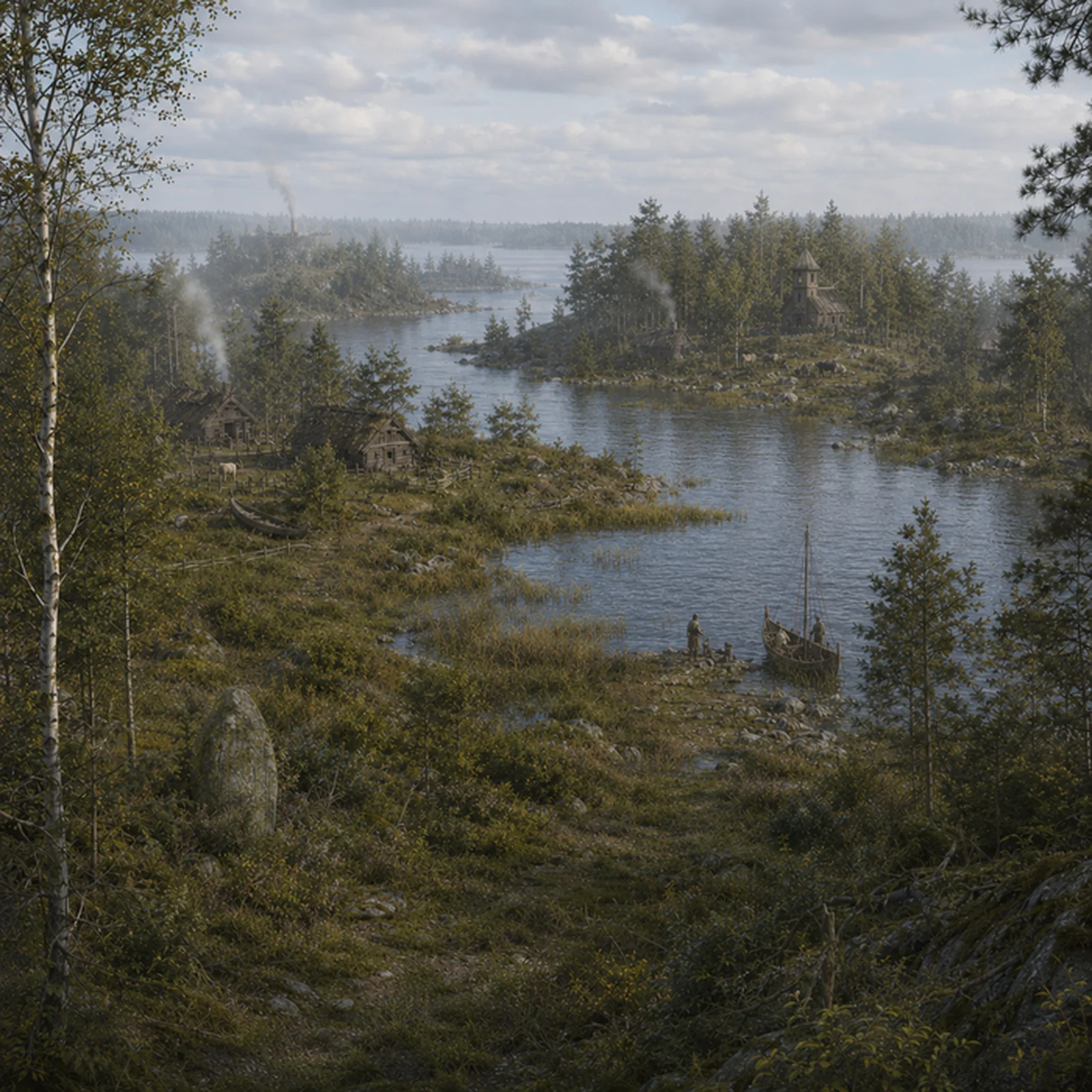
Northeast Europe in the High Medieval (Upper) age
Groups
Commodities
Subjects
Regions
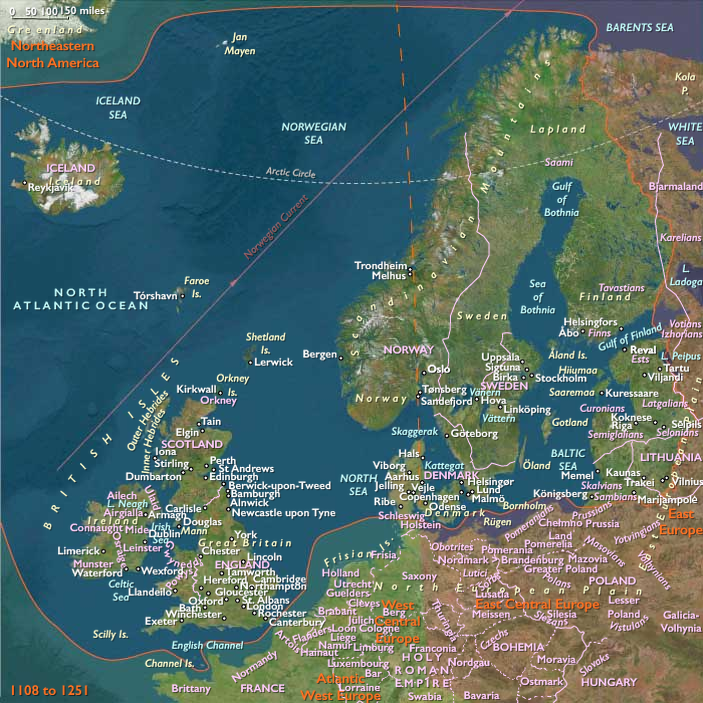
North Europe
View →Subregions