
Northeastern North America (1636 to 1647 …
Years: 1636 - 1647
Northeastern North America
(1636 to 1647 CE): Indigenous Conflict, Colonial Expansion, and Epidemic Catastrophe
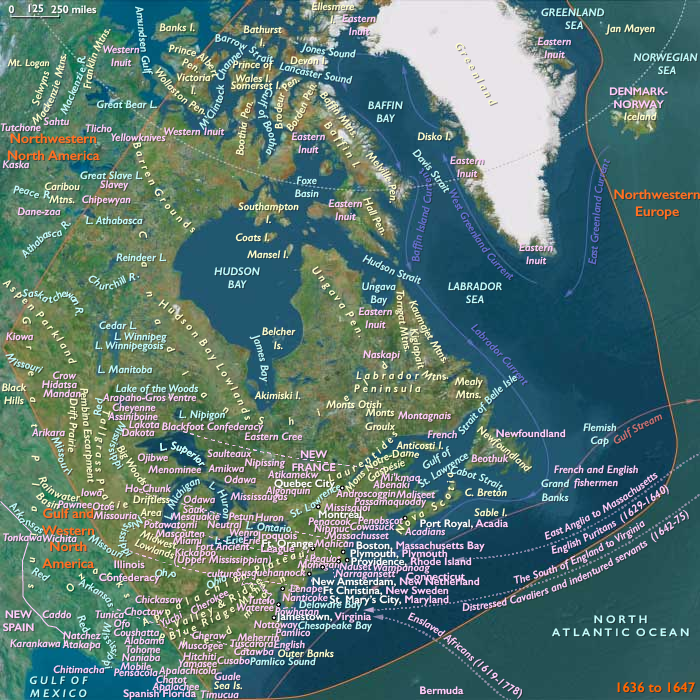
Between 1636 and 1647 CE, Northeastern North America witnessed dramatic changes through devastating indigenous-European conflicts, accelerated European colonial expansion, severe population declines due to disease, and intensified rivalry over fur-trade dominance. This period was dominated by the destructive Pequot War (1636–1638), catastrophic epidemics among the Huron (Wendat), fierce attacks by the Haudenosaunee Confederacy, and strategic realignments shaping indigenous-European alliances and power dynamics.
European Colonial Expansion and Consolidation
English Colonization Intensifies
English colonies expanded rapidly with new settlements established in Connecticut (1636) and Rhode Island (1636), greatly increasing territorial pressure on indigenous nations. Conflicts such as the Pequot War accelerated colonial dominance in southern New England, reshaping indigenous alliances and power structures significantly.
French Influence and Huron Alliances in New France
French colonization solidified around Quebec, largely due to alliances with the influential Huron Confederacy, which controlled critical fur-trading routes along the St. Lawrence River. In 1609, Atironta, a principal headman of the Arendarhonon tribe (a subgroup of the Huron), had forged the initial alliance with the French at Quebec, reinforcing cooperative ties that flourished through this period.
Detailed observations of the Huron by French Jesuits began to appear prominently in the Jesuit Relations, particularly in 1639, when Jesuit François du Peron vividly described the Huron as robust, tall individuals who wore beaver-skin mantles, porcelain bead necklaces, greased hair, and faces painted black and red.
Dutch Patroonship Expansion in New Netherland
Dutch colonization expanded through the patroon system in New Netherland, furthering agricultural settlement and extending trade networks along the Hudson Valley and surrounding regions.
Devastating Indigenous-European Conflicts
The Pequot War (1636–1638)
The destructive Pequot War dramatically reduced indigenous power in southern New England. English settlers and allied indigenous tribes, notably the Narragansett and Mohegan, decisively defeated the Pequot, profoundly reshaping regional power structures.
Haudenosaunee Attacks and Regional Instability
In the early 1640s, the Haudenosaunee Confederacy (Iroquois League)—particularly threatened by declining populations and disrupted fur-trade dominance—initiated fierce attacks against frontier Huron villages along the St. Lawrence River. The primary objective was disrupting the lucrative Huron-French fur-trade partnership, but this aggression rapidly escalated into direct conflict with the French colonists.
The Haudenosaunee, who considered themselves the region’s most advanced society, intensified these aggressive campaigns, seeking territorial expansion and dominance over the eastern Great Lakes region.
Epidemic Catastrophe and Demographic Collapse
Devastation of the Huron Population
From 1634 to 1640, Eurasian diseases—particularly smallpox and measles—severely devastated the Huron Confederacy, whose population at the onset of European contact ranged between 20,000 and 40,000 individuals. Epidemiological studies link this intensified wave of infection to increased immigration of European children from densely populated cities in France, Britain, and the Netherlands, where smallpox was endemic. These diseases likely spread rapidly to the Huron through routine contact with traders.
The epidemics killed between half and two-thirds of the Huron population, reducing their numbers dramatically to approximately 12,000 survivors. The catastrophic mortality disrupted family structures, depopulated villages, abandoned agricultural lands, and severely weakened their societal cohesion and traditional culture.
Broader Epidemic Effects
Similar epidemic devastation occurred widely among other indigenous groups, compounding demographic and societal disruption throughout Northeastern North America. Indigenous lands depopulated by epidemics enabled rapid European territorial expansion, exacerbating indigenous vulnerability.
Indigenous Strategic Realignments and Adaptations
Post-Pequot War Indigenous Alliances
The Narragansett and Mohegan tribes, by aligning with English settlers against the Pequot, reshaped regional indigenous power structures. This strategic alliance permanently altered the balance of power in southern New England.
Huron-French Alliance under Duress
Though the Huron retained their alliance with the French despite catastrophic epidemics, their capacity to control the fur trade diminished. Nevertheless, the French continued to support the surviving Huron through trade and limited military assistance against Haudenosaunee aggression.
Shifts in the Fur Trade and Environmental Consequences
Decline of the Hudson Valley Beaver Population
By 1640, firearms, increasingly traded to indigenous groups by Europeans, had dramatically accelerated the decline of the beaver population, nearly eliminating it from the Hudson Valley region. This environmental impact forced the fur trade’s center northward, focusing increasingly on colder regions along the St. Lawrence River, controlled by the Huron and their French trading partners.
Interior Indigenous Communities: Stability, Migration, and Adaptation
Great Lakes Algonquian Stability
The Potawatomi, Ojibway, Cree, Cheyenne, and Arapaho continued maintaining traditional subsistence patterns while cautiously engaging in expanding European trade networks. Similarly, tribes including the Kickapoo, Menominee, Sauk, and Fox adapted strategically to shifting regional alliances and economic opportunities.
Miami and Illinois Economic Positioning
The Miami and Illinois leveraged agriculturally productive territories along the Ohio Valley to strategically position themselves within European fur trade networks, increasing their political and economic significance.
Siouan-speaking Peoples: Stability and Westward Migration
Separation of the Assiniboine from the Sioux
The Assiniboine nation, sharing ancestry with the Sioux, separated from the larger Sioux nation no later than 1640, as evidenced by the Jesuit Paul Le Jeune’s reference to them alongside the "Naduessi" (Sioux) in the Jesuit Relations of that year. Linguistic analysis confirms that the Assiniboine and closely related Stoney of Alberta represent a distinct subdivision alongside the Santee, Lakota, and Yankton-Yanktonai.
Continued Stability Among Eastern Siouan Groups
The Dakota, Assiniboine, and Winnebago (Ho-Chunk) maintained stable settlements in Wisconsin and Upper Michigan, insulated from direct European settlement pressures, though other groups—including ancestors of the Omaha, Iowa, Kansa, Osage, and Quapaw—gradually moved westward.
Plains Indigenous Communities: Stability and Continuity
Pawnee Resilience
The Pawnee maintained stable, agriculturally prosperous villages along central Plains river valleys, preserving their ceremonial traditions and societal structures despite regional disruptions.
Gros Ventre and Tsuu T’ina Isolation
Northern Plains tribes, notably the Gros Ventre near Lake Manitoba and the Tsuu T’ina (Sarcee) in northern Saskatchewan, maintained cultural autonomy and stability, largely shielded by geographic isolation from direct European impacts.
Newfoundland’s Beothuk: Escalating Threats
Increasingly Vulnerable Beothuk
The Beothuk faced mounting pressures from expanding English settlements in Newfoundland. Competition for resources and exposure to disease increasingly threatened their survival, accelerating their eventual decline.
Indigenous Artistic and Cultural Continuity
Endurance of Cultural Practices
Indigenous groups continued vibrant artistic traditions—including intricate beadwork, ceremonial pottery, and ornate tobacco pipes—reinforcing cultural identity and resilience amidst ongoing societal disruption.
Continued Ceremonial Traditions
Haudenosaunee Longhouse ceremonies, Mi’kmaq seasonal celebrations, and Pawnee religious rites persisted robustly, providing essential cultural continuity amid geopolitical upheavals.
Environmental Context and Adaptation Strategies
Little Ice Age Challenges
Climatic variability associated with the Little Ice Age continued to challenge indigenous subsistence strategies. Communities demonstrated notable resilience through adaptive agriculture, extensive ecological knowledge, and flexible seasonal mobility.
Legacy of the Era (1636–1647 CE)
The period 1636–1647 CE reshaped Northeastern North America profoundly through intensified indigenous-European conflict, epidemic devastation, aggressive Haudenosaunee expansion, and strategic indigenous realignments. Severe declines in indigenous populations, notably among the Huron, coupled with environmental changes—particularly the collapse of the Hudson Valley beaver population—accelerated shifts in trade and territorial dominance. This era permanently altered regional dynamics, laying foundations for future indigenous-European interactions and shaping the geopolitical, cultural, and ecological landscape of Northeastern North America for generations.
Groups
- Iroquois (Haudenosaunee, also known as the League of Peace and Power, Five Nations, or Six Nations)
- Portuguese people
- Algonquin, or Algonkin, people (Amerind tribe)
- Basque people
- Abenaki people (Amerind tribe)
- Maliseet, or Wolastoqiyik, people (Amerind tribe)
- Mi'kmaq people (Amerind tribe)
- Ho-Chunk (Amerind tribe)
- Beothuk people
- Thule people
- Penobscot people (Amerind tribe)
- English people
- Mohawk people (Amerind tribe)
- Osage Nation (Amerind tribe)
- Wyandot, or Wendat, or Huron people (Amerind tribe)
- England, (Tudor) Kingdom of
- Yankton Sioux Tribe
- Cree (Amerind tribe)
- Tuscarora (Amerind tribe)
- Kickapoo people (Amerind tribe)
- Potawatomi (Amerind tribe)
- Menominee (Amerind tribe)
- Iowa (Amerind tribe)
- Ponca (Amerind tribe)
- Nanticoke people (Amerind tribe)
- Powhatan (Amerind tribe)
- Yuchi (Amerind tribe)
- Kiowa people (Amerind tribe)
- Tsuu T'ina; also Sarcee, Sarsi, Tsu T'ina, Tsuut'ina (Amerind tribe)
- Plains Apache, or Kiowa Apache; also Kiowa-Apache, Naʼisha, Naisha (Amerind tribe)
- Mohegan people (Amerind tribe)
- Massachusett people (Amerind tribe)
- Dakota, aka Santee Sioux (Amerind tribe)
- Cherokee, or Tsalagi (Amerind tribe)
- Sauk, or Sac, people (Amerind tribe)
- Meskwaki, or Fox tribe (Amerind tribe)
- Lenape or Lenni-Lenape (later named Delaware Indians by Europeans)
- Ojibwa, or Ojibwe, aka or Chippewa (Amerind tribe)
- Seneca (Amerind tribe)
- Cayuga people(Amerind tribe)
- Onondaga people (Amerind tribe)
- Oneida people (Amerind tribe)
- Lakota, aka Teton Sioux (Amerind tribe)
- Mahican (Amerind tribe)
- Innu (Montagnais, Naskapi) (Amerind tribe)
- Iroquoians, St. Lawrence
- Susquehannock (Amerind tribe)
- Narragansett people (Amerind tribe)
- Pequots (Amerind tribe)
- Wampanoag (Amerind tribe)
- Catawba people (Amerind tribe)
- Quapaw, or Arkansas (Amerind tribe)
- Omaha (Amerind tribe)
- Pawnee (Amerind tribe)
- Kaw, or Kanza, people (Amerind tribe)
- Caddo (Amerind tribe)
- Mandan (Amerind tribe)
- Hidatsa people (Amerind tribe)
- Shoshone, Shoshoni, or Snakes (Amerind tribe)
- Crow people, aka Absaroka or Apsáalooke (Amerind tribe)
- Cheyenne people (Amerind tribe)
- Arapaho people (Amerind tribe)
- Gros Ventre or “Atsina” people (Amerind tribe)
- Assiniboine people (Amerind tribe)
- Spaniards (Latins)
- Spain, Habsburg Kingdom of
- New France (French Colony)
- Jesuits, or Order of the Society of Jesus
- Spain, Habsburg Kingdom of
- Florida (Spanish Colony)
- Netherlands, United Provinces of the (Dutch Republic)
- France, (Bourbon) Kingdom of
- England, (Stuart) Kingdom of
- Plymouth Company, The (also called the Virginia Company of Plymouth)
- London Company, The (also called the Virginia Company of London)
- Virginia (English Colony)
- New Netherland (Dutch Colony)
- Plymouth Council for New England
- Dutch West India Company
- Massachusetts Bay Colony (sometimes called the Massachusetts Bay Company, for its founding institution)
Topics
- Little Ice Age (LIA)
- Colonization of the Americas, Spanish
- North American Fur Trade
- Colonization of Asia, Dutch
- Little Ice Age, Warm Phase II
- Colonization of the Americas, English
- Beaver Wars, or French and Iroquois Wars
- Pequot War
Commodoties
- Fish and game
- Weapons
- Hides and feathers
- Gem materials
- Domestic animals
- Grains and produce
- Textiles
- Ceramics
- Strategic metals
- Salt
- Fuels, lubricants and sealants
- Manufactured goods
- Tobacco
Subjects
- Commerce
- Public health
- Decorative arts
- Conflict
- Exploration
- Faith
- Government
- Custom and Law
- Technology
- Catastrophe
- Human Migration
Regions
Subregions
Related Events
Showing 10 events out of 32410 total
Years: 1636 - 1647
Groups
- Iroquois (Haudenosaunee, also known as the League of Peace and Power, Five Nations, or Six Nations)
- Portuguese people
- Algonquin, or Algonkin, people (Amerind tribe)
- Basque people
- Abenaki people (Amerind tribe)
- Maliseet, or Wolastoqiyik, people (Amerind tribe)
- Mi'kmaq people (Amerind tribe)
- Ho-Chunk (Amerind tribe)
- Beothuk people
- Thule people
- Penobscot people (Amerind tribe)
- English people
- Mohawk people (Amerind tribe)
- Osage Nation (Amerind tribe)
- Wyandot, or Wendat, or Huron people (Amerind tribe)
- England, (Tudor) Kingdom of
- Yankton Sioux Tribe
- Cree (Amerind tribe)
- Tuscarora (Amerind tribe)
- Kickapoo people (Amerind tribe)
- Potawatomi (Amerind tribe)
- Menominee (Amerind tribe)
- Iowa (Amerind tribe)
- Ponca (Amerind tribe)
- Nanticoke people (Amerind tribe)
- Powhatan (Amerind tribe)
- Yuchi (Amerind tribe)
- Kiowa people (Amerind tribe)
- Tsuu T'ina; also Sarcee, Sarsi, Tsu T'ina, Tsuut'ina (Amerind tribe)
- Plains Apache, or Kiowa Apache; also Kiowa-Apache, Naʼisha, Naisha (Amerind tribe)
- Mohegan people (Amerind tribe)
- Massachusett people (Amerind tribe)
- Dakota, aka Santee Sioux (Amerind tribe)
- Cherokee, or Tsalagi (Amerind tribe)
- Sauk, or Sac, people (Amerind tribe)
- Meskwaki, or Fox tribe (Amerind tribe)
- Lenape or Lenni-Lenape (later named Delaware Indians by Europeans)
- Ojibwa, or Ojibwe, aka or Chippewa (Amerind tribe)
- Seneca (Amerind tribe)
- Cayuga people(Amerind tribe)
- Onondaga people (Amerind tribe)
- Oneida people (Amerind tribe)
- Lakota, aka Teton Sioux (Amerind tribe)
- Mahican (Amerind tribe)
- Innu (Montagnais, Naskapi) (Amerind tribe)
- Iroquoians, St. Lawrence
- Susquehannock (Amerind tribe)
- Narragansett people (Amerind tribe)
- Pequots (Amerind tribe)
- Wampanoag (Amerind tribe)
- Catawba people (Amerind tribe)
- Quapaw, or Arkansas (Amerind tribe)
- Omaha (Amerind tribe)
- Pawnee (Amerind tribe)
- Kaw, or Kanza, people (Amerind tribe)
- Caddo (Amerind tribe)
- Mandan (Amerind tribe)
- Hidatsa people (Amerind tribe)
- Shoshone, Shoshoni, or Snakes (Amerind tribe)
- Crow people, aka Absaroka or Apsáalooke (Amerind tribe)
- Cheyenne people (Amerind tribe)
- Arapaho people (Amerind tribe)
- Gros Ventre or “Atsina” people (Amerind tribe)
- Assiniboine people (Amerind tribe)
- Spaniards (Latins)
- Spain, Habsburg Kingdom of
- New France (French Colony)
- Jesuits, or Order of the Society of Jesus
- Spain, Habsburg Kingdom of
- Florida (Spanish Colony)
- Netherlands, United Provinces of the (Dutch Republic)
- France, (Bourbon) Kingdom of
- England, (Stuart) Kingdom of
- Plymouth Company, The (also called the Virginia Company of Plymouth)
- London Company, The (also called the Virginia Company of London)
- Virginia (English Colony)
- New Netherland (Dutch Colony)
- Plymouth Council for New England
- Dutch West India Company
- Massachusetts Bay Colony (sometimes called the Massachusetts Bay Company, for its founding institution)
Topics
- Little Ice Age (LIA)
- Colonization of the Americas, Spanish
- North American Fur Trade
- Colonization of Asia, Dutch
- Little Ice Age, Warm Phase II
- Colonization of the Americas, English
- Beaver Wars, or French and Iroquois Wars
- Pequot War
Commodoties
- Fish and game
- Weapons
- Hides and feathers
- Gem materials
- Domestic animals
- Grains and produce
- Textiles
- Ceramics
- Strategic metals
- Salt
- Fuels, lubricants and sealants
- Manufactured goods
- Tobacco
Subjects
- Commerce
- Public health
- Decorative arts
- Conflict
- Exploration
- Faith
- Government
- Custom and Law
- Technology
- Catastrophe
- Human Migration
Regions
Subregions