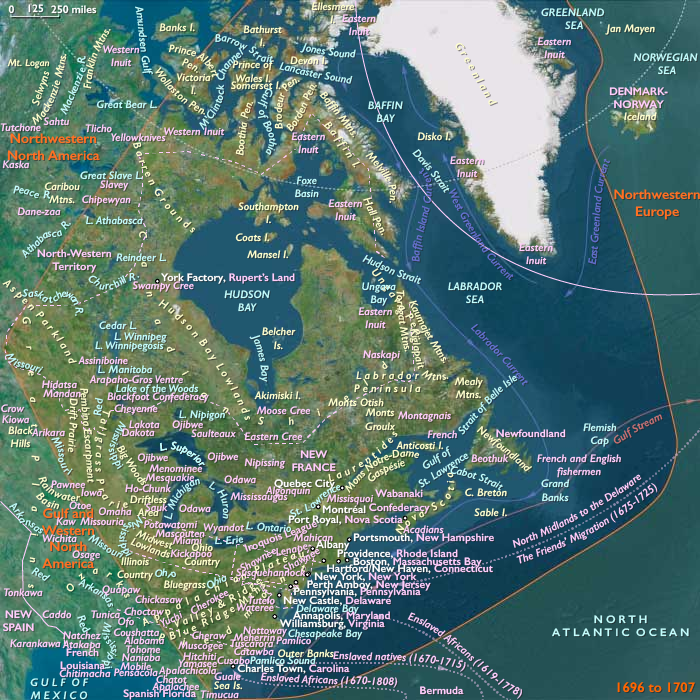
Northeastern North America (1696 to 1707 CE):…
1696 CE to 1707 CE
Northeastern North America
(1696 to 1707 CE): Frontier Warfare, Colonial Consolidation, and Shifting Indigenous Alliances
From 1696 to 1707, Northeastern North America experienced intensified frontier warfare, the entrenchment of plantation slavery, significant indigenous realignments, and growing cultural and economic complexity. The region was shaped by continuing colonial rivalries, indigenous migrations, and the emergence of new agricultural economies.
Colonial Warfare and European Rivalries
Iberville’s Newfoundland Campaign and the Treaty of Ryswick (1696–1697)
In 1696, French commander Pierre Le Moyne d’Iberville led successful attacks on English settlements in Newfoundland, capturing and devastating St. John’s and smaller ports, dealing a serious blow to English fishing and trading operations. The Treaty of Ryswick (1697) ended King William’s War, temporarily halting overt hostilities but leaving regional tensions unresolved.
Queen Anne’s War (1702) and the St. Augustine Campaign
Conflict reignited in 1702 with Queen Anne’s War, linked to Europe’s broader War of Spanish Succession. That year, English colonial forces captured and burned the Spanish town of St. Augustine, Florida. Despite initial successes, English attackers failed to take the well-defended presidio. Though the campaign was widely criticized as a failure, the English severely damaged the Spanish Florida mission system, culminating in the devastating Apalachee Massacre (1704), where the indigenous Apalachee population was nearly destroyed.
Indigenous Societies: Alliances, Conflicts, and Cultural Adaptations
Great Plains Peoples and Migrations
During this period, indigenous societies across the Plains continued evolving in response to external pressures. The Algonquian-speaking Blackfeet, originally from forests above Lake Winnipeg, and a southern branch of the Shoshone (later known as the Comanche) who had migrated from around Utah’s Great Salt Lake, stood out as non-agricultural nomads at the time of European contact.
Semi-nomadic farming peoples along the Missouri River, notably the Siouan-speaking Mandan and Hidatsa, lived in fortified villages composed of earthen lodges. They were joined in this region by agriculturist groups migrating northward from present-day Louisiana, including the ancestors of the Caddo, Wichita, Pawnee, and the Arikara—who later separated from the Pawnee, just as the Absaroke (Crow) had earlier separated from the Hidatsa.
Cheyenne Cultural Adaptation
The Cheyenne, having established themselves along the Missouri River by the late 1600s, interacted closely with their Mandan, Hidatsa (Tsé-heše'émâheónese, "people who have soil houses"), and Arikara (Ónoneo'o) neighbors, adopting significant aspects of their agricultural and cultural practices, and setting the stage for their later Plains identity.
Vincennes and the Miami Alliance
In 1696, Jean Baptiste Bissot, Sieur de Vincennes, appointed by Governor Comte de Frontenac, became the commander of French outposts in northeastern Indiana. He quickly formed a robust and enduring alliance with the Miami people. Vincennes settled first at the St. Joseph River, later establishing a trading post and fort at Kekionga (present-day Fort Wayne, Indiana) in 1704, solidifying French influence and fostering strong Franco-Miami cooperation.
Plantation Slavery and Agricultural Economies
Rice Cultivation and African Influence
In Carolina, low-country plantation owners actively experimented with cash crops ranging from tea to silk. Rice emerged as the most successful crop by 1700, thanks in large part to the expertise and agricultural techniques introduced by enslaved Africans, whose knowledge and labor proved indispensable. The transition into a full-scale slave-based agricultural economy accelerated, fundamentally reshaping South Carolina society.
Divergence of the Carolinas
Administrative divisions between North and South Carolina became entrenched during this period. In North Carolina, following Governor John Archdale’s departure to England in October 1696 (he would never return, dying in England in 1717), governance shifted. Joseph Blake succeeded Archdale as deputy governor. In 1699, Henderson Walker became deputy governor, pushing reforms to establish Anglicanism as the colony’s official religion. Walker passed the controversial Vestry Act, taxing all residents—regardless of faith—to fund the Church of England, significantly marginalizing Quakers.
Religious and Political Realignment in North Carolina
When Queen Anne ascended the throne in 1702, officials were required to renew oaths of loyalty. Quakers, traditionally prohibited from swearing oaths, lost political standing when their affirmations were no longer accepted as proof of loyalty. Over the following decade, the divide between the Quaker faction and the established Church faction deepened, marking a significant political and religious realignment.
Economic and Cultural Developments in the North
New York City’s Expansion: Slavery, Commerce, and Piracy
New York City grew substantially, becoming the most significant northern colonial port for importing enslaved Africans, essential to the economic growth of the region. The city also became a significant hub for piracy, supplying and profiting from pirate activities, further bolstering its economic importance within the English colonies.
Legacy of the Era (1696–1707 CE)
The era from 1696 to 1707 was transformative for Northeastern North America, marked by ongoing warfare, colonial rivalries, and significant indigenous adaptations. English campaigns against Spanish Florida reshaped the southern colonial landscape, while rice cultivation and plantation slavery dramatically altered Carolina’s economy and society. Indigenous peoples like the Cheyenne adapted culturally, and new alliances such as the Franco-Miami partnership at Kekionga shaped geopolitical dynamics. Religious and political realignments in North Carolina underscored evolving colonial identities and tensions. Collectively, these developments set lasting patterns for territorial control, economic reliance on slavery, and intercultural alliances that would shape the region throughout the eighteenth century.
People
Groups
Topics
Commodities
Subjects
Regions
Northern North America
View →Subregions