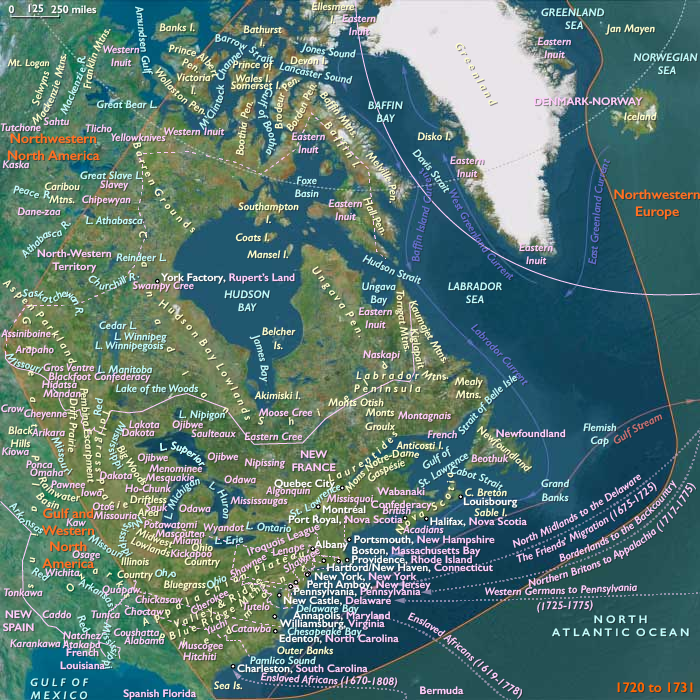
Northeastern North America (1720 to 1731 CE):…
1720 CE to 1731 CE
Northeastern North America
(1720 to 1731 CE): Colonial Prosperity, Indigenous Transformations, and Deepening Slavery
From 1720 to 1731, Northeastern North America experienced rapid colonial economic growth, deepening dependence on plantation slavery, further shifts in indigenous territories and alliances, and significant political and administrative transformations. The establishment and growth of fortified settlements, the restructuring of Carolina into crown colonies, and the continued evolution of indigenous societies defined this era.
Carolina: Administrative Realignment and Economic Expansion
Crown Colony Status and Division of Carolina (1719–1729)
In 1719, the Province of Carolina officially became a crown colony, coming under direct royal governance due to internal conflicts, economic concerns, and ongoing political tensions. In 1729, recognizing fundamental economic, social, and political differences, the British Crown formally split Carolina into two distinct colonies: North Carolina and South Carolina.
North Carolina continued developing around smaller-scale agriculture, timber, and naval stores, maintaining a more modest reliance on enslaved labor. It retained a more egalitarian, smaller-community character compared to its southern neighbor.
South Carolina prospered dramatically due to fertile soils and favorable climate conditions in the Lowcountry, its excellent natural harbors—particularly Charleston—and its diversified trade. The colony allowed significant religious toleration, encouraging immigration and settlement expansion. Thriving trade developed in deerskins, lumber, and beef, supporting regional economic stability.
Plantation Society and Rice Cultivation
Rice cultivation rapidly expanded, utilizing enslaved African labor and agricultural expertise, and by the late 1720s, South Carolina had become one of the wealthiest British colonies in North America. Plantation-based rice cultivation significantly transformed the Lowcountry’s society, economy, and landscape. By the second half of the eighteenth century, South Carolina emerged as among the richest of the soon-to-be Thirteen Colonies.
French Expansion and the Rise of Louisbourg
Founding and Development of Louisbourg (1719–1731)
In 1719, France began construction on a fortified town, named Louisbourg, strategically situated along the protected southwestern shore of Havre Louisbourg on Cape Breton Island. Louisbourg was designed as a formidable military stronghold to protect French maritime interests and secure the vital fishing grounds of the Grand Banks.
The enormous scale of French investment in the fortress and town infrastructure—prompting King Louis XV’s famous remark wondering if he might someday see Louisbourg from his palace at Versailles—underscored the settlement’s strategic importance. Louisbourg’s rapidly growing economy depended heavily on fishing, trade, and commerce between France, New France, and French colonies in the Caribbean.
The prosperity of Louisbourg, coupled with steady out-migration from the British-controlled colony of Nova Scotia (formerly Acadia), further strengthened this growing community, quickly establishing it as a vital French colonial center in North America.
Indigenous Migrations, Adaptations, and Alliances
Plains Peoples: Cheyenne Cultural Consolidation
The Cheyenne, increasingly established along the Missouri River, deepened their cultural exchange and integration with the semi-sedentary Mandan, Hidatsa ("Tsé-heše'émâheónese," meaning "people who have soil houses"), and Arikara ("Ónoneo'o"). These relationships bolstered their adaptation to Plains life, laying the groundwork for their future fully nomadic equestrian culture.
Siouan, Caddoan, and Algonquian Realignments
Indigenous nations across the Plains underwent further migration and realignment. The agriculturally proficient Mandan and Hidatsa continued semi-sedentary village life along the upper Missouri. Meanwhile, the Arikara strengthened their role as traders and intermediaries in the region, maintaining stable, fortified settlements. To the south, ancestors of the Caddo, Wichita, and Pawnee migrated northward from the southern Plains and the Mississippi River region, further extending their presence into the central Plains.
French and British Colonial Dynamics
French Alliances in the Interior
French commander Jean Baptiste Bissot, Sieur de Vincennes, maintained strong diplomatic and trade alliances with the Miami people at the strategic settlement of Kekionga (modern Fort Wayne, Indiana). French traders expanded their fur trade networks deep into the interior river valleys, strengthening economic and strategic ties and sustaining French influence in the Ohio Valley and Illinois Country.
British Territorial Consolidation
Britain solidified administrative and territorial control over the colonies during the 1720s, following earlier wars and the terms set by the Treaty of Utrecht (1713). Increased settlements in frontier regions and stable governance structures marked British consolidation efforts, particularly in the Atlantic coastal areas and Nova Scotia.
Maritime Commerce and Urban Growth
Continued Economic Expansion of New York City
New York City continued its emergence as a leading northern maritime hub during the 1720s, deeply engaged in Atlantic trade networks—including the slave trade—and acting as an essential center for commercial exchange. Despite regulatory attempts, piracy persisted, contributing to the city’s economic complexity and cultural reputation as a bustling Atlantic port.
Indigenous-European Relations and Cultural Exchange
Diplomatic Realignments and Peace Treaties
Following previous colonial wars, diplomatic relationships between indigenous nations and European powers became increasingly structured. The Haudenosaunee (Iroquois Confederacy) maintained a policy of strategic neutrality, negotiating carefully with both French and British officials to preserve autonomy and territorial integrity.
Environmental Transformations and Agricultural Innovations
Lowcountry Agricultural Systems
South Carolina’s agricultural systems, driven by enslaved African expertise, further integrated sophisticated West African rice cultivation and irrigation methods, including dikes and canals. These innovations suited the humid coastal environment, reshaping the region’s agriculture and ecology profoundly and permanently.
Continued Spanish Resilience in Florida
Stability of Spanish Territorial Control
Despite British expansion and earlier conflicts, Spanish control persisted in Florida’s key fortified settlements at St. Augustine and Pensacola, maintaining Spanish presence and influence in the southeastern frontier region throughout the 1720s.
Legacy of the Era (1720–1731 CE)
From 1720 to 1731, critical shifts occurred in colonial governance, economic prosperity, and territorial expansion in Northeastern North America. The division of Carolina into separate crown colonies fundamentally altered colonial administration, enabling South Carolina’s rapid economic growth and social stratification. The French establishment and growth of Louisbourg represented a major investment in North American military and economic interests, shaping subsequent Anglo-French rivalry. Indigenous communities, particularly Plains peoples, adapted strategically to changing conditions, significantly influencing their future cultures and territorial presence. Britain’s stable governance structures and territorial boundaries laid groundwork for further colonial expansion and settlement. Collectively, these developments deeply influenced economic, political, and cultural landscapes, setting the stage for continued colonial rivalry, indigenous adaptations, and the intensifying reliance on enslaved African labor that characterized subsequent decades.
People
Groups
Topics
Subjects
Regions

Northern North America
View →Subregions