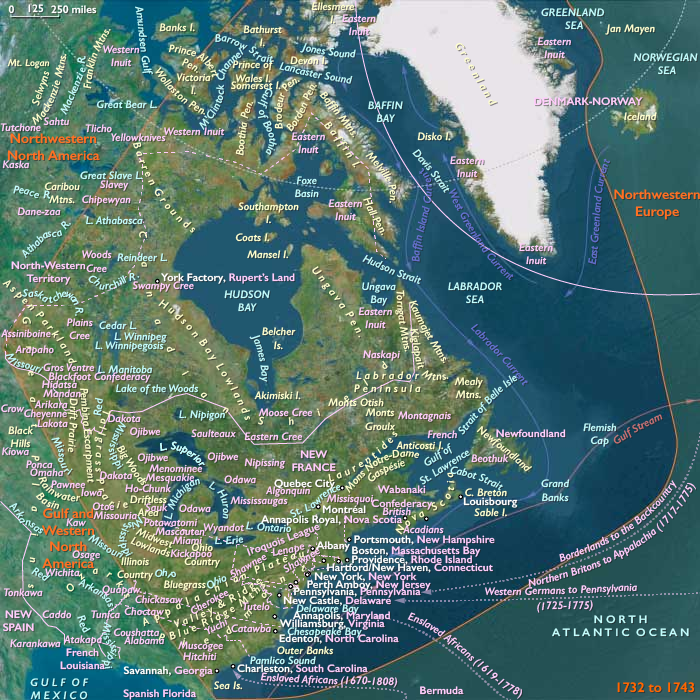
Northeastern North America (1732 to 1743 CE):…
1732 CE to 1743 CE
Northeastern North America
(1732 to 1743 CE): Territorial Expansion, Indigenous Diplomacy, and Economic Consolidation
Between 1732 and 1743, Northeastern North America saw territorial growth, intensified colonial rivalries, significant indigenous diplomacy, and economic prosperity through plantation agriculture and maritime commerce. This era also witnessed a powerful wave of religious revivalism known as the Great Awakening, and expansive French exploration into North America’s interior river valleys, significantly shaping cultural, social, and geopolitical dynamics.
Establishment and Expansion of British Colonies
Founding of Georgia (1732–1733)
In 1732, Britain founded its last mainland colony, Georgia, under James Oglethorpe. Designed as a refuge for debtors and as a buffer against Spanish Florida and French Louisiana, Georgia’s principal settlement, Savannah, emerged rapidly in 1733. Despite initial prohibitions against slavery and large plantations, regional economic pressures soon eroded these early ideals.
Economic Flourishing of South Carolina
South Carolina’s economy continued thriving, particularly due to rice plantations and extensive reliance on enslaved African labor. By the 1730s, Charleston ranked among the wealthiest colonial ports, exporting rice, indigo, deerskins, lumber, and beef, cementing South Carolina’s position as a dominant southern colony.
Louisbourg’s Strategic Importance
Completion and Prosperity of Louisbourg
By the early 1730s, France completed construction of the fortress town Louisbourg on Cape Breton Island. Louisbourg quickly became the most formidable French fortress in North America, strategically protecting maritime routes to New France and guarding vital fishing grounds on the Grand Banks. Its vibrant economy connected France, New France, and the French Caribbean colonies, escalating Anglo-French rivalries.
French Exploration into the Interior
Expansion of French Voyagers and Trade Routes
During this era, French voyageurs significantly expanded exploration into North America's interior. By 1743, French expeditions had explored and mapped extensive new regions, including the river valleys of the Red, Arkansas, and Platte Rivers, as well as areas surrounding Lake Winnipeg, Lake Manitoba, and along the Lower Saskatchewan River. This expansion deepened French influence, extending their trade networks and alliances far into the continental interior, establishing essential fur-trade pathways that would shape future geopolitical conflicts.
The Great Awakening and Religious Revivalism
Religious Enthusiasm and Growing Pluralism
The Great Awakening, a powerful Christian revivalist movement that peaked in the 1730s and 1740s, profoundly influenced colonial culture and society. Preachers such as Jonathan Edwards and later George Whitefield inspired widespread evangelical enthusiasm, leading to increased church participation, religious diversity, and a growing insistence on religious liberty. This movement fostered the growth of new denominations, weakened established religious authorities, and laid foundational ideas about individual rights and liberties that would later influence colonial politics.
Indigenous Diplomacy and Realignments
Plains and Great Lakes Indigenous Nations
On the Plains, the Cheyenne solidified relationships with the semi-sedentary agricultural communities of the Mandan, Hidatsa ("Tsé-heše'émâheónese"), and the Arikara ("Ónoneo'o"). Adopting agricultural practices and adapting to Plains life, they strengthened their resilience against external pressures.
The agriculturally sophisticated Mandan and Hidatsa maintained fortified villages along the Missouri River, thriving through trade, while the Arikara continued to hold vital roles as regional economic intermediaries.
French and British Rivalries in the Interior
Strengthening French-Miami Relations
French commanders such as Jean Baptiste Bissot, Sieur de Vincennes, maintained strategic alliances with the Miami at Kekionga (present-day Fort Wayne, Indiana). French traders leveraged these alliances, expanding trade routes and fortifying economic and political influence throughout the Ohio Valley and Illinois Country.
British Frontier Pressures and Indigenous Diplomacy
Britain continued westward settlement pressures from Pennsylvania, Virginia, and the Carolinas, increasing competition with French and indigenous interests. Indigenous nations, notably the Haudenosaunee (Iroquois Confederacy), engaged in sophisticated diplomacy, carefully managing European rivalry through strategic neutrality and selective alliances.
Maritime Commerce, Piracy, and Urban Growth
Prosperity and Regulation in New York City
New York City expanded rapidly during the 1730s, significantly engaged in Atlantic maritime commerce and the slave trade. British regulatory efforts intensified to curb piracy, but the city continued its economic ascent, reinforcing its critical role in colonial trade networks.
Slavery, Social Stratification, and Economic Dependence
Deepening Dependence on Enslaved African Labor
The prosperity of South Carolina’s plantation economy deepened reliance on enslaved Africans, reinforcing rigid social stratification based on race. Georgia’s initial resistance to slavery gradually weakened under economic pressure from its neighbors, laying the groundwork for slavery’s eventual establishment there.
Spanish Persistence and the Florida Frontier
Oglethorpe’s Georgia and Spanish Tensions
Spanish settlements, notably St. Augustine, remained resilient despite increased British frontier pressure. In 1740, James Oglethorpe unsuccessfully attempted to capture St. Augustine, highlighting ongoing Anglo-Spanish tensions and solidifying the southern colonial border.
Environmental Transformations and Agricultural Innovations
African Agricultural Techniques in Rice Cultivation
South Carolina’s plantation agriculture extensively utilized enslaved Africans’ agricultural knowledge, particularly in rice cultivation. Complex irrigation and water-management systems, including dikes and canals, transformed the Lowcountry ecology, ensuring large-scale, profitable rice production.
Legacy of the Era (1732–1743 CE)
The era from 1732 to 1743 profoundly influenced Northeastern North America. The establishment of Georgia completed British territorial claims along the Atlantic seaboard, intensifying rivalries with Spanish Florida and French Louisiana. Louisbourg’s strategic completion and expanded French explorations inland deepened Anglo-French tensions, setting the stage for future conflicts. The Great Awakening significantly shaped colonial culture, enhancing religious pluralism and ideas about individual liberty. Indigenous nations continued strategic adaptations, maintaining autonomy amid competing colonial pressures. Economic prosperity driven by plantation agriculture, slavery, and maritime trade reinforced regional wealth and social stratification. Collectively, these developments laid critical foundations for economic growth, indigenous diplomacy, geopolitical rivalry, and cultural transformations shaping subsequent North American history.
People
Groups
Topics
Commodities
Subjects
Regions
Northern North America
View →Subregions