Northeastern North America (1828–1971 CE) Industrial Heartlands,…
1828 CE to 1971 CE
Northeastern North America (1828–1971 CE)
Industrial Heartlands, Atlantic Gateways, and Cold War Crossroads
Geography & Environmental Context
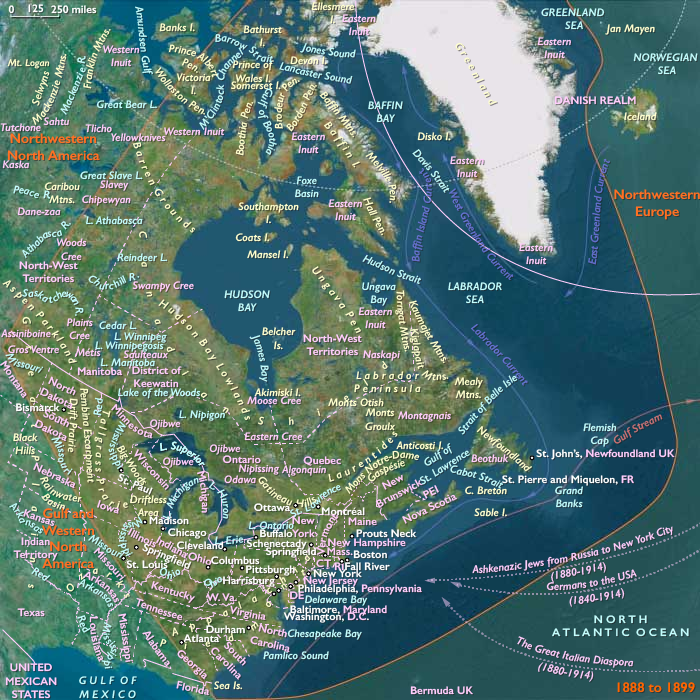
Northeastern North America includes all territory east of 110°W, except the lands belonging to Gulf and Western North America. This encompasses the Great Lakes basin, the St. Lawrence River corridor, Hudson Bay and Labrador, Newfoundland, Greenland, the Arctic, the Maritime provinces, and the Atlantic seaboard from New England through Virginia, the Carolinas, and most of Georgia. It also contains the Mississippi Valley north of Illinois’ Little Egypt and the Upper Missouri above the Iowa–Nebraska crossing, as well as northeast Alabama, central and eastern Tennessee, and nearly all of Kentucky.
Anchors included the Great Lakes–St. Lawrence corridor, the Appalachian piedmont, Hudson Bay, the Greenland ice sheet, and the Atlantic coastal plain. This was a region of forests and prairies, industrializing river valleys, and Arctic margins increasingly integrated into continental and global networks.
Climate & Environmental Shifts
The 19th century saw the close of the Little Ice Age, with harsh winters persisting into the mid-century before gradual warming by the 20th. The Great Lakes and St. Lawrence valleys endured blizzards and drought cycles. Greenland’s sea ice remained extensive until the early 20th century, then retreated. Atlantic storms reshaped seaboards, while the Dust Bowl’s fringes touched the upper Mississippi Valley. By the mid-20th century, industrial pollution, damming, and deforestation altered rivers and lakes. Warmer conditions opened some Arctic navigation and enabled agricultural expansion on the prairies.
Subsistence & Settlement
-
United States:
-
The eastern seaboard and interior transformed into an industrial core. Wheat, corn, and cotton farming underpinned rural life, while cities like New York, Boston, Philadelphia, Cleveland, Detroit, and Chicago grew as manufacturing giants.
-
Immigration from Europe swelled urban populations; African Americans migrated north in the Great Migration, reshaping cities.
-
-
Canada:
-
Confederation (1867) bound Ontario, Quebec, and the Maritimes; later provinces joined as prairie farming expanded through the Great Lakes–St. Lawrence corridor.
-
Industrial centers like Montreal, Toronto, and Halifax grew rapidly.
-
-
Greenland:
-
Inuit sustained hunting and fishing lifeways; Danish colonial administrators introduced trade posts, missions, and modernization projects.
-
Sealing and cod fisheries dominated, while U.S. bases after WWII tied Greenland into Cold War strategy.
-
-
Indigenous nations: Though often displaced or confined, Native communities persisted through fur trade, wage labor, and mixed economies, maintaining ceremonies and oral traditions despite assimilationist pressures.
Technology & Material Culture
-
Industrialization: Steamships, canals (Erie, Welland), and railroads structured 19th-century movement. Iron, coal, and later oil fueled factories; by the 20th century, automobiles, telephones, and electricity reshaped life.
-
Great Lakes: Shipyards, steel mills, and automotive industries (Detroit) symbolized industrial power.
-
Urban landscapes: Skyscrapers rose in New York and Chicago; monumental civic buildings reflected republican ideals.
-
Inuit technology: umiaks, sledges, and skin clothing persisted, gradually blending with rifles, aluminum boats, and modern textiles.
Movement & Interaction Corridors
-
St. Lawrence–Great Lakes corridor: Lifeline for grain, timber, coal, and manufactured goods; the St. Lawrence Seaway (1959) opened direct passage to the Atlantic.
-
Atlantic ports: New York, Boston, Halifax, and Norfolk became hubs for immigration, finance, and shipping.
-
Hudson Bay Company posts: Continued fur trading into the 19th century, later giving way to mining and forestry.
-
Greenland: Danish trade routes and, later, U.S. airbases connected Inuit settlements to North Atlantic geopolitics.
-
Railroads and highways: Linked Atlantic and Great Lakes cities to prairies; by mid-20th century, interstate highways and air travel reinforced northeastern dominance.
Cultural & Symbolic Expressions
-
Indigenous resilience: Powwows, art, and oral tradition preserved identity despite reservation and assimilation policies.
-
United States: Republican ideals, frontier and industrial myths, and later consumer democracy shaped identity; jazz, blues, and rock emerged from northeastern cities.
-
Canada: Bilingual (French-English) traditions, maritime folklore, and Indigenous storytelling marked cultural life.
-
Greenland Inuit: Shamanic traditions blended with Lutheranism; drum dances, carvings, and hunting songs remained central.
-
Symbols of modernity: factories, bridges, skyscrapers, and lighthouses expressed progress and connection to the Atlantic.
Environmental Adaptation & Resilience
-
Farmers expanded into prairies with mechanization and fertilizers, though soil depletion and dust crises highlighted limits.
-
Industrial growth degraded landscapes with smoke and effluent; the Great Lakes suffered heavy pollution by mid-20th century.
-
Fisheries collapsed in parts of the Atlantic; conservation movements responded with national parks and wildlife protections.
-
Inuit adapted to retreating sea ice by diversifying hunting practices and incorporating modern tools.
Political & Military Shocks
-
United States: Civil War (1861–65) ended slavery and reshaped the Union; World Wars I & II propelled it to superpower status.
-
Canada: Confederation (1867) and expansion west built a new nation within the British Empire; by 1931 (Statute of Westminster), Canada achieved near-full sovereignty.
-
Greenland: Remained a Danish colony until 1953, when it became an autonomous province; Cold War airbases underscored its strategic value.
-
Indigenous dispossession: Treaties, removals, and boarding schools stripped communities of land and autonomy, though resistance and renewal persisted.
Transition
By 1971 CE, Northeastern North America had become an industrial heartland and Atlantic hub. The United States emerged as a global superpower anchored in its eastern cities; Canada consolidated as a bilingual, industrial nation; and Greenland shifted into Cold War geopolitics under Danish and U.S. oversight. Indigenous nations endured profound losses but maintained cultural resilience. This subregion had become both the engine of the Atlantic world and a critical stage for modern geopolitics, carrying deep ecological and cultural legacies into the late 20th century.
People
Groups
Topics
Commodities
Subjects
Regions
Northern North America
View →Subregions