Upper South Asia (1629–1486 BCE): Consolidation of…
1629 BCE to 1486 BCE
Upper South Asia (1629–1486 BCE): Consolidation of Post-Harappan Cultures
Late Harappan Civilization and Regional Fragmentation
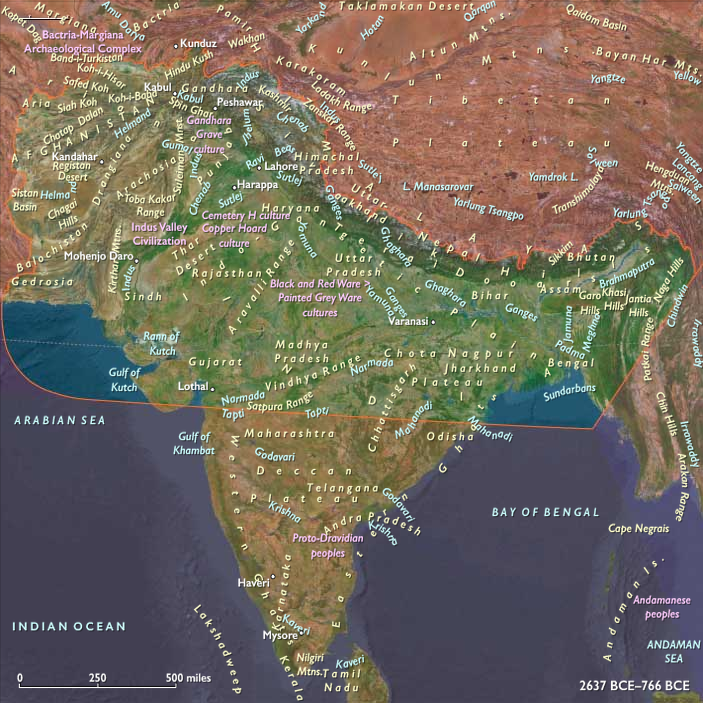
Between 1629 and 1486 BCE, Upper South Asia experiences ongoing fragmentation and localization following the decline of the mature Harappan Civilization around 1900 BCE. Former urban centers such as Harappa in Punjab, Mohenjo-daro in Sindh, Dholavira in Gujarat, and Rakhigarhi in Haryana continue to decline, while smaller, rural settlements proliferate across the region. This marks the transition from the Mature Harappan to the Late Harappan phase.
Agricultural Adaptations and Community Resilience
Agricultural practices adapt to new environmental conditions across Punjab, Haryana, Uttar Pradesh, Rajasthan, and the Gangetic Plain. Communities increasingly rely on diversified crops and localized irrigation techniques to sustain themselves amid changing river patterns and climatic shifts.
Continued Trade Networks and Economic Reorientation
Despite the decline in large-scale urbanism, trade continues, albeit at a reduced scale. Connections persist with resource-rich areas such as Rajasthan, Gujarat, Madhya Pradesh, Odisha, and Afghanistan, sustaining exchanges of metals, gemstones, and agricultural products. These interactions become more localized, reflecting changing economic and social dynamics.
Cultural Developments in Afghanistan and Western Regions
Present-day Afghanistan and adjacent regions continue cultural and economic interactions with Northern South Asia. Sites like Mundigak and Shortugai maintain smaller-scale trade connections, facilitating exchanges that help sustain local economies. This period witnesses increasing local autonomy and the consolidation of regional identities.
Mountainous and Himalayan Societies
In the Himalayan regions, including Jammu and Kashmir, Himachal Pradesh, Ladakh, Nepal, Bhutan, and Uttarakhand, communities deepen their reliance on terrace farming and pastoralism. Interactions through mountain trade routes remain vital, connecting these regions with agricultural communities in the plains.
Growth and Complexity in Eastern Regions
Eastern areas encompassing modern-day Bangladesh, Assam, Tripura, Nagaland, Manipur, Meghalaya, Mizoram, Arunachal Pradesh, and northwestern Myanmar (Kachin State, Sagaing Region, Chin State, northern Rakhine State) experience sustained agricultural development, particularly rice cultivation. Localized political entities begin to form, supported by stable food production and community organization.
Indo-Aryan Migration and Vedic Emergence
The second half of the second millennium BCE sees intensified Indo-Aryan migrations into northwestern India, particularly Punjab, Haryana, and regions along the Gangetic Plain. Originating from the Sintashta culture and passing through the Bactria–Margiana area (present-day northern Afghanistan), the Indo-Aryans bring their distinctive pastoral practices, Vedic traditions, and languages. The Vedic beliefs of this period, closely related to the Indo-Iranian religion, integrate local cultural elements such as the god Indra and the ritual drink Soma.
Cultural Syncretism and Religious Evolution
The convergence of Indo-Aryan and indigenous cultures leads to significant syncretism, reshaping religious and social traditions. Early Vedic practices integrate local beliefs, laying the groundwork for later Hinduism and influencing the region's spiritual and cultural identity.
Technological Continuities and Innovations
Technological practices, particularly in agriculture and metallurgy, evolve to meet local needs. Communities continue to refine metalworking techniques, including bronze and early iron tools, enhancing productivity and social complexity within increasingly localized economies.
Proto-Dentistry and Early Medical Knowledge
Archaeological discoveries at Mehrgarh in present-day Pakistan indicate early medical practices, such as proto-dentistry, with evidence of teeth drilling found in skeletal remains from around this period. Such findings highlight the advanced nature of early medical and dental care practices in Northern South Asia.
Legacy of the Age
The age from 1629 to 1486 BCE marks a critical phase of cultural consolidation and adaptation following the decline of the Harappan Civilization. The integration of Indo-Aryan elements, agricultural innovation, and regional specialization establishes enduring patterns that profoundly shape the historical trajectory of Upper South Asia.
Topics
Commodities
Subjects
Regions
South Asia
View →Subregions