Upper South Asia (1773–1630 BCE): Emergence of…
1773 BCE to 1630 BCE
Upper South Asia (1773–1630 BCE): Emergence of Post-Harappan Regional Cultures
Regionalization and Cultural Diversification
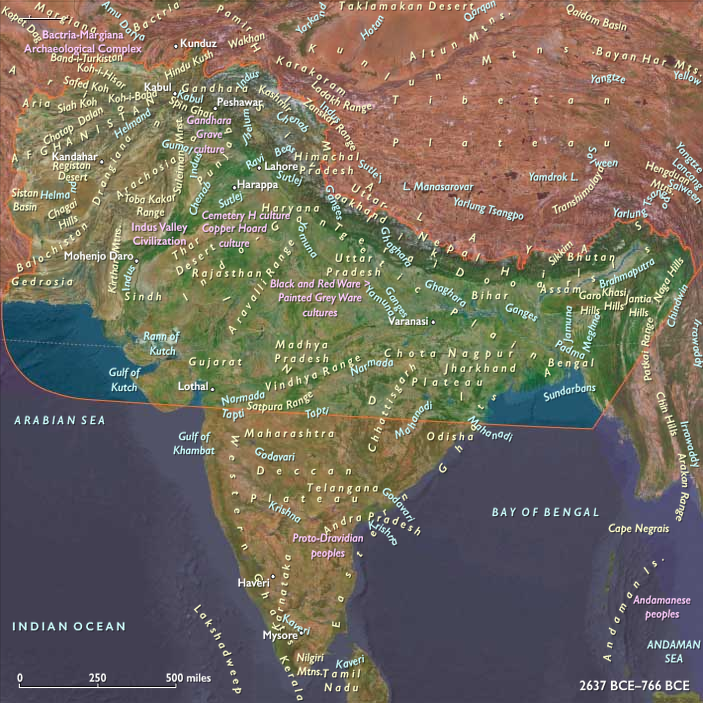
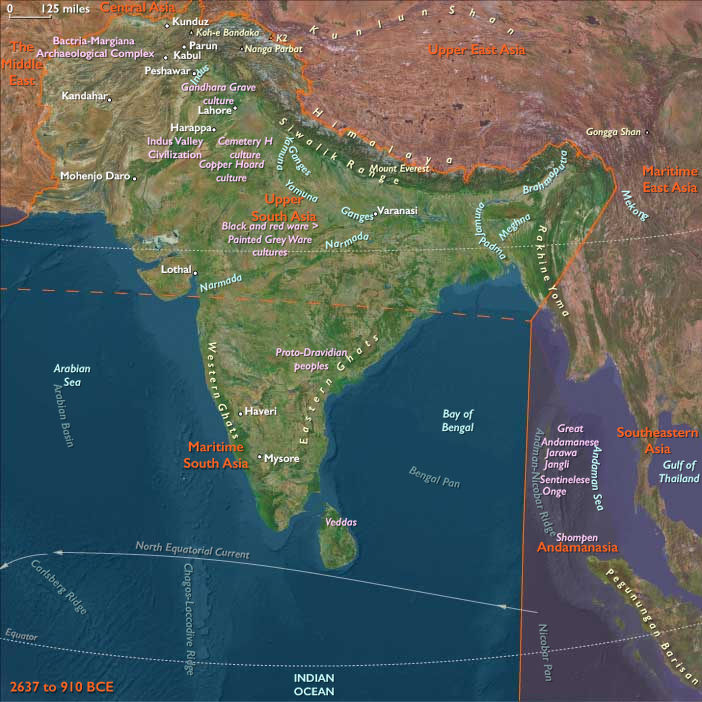
Between 1773 and 1630 BCE, Upper South Asia witnesses the fragmentation of the Late Harappan Civilization into distinct regional cultures. Formerly prominent urban centers like Harappa, Mohenjo-daro, Dholavira, and Rakhigarhi continue their gradual decline, giving way to smaller, localized settlements dispersed throughout the subcontinent. This shift leads to increasing cultural diversity, as populations adapt independently to changing ecological and social conditions.
Post-Harappan Societies in the Indus Basin
In the core Indus Basin (Punjab, Sindh, Haryana), urban centers diminish significantly in scale and complexity. Settlements become smaller and more scattered, focusing primarily on agriculture and pastoralism. Localized pottery styles emerge, marking a departure from previously standardized Harappan craft traditions.
Agricultural Expansion and Innovation
Despite urban decline, agricultural practices flourish across various regions. In the Gangetic plains (Uttar Pradesh, Bihar), communities enhance rice and millet cultivation techniques, laying the foundations for sustained agrarian societies. In western regions like Rajasthan and Gujarat, pastoralism and mixed farming become prevalent, sustaining regional populations through periods of climatic uncertainty.
Development in Central and Eastern Regions
The eastern and central regions, encompassing modern Madhya Pradesh, Chhattisgarh, Jharkhand, Odisha, and West Bengal, experience intensified agricultural practices and increased population densities. Settlements along rivers and fertile plains support substantial communities that form the basis of future cultural and political entities.
Expansion and Consolidation in the Northeast
In northeastern areas (Assam, Meghalaya, Nagaland, Manipur, Tripura, Mizoram, Arunachal Pradesh), as well as northwestern Myanmar (Kachin State, Sagaing Region, Chin State, northern Rakhine State), rice cultivation expands, allowing more complex societies to develop. These regions strengthen internal trade networks, fostering distinct cultural identities through localized artistic expressions and evolving rituals.
Himalayan and Mountainous Cultural Continuity
Himalayan communities in Jammu and Kashmir, Himachal Pradesh, Ladakh, Uttarakhand, Nepal, and Bhutan maintain continuity with established cultural and economic patterns, focusing on terrace agriculture, pastoralism, and trans-Himalayan trade. Exchange with lowland communities remains active, facilitating cultural interchange despite broader regional fragmentation.
Continued Interactions with Afghanistan
The regions of present-day Afghanistan, especially around Shortugai and Mundigak, maintain economic and cultural connections with the northern Indian subcontinent, particularly through trade routes carrying lapis lazuli, copper, and tin. Localized urban settlements continue to adapt to changing trade dynamics, influenced by emerging post-Harappan societies.
Legacy of the Age
The age from 1773 to 1630 BCE represents a critical period of decentralization, regionalization, and cultural diversification following the disintegration of the mature Harappan civilization. While the large, uniform urban identity of the Indus Valley fades, diverse regional cultures rise, laying the foundations for the subsequent historical developments across Upper South Asia.
Topics
Commodities
Subjects
Regions
South Asia
View →Subregions