Upper South Asia (2493–2350 BCE): Foundations of…
2493 BCE to 2350 BCE
Upper South Asia (2493–2350 BCE): Foundations of Urban Life and Intensified Regional Interactions
Rise of Urban Centers
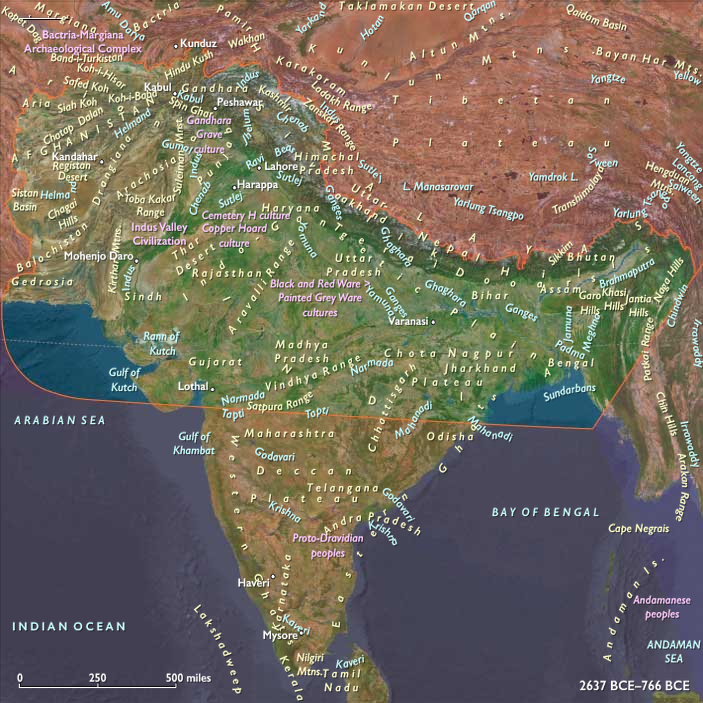
Between 2493 and 2350 BCE, Upper South Asia witnesses the emergence of increasingly complex urban centers, particularly along the Indus and its tributaries. Communities in regions encompassing modern-day Pakistan, North India, Afghanistan, and Bangladesh develop proto-urban characteristics, laying critical foundations for the mature Indus Valley Civilization. Sites such as Harappa (Punjab), Mohenjo-daro (Sindh), and emerging settlements in Gujarat and Rajasthan begin transitioning from large agricultural villages into structured cities, marked by organized streets, standardized brick sizes, and advanced drainage systems.
Agricultural Innovations and Surplus Production
Innovative agricultural techniques and irrigation systems significantly increase crop yields, particularly in regions like Punjab, Haryana, Uttar Pradesh, and the Gangetic Plain. Enhanced agricultural surplus supports growing populations and promotes occupational specialization. Villages become increasingly interconnected, exchanging surplus grains, pottery, tools, and crafts.
Trade and Cultural Networks
Long-distance trade expands notably, connecting settlements in the Indus Valley and Gangetic Plain with resource-rich areas such as Rajasthan, Gujarat, Madhya Pradesh, and Odisha. Trade networks extend westward into Afghanistan, reaching settlements such as Mundigak, facilitating exchanges in lapis lazuli, copper, and tin—resources essential for developing metallurgy.
Developments in Afghanistan and the Western Regions
In present-day Afghanistan, particularly around the Helmand River and Balkh, communities continue developing sophisticated irrigation and urban planning. Mundigak emerges as a key regional center, deeply connected through trade and cultural exchange to the emerging cities of the Indus Valley. This interaction fosters technological and cultural diffusion, significantly influencing regional development.
Himalayan Communities and Mountain Trade
Communities in the mountainous regions, including present-day Jammu and Kashmir, Himachal Pradesh, Ladakh, Nepal, Bhutan, and Uttarakhand, expand terraced agriculture and pastoral economies. The establishment of stable trade routes across mountain passes bolsters exchange with the plains, enabling Himalayan communities to access goods such as grains, textiles, and metal tools, in return supplying forest products, precious stones, and medicinal herbs.
Eastern Settlement Expansion and Agricultural Development
In the east, regions such as modern-day Bangladesh, Assam, Tripura, Nagaland, Manipur, Meghalaya, Mizoram, Arunachal Pradesh, and northwestern Myanmar (especially Kachin State, Sagaing Region, Chin State, and northern Rakhine State) see expansion and intensification of rice-based agriculture and fishing. Advanced flood management systems emerge to cope with seasonal inundations, supporting larger populations and leading to greater social complexity.
Early Social Stratification and Craft Specialization
Increasing agricultural productivity and economic complexity lead to clear signs of social stratification, especially visible in emerging cities. Specialized workshops for ceramics, metallurgy, and textile production indicate division of labor and skilled craftsmanship, reflecting broader economic and social transformations across Northern South Asia.
Religious and Cultural Evolution
Ritualistic and ceremonial activities become more structured, demonstrated by organized burial practices and ritual sites uncovered at settlements throughout the region, particularly at sites like Harappa and Mohenjo-daro. Symbolic artifacts and early religious iconography suggest evolving spiritual beliefs that underpin the social order and governance.
Legacy of the Age
The period from 2493 to 2350 BCE lays critical foundations for urbanization, intensified regional interaction, and advanced agricultural and technological practices. These developments profoundly shape the trajectory of Upper South Asia, setting the stage for the full flowering of the Indus Valley Civilization and influencing cultural and social dynamics across the region for millennia.
Topics
Commodities
Subjects
Regions
South Asia
View →Subregions