
The West Indies (1684 – 1827 CE): …
Years: 1684 - 1827
The West Indies (1684 – 1827 CE): Empire, Slavery, and the Atlantic Crossroads
Geographic and Environmental Context
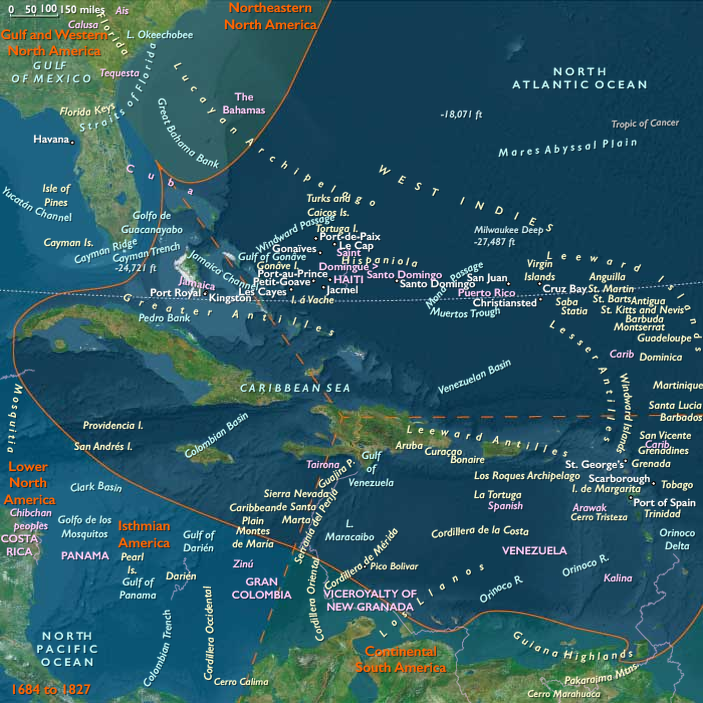
The West Indies of the long eighteenth and early nineteenth centuries—stretching from Cuba and Jamaica in the west through Hispaniola, Puerto Rico, and the Lesser Antilles to Trinidad, and northward through the Bahamas, Bermuda, and Turks and Caicos—formed one of the most strategic and contested maritime regions in the world.
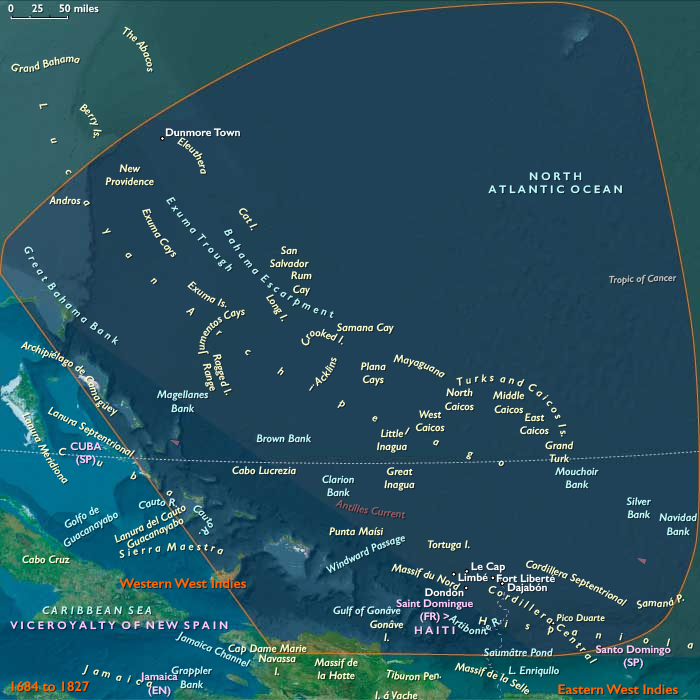
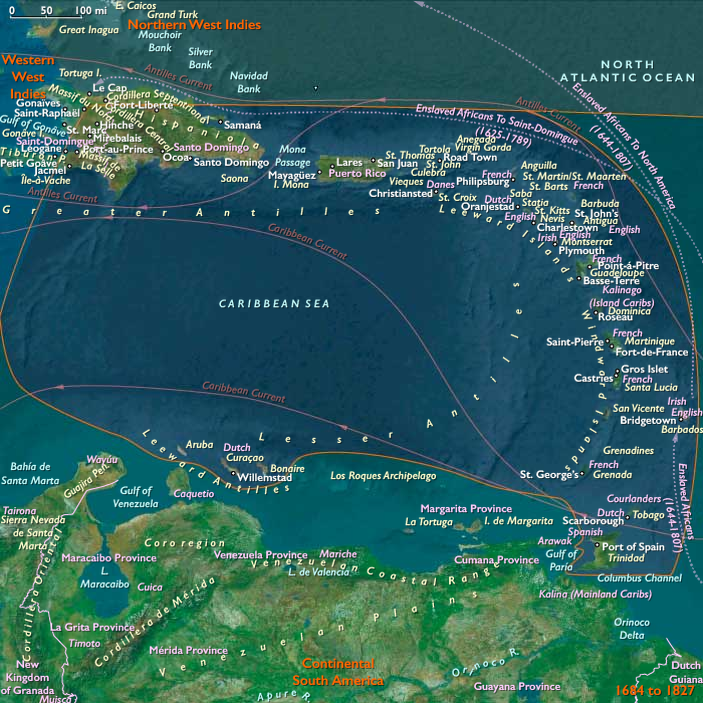
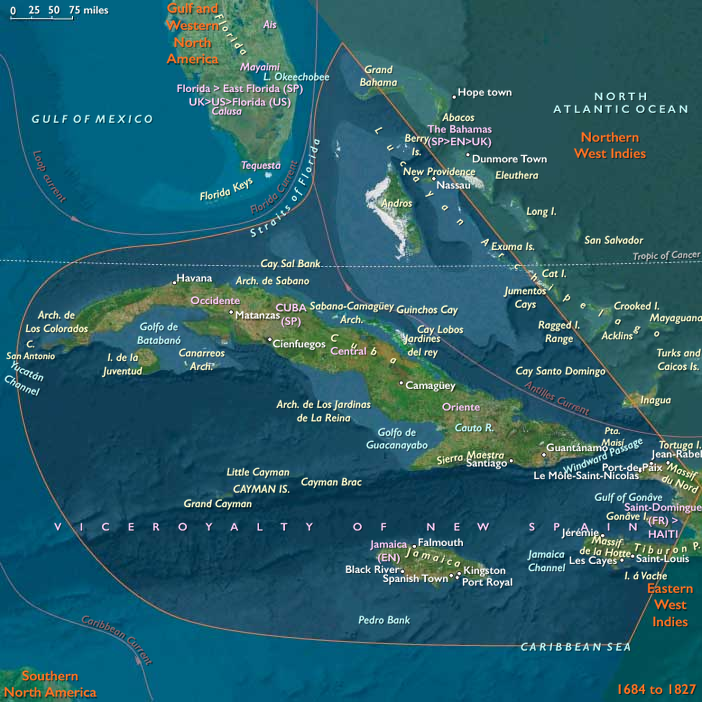
This region’s division into three natural and historical subrealms—the Northern, Eastern, and Western West Indies—was defined by wind, current, and empire as much as by geography.
-
The Northern West Indies (Bahamas, Turks and Caicos, Bermuda, northern Hispaniola) was a world of shallow banks, salt pans, and smuggling harbors, a crossroads of piracy and empire.
-
The Eastern West Indies (Trinidad, Barbados, Saint Lucia, Puerto Rico, Virgin Islands, eastern Hispaniola) became the plantation heart of the Caribbean, where sugar, slavery, and revolt shaped the modern Atlantic.
-
The Western West Indies (Cuba, Jamaica, the Caymans, and the Inner Bahamas) was the imperial cockpit—a corridor of treasure fleets, naval wars, and plantation kingdoms whose influence reached far beyond the Caribbean basin.
Together these subregions bound Europe, Africa, and the Americas into a single, brutal, and creative system: the Atlantic World.
Climate and Environmental Shifts
The late Little Ice Age persisted into the 1700s, bringing alternating pulses of storm and drought.
-
Hurricanes periodically erased entire settlements—from the Great Hurricane of 1780 that devastated Barbados and Saint Lucia to the cyclones that swept the Bahamas and Jamaica.
-
Droughts afflicted Hispaniola and eastern Cuba, while floods reshaped Puerto Rico’s valleys and washed away fragile terraces.
-
Volcanic and coral soils in the eastern arc buffered rainfall variability, but thin limestone and wind-exposed cays in the north demanded constant rebuilding.
Despite climatic instability, warm seas, and the steady northeast trades made the Caribbean a perennial hub of shipping and migration.
Subsistence, Settlement, and Economy
Across the archipelago, local adaptations reflected the twin forces of ecology and empire.
-
In the Northern West Indies, shallow banks and reefs nurtured piracy and contraband. Nassau and Tortuga became pirate havens before being “reformed” into colonial ports. Bermuda evolved into a shipbuilding and trading powerhouse, while salt-raking and small-scale ranching sustained the Turks and Caicos and northern Hispaniola’s frontier.
-
In the Eastern West Indies, plantation economies reached their zenith. Barbados, Saint-Domingue, Puerto Rico, Trinidad, and the Danish and British Virgins built vast estates of sugar and coffee, their profits extracted through the labor of enslaved Africans. The Treaty of Ryswick (1697) split Hispaniola into French and Spanish halves—Saint-Domingue, the world’s richest colony, and Santo Domingo, a ranching and provisioning frontier.
-
In the Western West Indies, Spain’s Cuba and Britain’s Jamaica anchored rival empires. Havana became a fortified naval hub and the final stop for Spanish treasure fleets; Jamaica grew into the centerpiece of the British sugar system, defended by Maroon treaties and fed by Atlantic slavery. The Bahamas and Caymans remained smaller satellite economies, dependent on fishing, turtling, and trade.
Everywhere, African labor and knowledge made the system function: sugar cultivation, salt evaporation, animal husbandry, shipwrighting, and tropical medicine all drew on African expertise.
Technology and Material Culture
-
Plantation industry reached new levels of mechanization: wind- and later steam-powered mills, boiling houses, and curing houses dotted the islands.
-
Shipbuilding thrived in Bermuda and Jamaica, producing sleek sloops that outsailed European vessels.
-
Fortification architecture defined Havana, San Juan, and Port Royal; the ruins of stone mills, cisterns, and aqueducts endure as the era’s material signature.
-
Enslaved Africans and their descendants contributed ironworking, weaving, pottery, basketry, and culinary traditions that transformed Caribbean daily life.
Movement and Interaction Corridors
The West Indies was the beating heart of Atlantic circulation:
-
Trade routes carried sugar, rum, and molasses to Europe and North America, returning with goods, guns, and enslaved captives from Africa.
-
Naval convoys guarded silver fleets through the Windward and Mona Passages.
-
Pirates and privateers exploited the same currents, operating from the Bahamas and Hispaniola.
-
Slave ships traversed the Middle Passage to Saint-Domingue, Jamaica, Cuba, and Trinidad.
-
Maroon and contraband networks stitched together mountain refuges and frontier coasts from Jamaica to Santo Domingo.
-
Migrant flows after the American Revolution—Loyalists, free Blacks, and enslaved Africans—reshaped Bahamian and Cayman society.
These corridors made the region at once interconnected and violently unequal.
Cultural and Symbolic Expressions
The West Indies forged some of the most profound cultural syntheses in the Atlantic world.
-
Religions: Catholicism and Protestantism provided colonial frameworks, but African cosmologies—Vodou, Santería, Obeah, Myal, and others—redefined the sacred landscape.
-
Languages and Music: Creole languages, drumming, and call-and-response singing blended African, European, and Indigenous rhythms.
-
Resistance and Community: Festivals, ring-shouts, and secret gatherings sustained solidarity among the enslaved; pirates, maroons, and sailors developed their own egalitarian codes.
-
Architecture and Landscape: Plantation great houses stood above quarters, mills, and cane fields, while vernacular huts and maroon villages adapted to hills, mangroves, and storms.
Through suffering and creativity, Caribbean people produced enduring art, faith, and identity.
Environmental Adaptation and Resilience
Despite relentless exploitation, the region’s inhabitants learned resilience:
-
Islanders rebuilt after each hurricane with stronger stone, better cisterns, and low, wind-resistant roofs.
-
Provision grounds allowed enslaved and free people to maintain food security with cassava, yams, and plantains.
-
African agronomy and water management sustained fertility in thin tropical soils.
-
Cattle and small stock on drier islands (Turks, Caicos, Santo Domingo) supplemented the plantation diet and economy.
Human adaptation paralleled ecological resilience: mangroves, reefs, and coral cays regenerated repeatedly after devastation.
Transition and Legacy (by 1827 CE)
By the early nineteenth century, the West Indies was transforming under revolutionary and abolitionist pressure:
-
The Haitian Revolution (1791–1804) destroyed the world’s richest colony and created the first Black republic, inspiring fear and hope across the region.
-
British Jamaica and Barbados tightened control but faced growing unrest; debates over emancipation gained force.
-
Cuba and Puerto Rico, under Spain, expanded sugar and slavery even as neighboring colonies moved toward freedom.
-
Trinidad absorbed French planters and enslaved labor under British rule after 1797.
-
Bermuda and the Bahamas became minor metropoles of Atlantic shipping and, eventually, abolitionist transit.
By 1827, the West Indies had become both the engine and the conscience of the Atlantic world—its wealth built on enslavement, its resistance birthing freedom’s first revolutions.
In the framework of The Twelve Worlds, the region embodied the paradox of modernity itself:
a crossroads where empire, ecology, and human endurance converged to shape the moral and material map of the modern age.
People
Groups
- French people (Latins)
- English people
- Santo Domingo, Captaincy General of
- Santo Domingo, Real Audiencia de
- Spain, Habsburg Kingdom of
- Spaniards (Latins)
- France, (Bourbon) Kingdom of
- Saint Domingue, French Colony of
- Santo Domingo (Spanish Colony)
- France, Kingdom of (constitutional monarchy)
- French First Republic
- Santo Domingo (French Colony)
- Haiti, Republic of
- France, (first) Empire of
- Haiti, Kingdom of northern
- Santo Domingo, Captaincy General of
- France, constitutional monarchy of
- Santo Domingo (Haitian-occupied)
Topics
- Age of Discovery
- Colonization of the Americas, Spanish
- Encomienda system
- Piracy, Golden Age of
- Haitian Revolution
Commodoties
Subjects
Regions
Subregions
Years: 1684 - 1827
People
Groups
- French people (Latins)
- English people
- Santo Domingo, Captaincy General of
- Santo Domingo, Real Audiencia de
- Spain, Habsburg Kingdom of
- Spaniards (Latins)
- France, (Bourbon) Kingdom of
- Saint Domingue, French Colony of
- Santo Domingo (Spanish Colony)
- France, Kingdom of (constitutional monarchy)
- French First Republic
- Santo Domingo (French Colony)
- Haiti, Republic of
- France, (first) Empire of
- Haiti, Kingdom of northern
- Santo Domingo, Captaincy General of
- France, constitutional monarchy of
- Santo Domingo (Haitian-occupied)
Topics
- Age of Discovery
- Colonization of the Americas, Spanish
- Encomienda system
- Piracy, Golden Age of
- Haitian Revolution
Commodoties
Subjects
Regions
Subregions