Event
Western West Indies (49,293–28,558 BCE): Late Pleistocene…
Western West Indies (49,293–28,558 BCE): Late Pleistocene I — Cuban Plains, Jamaican Mountains, and Expanded Caribbean Banks
Geographic and Environmental Context
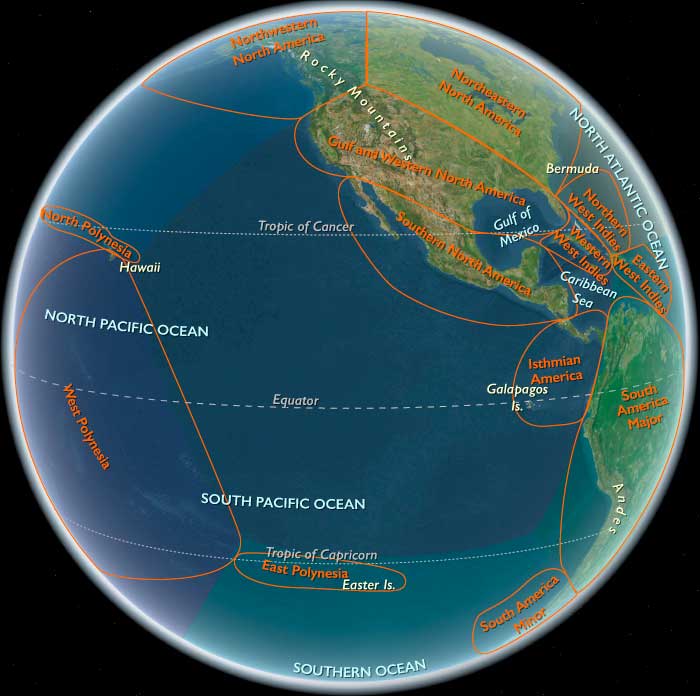
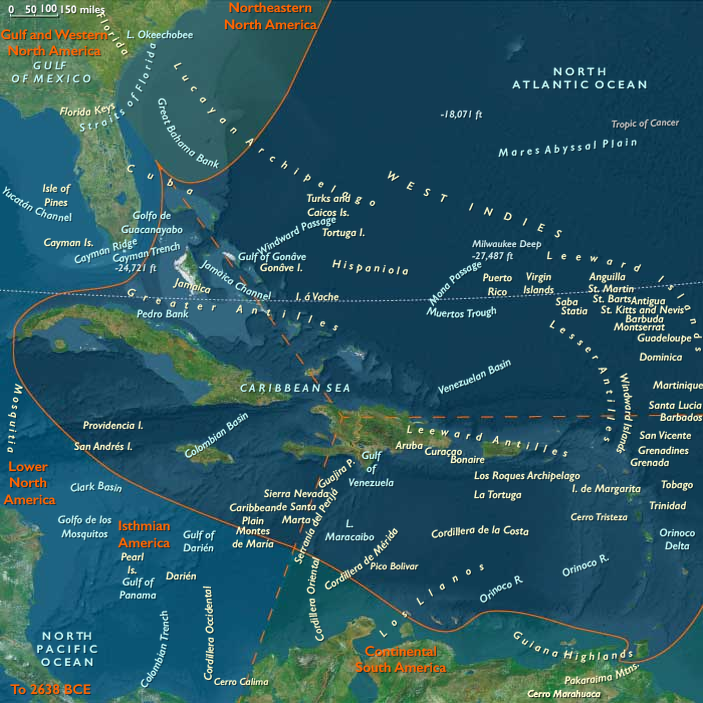
Western West Indies includes Cuba and surrounding isles, Jamaica, the Cayman Islands, the western Bahamas within the canonical boundary, and western Haiti.
Lower sea level substantially enlarged Cuba and the Bahamian banks and exposed broader coastal plains around Jamaica and Hispaniola.
Cuba formed the largest terrestrial landscape in the subregion, combining broad plains, karst districts, wetlands, hills, and mountain systems.
Jamaica retained a more compact but strongly mountainous geography, while western Hispaniola combined rugged highlands, river valleys, karst terrain, and lowland basins.
The Cayman Islands and western Bahamian sectors consisted of much lower carbonate landscapes whose exposed land areas changed strongly with sea level.
Climate and Environmental Shifts
Marine Isotope Stage 3 brought cooler conditions and repeated fluctuations in rainfall and trade-wind patterns.
Dry woodland, humid forest, savanna-like openings, wetlands, scrub, and karst vegetation shifted according to island topography and moisture.
Higher elevations in Cuba, Jamaica, and Hispaniola retained wetter forest communities, while lowlands and exposed carbonate platforms could become substantially drier.
Lower sea level broadened coastal plains and altered freshwater lenses, wetlands, lagoons, reef margins, and beach systems.
The subregion therefore contained strong contrasts between large high islands with complex topography and low carbonate banks whose ecology was especially sensitive to sea-level change.
Human Presence
The Western West Indies remained entirely without humans during this interval.
No secure Late Pleistocene occupation is known from Cuba, Jamaica, the Cayman Islands, the western Bahamas, or western Haiti for this eon.
Their terrestrial and marine ecosystems therefore developed without hunting, cultivation, introduced species, deliberate burning, or other sustained cultural disturbance.
Later Caribbean settlement belongs to a much younger period and should not be projected backward into MIS 3.
Baseline Ecology
Cuba and Hispaniola supported rich endemic communities including ground sloths, hutia-like rodents, insectivorous mammals, bats, birds, reptiles, and highly diverse plants.
Cuba’s larger land area allowed a broad range of forest, woodland, wetland, karst, and open-country habitats.
Jamaica possessed its own strongly isolated fauna and montane forest systems, shaped by long-term separation from the other Greater Antilles.
Western Hispaniola supported complex elevational ecosystems ranging from humid mountain forest to drier lowland vegetation.
The Cayman Islands and exposed Bahamian banks supported lower-diversity terrestrial communities more strongly influenced by seabirds, shoreline dynamics, and marine nutrient input.
Marine and Coastal Ecology
Reefs, seagrass beds, lagoons, mangroves, turtles, fish, mollusks, crustaceans, seabirds, and crocodilians in suitable areas occupied extensive lowstand coastlines.
Lower sea level shifted reef systems and shorelines seaward and changed the geometry of shallow banks and coastal wetlands.
Marine ecosystems were especially important around smaller carbonate islands, where terrestrial productivity was limited.
Seabirds transferred nutrients onto land, while turtles used suitable beaches and nearshore habitats.
The marine and terrestrial worlds were therefore tightly linked even in the absence of humans.
Movement and Connectivity
Connectivity was entirely biological and oceanographic.
Lower sea level increased terrestrial continuity within some Bahamian and Cuban shelf areas and reduced distances among islands in certain sectors.
Deep-water channels nevertheless continued to separate the major Greater Antillean islands.
Birds, bats, storms, floating vegetation, and ocean currents provided the principal mechanisms of long-distance dispersal.
Cuba, Jamaica, and Hispaniola therefore maintained strongly differentiated terrestrial faunas despite broader Caribbean marine connectivity.
The western Bahamian and Cayman systems depended more heavily on rare over-water colonization and local ecological persistence.
Environmental Adaptation and Resilience
Repeated sea-level fluctuations changed island size, habitat continuity, and opportunities for biological dispersal.
As land areas expanded, terrestrial populations could spread across broader plains and newly exposed banks.
When marine barriers widened again, populations became more isolated and local differentiation increased.
Mountainous islands preserved wetter refugia during dry phases, while low carbonate islands experienced stronger constraints from drought and freshwater availability.
Forest, woodland, wetland, and scrub communities shifted with rainfall and elevation.
Resilience therefore depended on a combination of refugial persistence, range shifts, local adaptation, and rare recolonization across marine barriers.
Transition
By 28,558 BCE, the Western West Indies remained entirely outside the human world.
Cuba, Jamaica, western Hispaniola, the Cayman Islands, and the western Bahamian sectors still supported large Pleistocene island ecosystems shaped by lower sea level, cooler climate, endemic evolution, and marine connectivity.
The larger high islands retained rich and differentiated terrestrial faunas, while smaller carbonate islands remained more ecologically constrained and ocean-dependent.
At the close of Late Pleistocene I, the Western West Indies was therefore a fully nonhuman landscape of enlarged island plains, mountain refugia, karst systems, reefs, and endemic faunas—its ecosystems still governed entirely by climate, sea level, dispersal, and isolation.

-
{# Image navigates to the detail page; the magnifying-glass chip is the only Fancybox lightbox trigger (kept a separate sibling — anchors can't nest). #}
 The Far West
World
-
{# Image navigates to the detail page; the magnifying-glass chip is the only Fancybox lightbox trigger (kept a separate sibling — anchors can't nest). #}
 West Indies
Region
-
{# Image navigates to the detail page; the magnifying-glass chip is the only Fancybox lightbox trigger (kept a separate sibling — anchors can't nest). #}
 Western West Indies
Subregion