
Event
Northern West Indies (964–1107 CE): Expanding Island…
Northern West Indies (964–1107 CE): Expanding Island Communities and Maritime Connectivity
Geographic and Environmental Context
Between 964 and 1107, the Northern West Indies remained divided between the fertile agricultural landscapes of northern Hispaniola and the low, environmentally constrained islands of the Bahamas and Caicos. Rivers, valleys, and humid uplands gave northern Hispaniola greater agricultural capacity, while the islands depended more heavily on reefs, shallow waters, coppice woodland, mangroves, and small patches of cultivable soil.
The Lucayan settlement zone expanded during this period, though occupation remained uneven. Individual communities developed where freshwater, soils, reef resources, and safe canoe access made sustained settlement possible.
Bermuda remained uninhabited.
Societies and Political Development
Northern Hispaniolan communities grew in number and complexity. Local leaders increasingly coordinated agricultural production, exchange, ceremony, and relations among neighboring settlements. These processes contributed gradually to the chiefly political structures that became much more visible in later centuries.
Lucayan communities remained smaller than those of Hispaniola. Their social world was based on households and villages connected through marriage, exchange, travel, and shared cultural practices. Leadership likely existed at local and regional scales, but political centralization remained more limited than in the larger Greater Antillean societies.
Productive Landscape and Economy
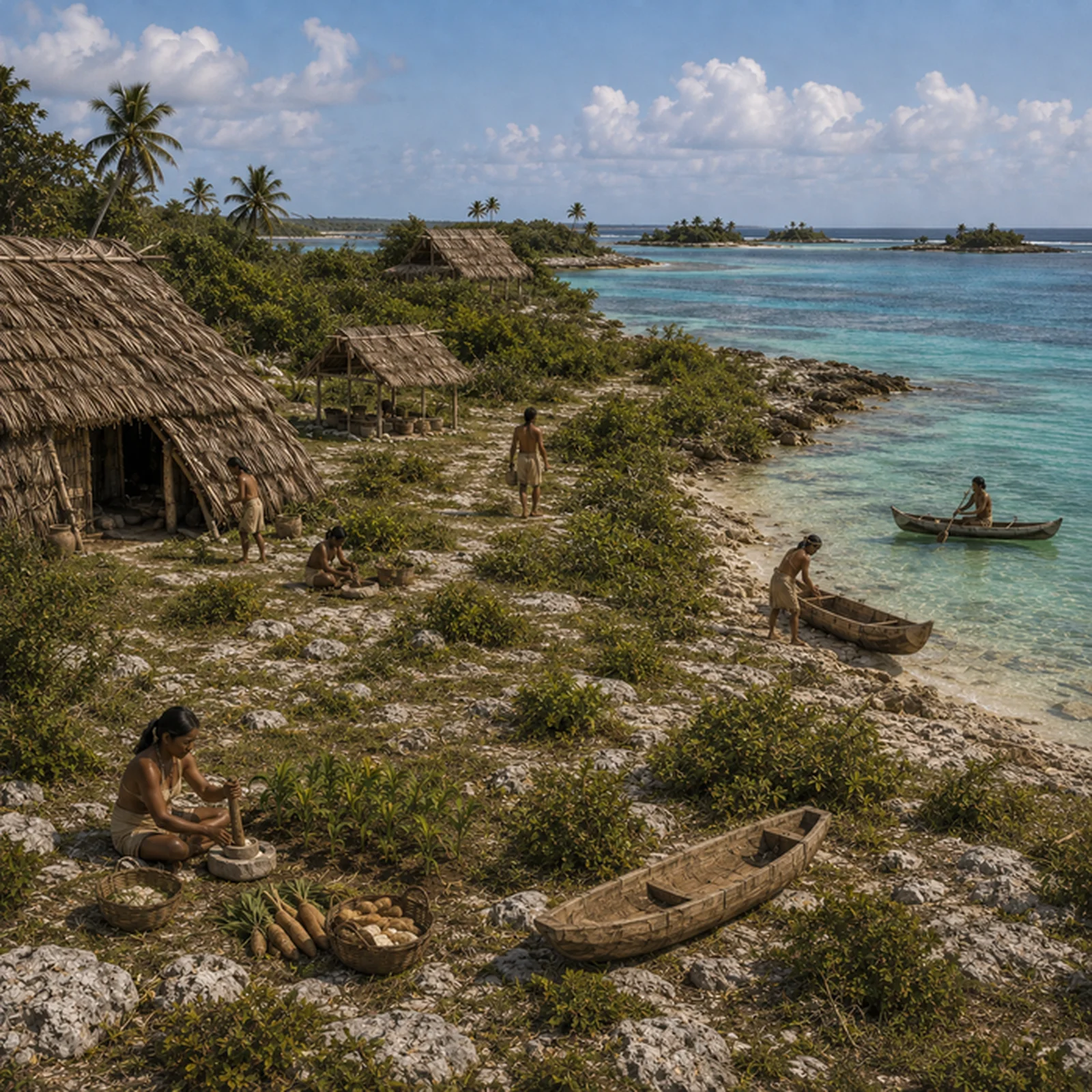
Cassava and other root crops remained central to food production. Maize, fruits, peppers, beans, and other crops were cultivated where soils allowed. In the islands, farmers balanced horticulture with intensive marine exploitation.
Fishing took place on reefs, in lagoons, and across shallow banks. Shellfish, turtles, and other marine animals supplied food and raw material. Cotton and plant fibers supported cordage, weaving, hammocks, and other household production.
Movement and Interaction Corridors
Canoe travel increased as more islands became incorporated into the settlement network. Communities maintained exchanges among the Bahamas, Turks and Caicos, and Hispaniola, with movement often following chains of visible islands and familiar currents.
These routes carried food, pottery, tools, shells, cotton, and social relationships. Marriage and visiting were as important to regional integration as material trade.
Technology and Material Culture
Dugout canoes remained the key transportation technology. Stone and shell tools were used for woodworking, food preparation, farming, fishing, and craft production. Pottery became increasingly characteristic of local island communities while retaining broader Caribbean connections.
Houses continued to use timber frames and thatch, usually clustered in small settlements rather than large towns. Storage, cooking, crop processing, fishing gear, and canoe maintenance formed ordinary parts of settlement life.
Religion and Cultural Expression
Shared beliefs linked Lucayan communities to the broader Taíno-related cultural world. Ancestors, sacred landscapes, and spiritual beings were honored through ritual objects and community practices. On Hispaniola, religious authority increasingly intersected with political leadership.
Ceremonial gathering helped reinforce alliances, kinship, and community identity.
Adaptation and Resilience
Lucayan communities became increasingly skilled at combining limited terrestrial resources with abundant marine ones. Settlement remained responsive to freshwater availability, shoreline change, and storm exposure.
Hurricanes and drought could damage crops, but mobility and exchange allowed communities to obtain resources from other islands and recover over time.
Legacy of the Age
By 1107, the Northern West Indies contained a more extensive and interconnected Indigenous maritime society. Northern Hispaniola supported increasingly organized agricultural communities, while Lucayan settlements had spread more broadly through the island chain. Canoe movement now connected an expanding network of small island communities to the larger societies of the Greater Antilles.
-
{# Image navigates to the detail page; the magnifying-glass chip is the only Fancybox lightbox trigger (kept a separate sibling — anchors can't nest). #}
 The North Atlantic Lands
World
-
{# Image navigates to the detail page; the magnifying-glass chip is the only Fancybox lightbox trigger (kept a separate sibling — anchors can't nest). #}
 West Indies
Region
-
{# Image navigates to the detail page; the magnifying-glass chip is the only Fancybox lightbox trigger (kept a separate sibling — anchors can't nest). #}
 Northern West Indies
Subregion
